



-

Jeff Kassouf
Multiple Authors
Not long ago, the field was filled with confetti celebrating Spain’s victory in the 2026 Men’s World Cup, but the focus shifts now to the upcoming Women’s World Cup.
As of Saturday, we mark one year until the final of the 2027 Women’s World Cup, raising the question of whether the U.S. women’s national team will make it.
What seemed like a sure thing is now clouded with uncertainty, and it’s not solely due to the USWNT’s performance decline. While their 2023 World Cup performance was below expectations, a coaching and roster revamp led to a gold medal at the 2024 Olympics, showcasing their talent.
The challenge lies more in the increasing competitiveness of global teams. The common adage that “the world is catching up” is outdated; it has already arrived. This has been clearly indicated over the last decade.
Currently, the USWNT must navigate a pool of more competitive teams with refined tactics and skills capable of winning in tournament settings, as seen when Portugal nearly eliminated the Americans in the 2023 group stage and triumphed over them in a friendly last year.
Furthermore, the number of teams with realistic World Cup-winning potential has grown, a reality embodied by Spain’s first championship in 2023.
The last Women’s World Cup marked a downturn for the U.S., as they fell in the round of 16 in a penalty shootout against their bitter rival Sweden. Entering that tournament as two-time defending champions, the Americans had never previously placed worse than third in their eight World Cup appearances.
Yet, as the song goes, “the times they are a-changin’”—a sentiment resonating in women’s soccer today. The USWNT appeared disjointed and unprepared for challenges in 2023.
Emma Hayes, who took over following the 2023 disappointment, has revamped the player roster and enhanced tactical versatility. This new approach led to Olympic success, but will it suffice on the bigger World Cup stage?
Hayes has given international debuts to 32 players in her first 32 games as coach—a record for the program. She has bolstered the squad’s depth through investment in the U-23 national team, seen as the future of USWNT. In the process, she has nurtured emerging talents like forward Alyssa Thompson and midfielder Claire Hutton.
With the U.S. women’s team currently ranked second in the world, they are once again marked as favorites for the upcoming World Cup. However, the path to their fifth title is more complicated than ever. Evidence of this challenge is their recent match against Brazil, where they experienced a defeat before prevailing in a rematch marked by fierce competition.
So, will the USWNT reach the World Cup final on July 25, 2027? Here’s a look at what they need to secure another World Cup victory.
Key Players Must Shine Ahead of the World Cup
The forward trio known as “Triple Espresso”—comprised of Trinity Rodman, Sophia Wilson, and Mallory Swanson—was instrumental in securing the gold medal at the 2024 Olympics, contributing 10 of the team’s 12 goals for the tournament. Each player was performing at their best during the event, alongside standout contributions from defender Naomi Girma and goalkeeper Alyssa Naeher.
As straightforward as it may seem, for the USWNT to contend for victory in 2027, their top players will need to perform exceptionally; the stakes are simply too high for less.
In contrast, during the USWNT’s disappointing 2023 campaign, consistent production from the team was lacking. The team’s attack faltered, producing just four goals out of 9.30 expected goals, with three of those against Vietnam, one of the tournament’s lower-ranked teams. Throughout the team’s struggles, consistent performances from defenders Girma and Julie Ertz stood out as bright spots—but Swanson, the USWNT’s top attacker in 2023, unfortunately suffered an injury prior to the tournament.
Currently, Rodman and Wilson have solidified their roles as USWNT starters and are in excellent club form, while Thompson has emerged as arguably the team’s standout performer over the past year, following a major transfer to Chelsea.
Girma has faced injury troubles since her move to Chelsea over a year ago. When healthy, she is undeniably the team’s top defender and among the best globally. The USWNT’s defensive capabilities shift dramatically with her presence on the field, despite the depth developed under Hayes.

2:08
How has Alyssa Thompson adapted to the WSL at Chelsea?
Finding a New No. 1 American Goalkeeper
With Alyssa Naeher’s retirement from international play post-Olympics, the starting goalkeeper role for the USWNT at the 2027 World Cup remains uncertain.
Manchester United‘s Phallon Tullis-Joyce seemed to be the frontrunner in 2025, but attention has turned toward Claudia Dickey from Seattle Reign. Recently, Mandy McGlynn has also re-emerged in the conversation with exceptional performances for the Utah Royals.
While uncertainty about the goalkeeper role isn’t ideal, it echoes the situation encountered by Naeher prior to the 2019 World Cup, when she had limited experience but ultimately led the team to victory with standout performances.
By 2027, it will be essential for Hayes to identify her starting goalkeeper and cultivate synergy between the defense and the keeper. This clarity may arise during the World Cup qualifying round set for the end of this year, where the U.S. still needs to secure a place in the tournament.
Next summer will mark a major tournament debut for one of these players, following in the legacy of goalkeepers like Briana Scurry, Solo, and Naeher. The question remains: can one of them rise to the occasion?
Hayes Needs to Balance Tactical Flexibility with Core Principles
The chaos and unexpected outcomes of the recent Men’s World Cup serve as a reminder that successful teams must adapt to the game at hand.
The USWNT’s gritty 1-0 win over Brazil on June 9 was filled with drama: eight red cards, 28 fouls, escalating tensions. Though the style of play was unappealing, the match demonstrated the team’s ability to keep their composure in intense situations. This less experienced cohort of the USWNT emerged from this experience better prepared for future challenges.
In October, the USWNT will welcome world No. 1 Spain for two friendlies, which will offer an entirely different test than the June encounter. Expect Spain to dominate possession, challenging the Americans to maintain defensive discipline and be precise on counters in order to overcome the top-ranked team. Hayes has consistently urged her squad to elevate their play in critical offensive moments.
In November, the U.S. will face El Salvador in a crucial quarterfinal within World Cup qualifying, where they will once again need to break down a sturdy defensive setup.
The 2027 World Cup is anticipated to pose a range of challenging scenarios for the USWNT. While staying true to their core strategies that mix possession with transition is crucial, adapting their approach to suit each opponent will be essential for reaching the tournament final.
Hayes has continually prepared her players for these eventualities by presenting diverse challenges since taking the helm.
Finding the Right Midfield Balance
Success in the tournament will hinge on deploying the right players to counter varying opponents. As previously discussed, the optimal lineup is highly contingent on the adversary, especially in midfield, which presents a significant tactical dilemma.
At the 2024 Olympics, Hayes utilized Sam Coffey in the holding role, Rose Lavelle as the attacking midfielder, and captain Lindsey Heaps in a box-to-box role. During that tournament, the midfield was often bypassed to create opportunities for the dynamic forwards.
Since then, Hutton has emerged as a viable competitor for a defensive midfield spot alongside the impressive Coffey (imagine a USWNT boasting two starting-quality defensive midfielders) while 19-year-old Lily Yohannes has grown into a promising option for possession-oriented matchups.
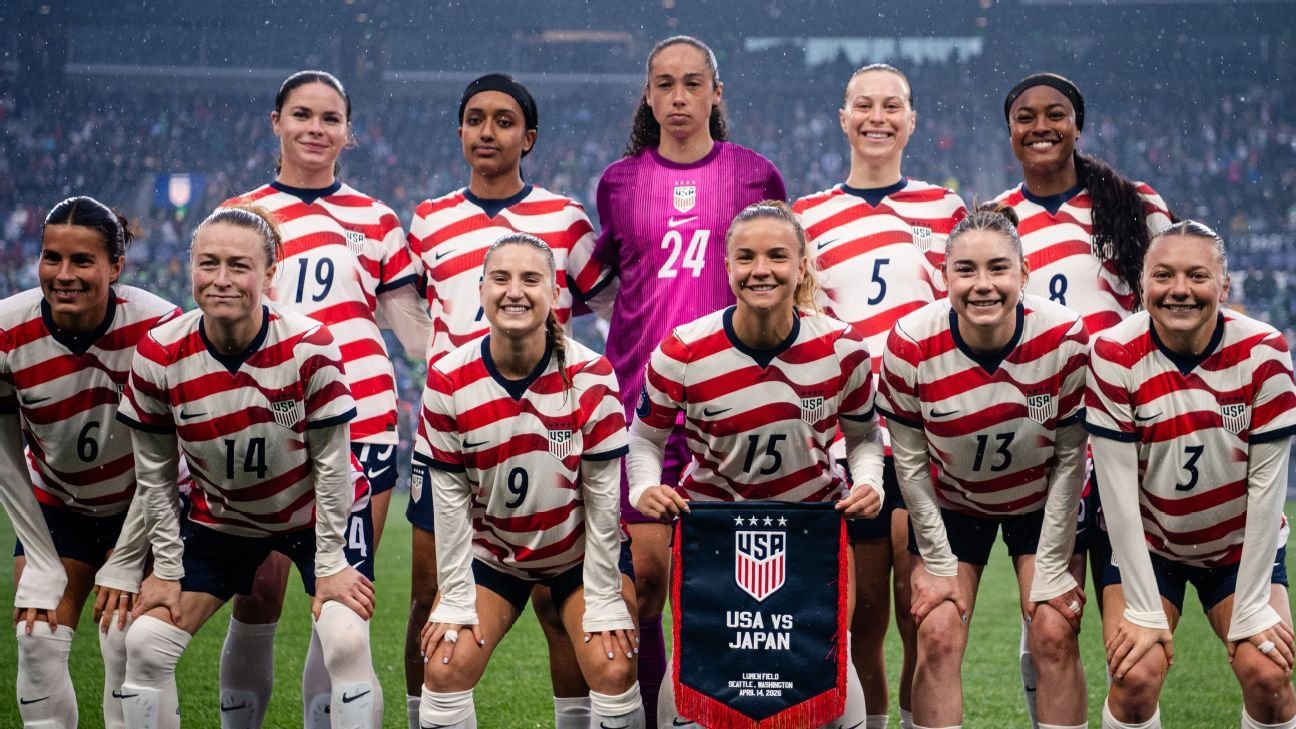
Hayes has experimented with various midfield configurations, including reverting to the Coffey-Lavelle-Heaps combination in a 2-1 triumph over Japan this past April and a 2-1 defeat against Portugal last year.
With Coffey sidelined for the June matches due to a knee injury, the Hutton-Yohannes-Heaps trio struggled to cope with Brazil’s physicality in a 2-1 loss. In contrast, the trio of Yohannes, Heaps, and Lavelle performed well in the subsequent 1-0 victory.
Hayes has also explored utilizing Coffey and Hutton in tandem behind Lavelle on several occasions, including a convincing 3-0 win over Canada last year. Some matches will necessitate a more defensive setup, while others may require Yohannes’s creative playmaking for the decisive pass.
Regardless of how Hayes chooses to approach the midfield, discovering the right balance will be crucial from match to match. This sector of the field will significantly impact the team’s World Cup aspirations.
A Positive World Cup Draw?
Let’s face it: FIFA can be somewhat unpredictable when it comes to the draw.
In 2015, specific teams were manipulated into certain groups for “geographical reasons,” ending with the sixth-seeded team, world No. 5 Sweden, being excluded. During the 2011 draw, FIFA also altered tournament pathways. While it raised fewer eyebrows at the time, one can’t deny its questionable nature.
Moving toward the draw for the 2026 Men’s World Cup, FIFA again set a precedent by ensuring that the world’s four top teams would not face each other until the semifinals—provided they advanced from their groups. Guess who made the semifinals? Yes, the top four rated teams: Spain, Argentina, France, and England.
If a similar manipulation occurs for the Women’s World Cup, it could fundamentally alter tournament dynamics. As of now, FIFA has not clarified specifics regarding how December’s draw will be handled.
Could the USWNT’s draw lead to a quarterfinal showdown against hosts Brazil or top-ranked Spain? Either matchup would present a notably tougher route to the final compared to most alternatives.
With 48 teams participating in the upcoming Men’s World Cup, the uncertainty surrounding third-place teams qualifying adds a layer of complexity. Conversely, the next Women’s World Cup will, for the last time, feature 32 teams (before transitioning to 48 in 2031), allowing only the top two teams from each group to move on.
In summary, claiming a World Cup title requires a blend of peak performance, favorable matchups, and a sprinkle of luck. When the draw occurs in December, it’s vital to assess not only the USWNT’s group opponents but also the road to the final during knockout rounds.
One certainty stands: winning the Women’s World Cup is more challenging than ever, a reality that will only intensify as investment in women’s soccer grows globally and the tournament expands in coming years.
The USWNT is well-positioned to win the 2027 edition, but timing and circumstances will need to align perfectly.