



-

Bill Connelly
Welcome to the “nerd zone” of the 2025-26 European soccer season. Experts suggest that it takes roughly 10 matches for expected goals (xG) metrics to provide a predictive overview of a team’s performance. This range might actually extend from eight to 15 games, but the key point is that we are now in that range. Ligue 1 and La Liga have each completed 12 matchdays, while the Premier League and Serie A have played 11, and the Bundesliga has seen 10 matches so far.
As mid-November approaches and we enter the third international break of the season, all eyes are on World Cup qualification. Will Nigeria and Congo DR keep their hopes alive, and can the Faroe Islands achieve a miracle? Now seems like an excellent opportunity to review the analytics surrounding the club season at this point.
Considering that top teams usually possess the best finishers (and may therefore slightly exceed their xG ratings), I will reference overall xG statistics for clarity, and keep in mind that injuries can distort the data. Below is a look at each league, roughly a third of the way through the 2025-26 season.
– Fortunate or unfortunate: How are Arsenal, Liverpool, and others faring?
– Ranked: The best and worst summer transfers of 2025 from the Premier League and beyond
– Gyökeres, Isak, Sesko: A look at the summer of strikers
 Premier League: Arsenal shines, while Haaland-reliant Man City may still pose a threat
Liverpool is a prime example of why patience is needed when evaluating early-season performances. In August, they triumphed over Newcastle United 3-2 despite a -0.3 xG differential and edged Arsenal 1-0 in a tightly contested match with nearly identical xG figures. In October, Liverpool dropped matches against Chelsea and Manchester United with matching 2-1 scores, although their combined xG differential suggested they should have performed better.
While randomness has played a significant role for Liverpool, we see that their current table position is reflective of their overall performance: They sit fifth in xG differential and have accumulated 18 points so far.

The chart above illustrates that Liverpool’s results align well with their expected goals. Though they rank eighth due to goal differential, the clubs also in the 18-point club have exceeded expectations, including fourth-place Sunderland, currently at 19 points. All of these teams look likely to regress towards the mean.
The top three teams in the Premier League are also the ones with the highest xG differentials, which is to be expected. However, Liverpool should watch out for Crystal Palace, who are in tenth place with 17 points. They are just two points off the top four, and their xG differential is plus-6.6, very close to third-place Chelsea (plus-7.0). Despite inconsistent results, where they’ve scored 14 goals on 19.3 xG while allowing only nine goals from 12.7 xG, they are still in contention for a Champions League spot if their chance creation remains consistent.
At the top of the standings, Arsenal holds a four-point cushion over Manchester City with a notable plus-4.5 xGD advantage. They’ve undoubtedly been the premier team in the league—and possibly all of Europe—so far this season. However, it appears that City’s form is improving, evidenced by a jumps in their xG differential; their average xGD increased from +0.60 to +0.96 over the past six matches.
City’s success has been largely tied to Erling Haaland, who is the top scorer with 14 league goals, while no other City player has scored more than one. Haaland’s performance has exceeded his expected goals as he has netted 14 goals from shots worth 11.1 xG, suggesting a 26% overachievement. Although this could lead to regression, his presence on the pitch presents a significant threat to Arsenal.
 Bundesliga: Bayern sets a new standard as the top four race heats up
In the Bundesliga, Bayern Munich are setting the bar so high that it distorts the comparative analysis. With a staggering plus-2.0 xGD per match, Bayern should theoretically average around 3.1 points per game, which is unfeasible. They have not dropped a single point all season until a recent 2-2 draw against Union Berlin, which, while subpar by their standards, still yielded a +0.5 xGD.
The Bavarians usually dominate the league, but this season, they’ve taken it to a whole new level, defeating their closest rivals, including those currently near the top of the table, with an incredible combined scoreline of 22-2 across six matches.
Since Bayern’s performance is an outlier, let’s examine the Bundesliga without their influence:

In the absence of Bayern, Bayer Leverkusen appears to be the second-best team in the league, boasting a plus-1.0 xGD per match since their management change on Sept. 1. However, they have underperformed relative to their xG figures, which indicates a highly competitive race for the top four, involving Borussia Dortmund, Eintracht Frankfurt, and current overachievers RB Leipzig.
On the opposite end of the table, there may be hope for Mainz, who have just five points from their first ten matches. Despite this poor performance, their xGD ranks an encouraging 11th, implying that results might improve in the coming matches.
 Spain’s LaLiga: Limited excitement at the top
LaLiga is known for its intriguing narratives, and this season is no exception. Xabi Alonso’s efforts to forge a cohesive team at Real Madrid and Hansi Flick’s attempts to maintain a high defensive line at Barcelona have been compelling. Atletico Madrid’s inconsistency and Villarreal’s rise to third due to a resurgence from Nicolas Pépé add to the season’s narrative.
Despite the engaging stories, the top of LaLiga lacks competitiveness this season. Real Madrid leads Barcelona by a mere three points, yet their superior xGD suggests their lead is warranted. There is already a significant gap between fourth and fifth place, indicating a lack of drama in the league’s hierarchy.

With eight teams within six points of relegation, the battle at the bottom could become tense, especially for ninth-place Sevilla, currently the league’s biggest overachiever in xG terms.

1:49
The situation with Yamal illustrates ongoing tensions between Barcelona and the Spanish FA.
Julien Lauren suggests that resolving the situation could be straightforward if both sides communicate effectively.
 Italy’s Serie A: Inter dominates, while managerial changes loom in Turin and Bergamo
In Serie A, the numbers don’t always tell the full story. While Inter tops the table with a glaring +12.0 xGD, they share the same point total with a surprisingly effective Roma, which has overachieved significantly.
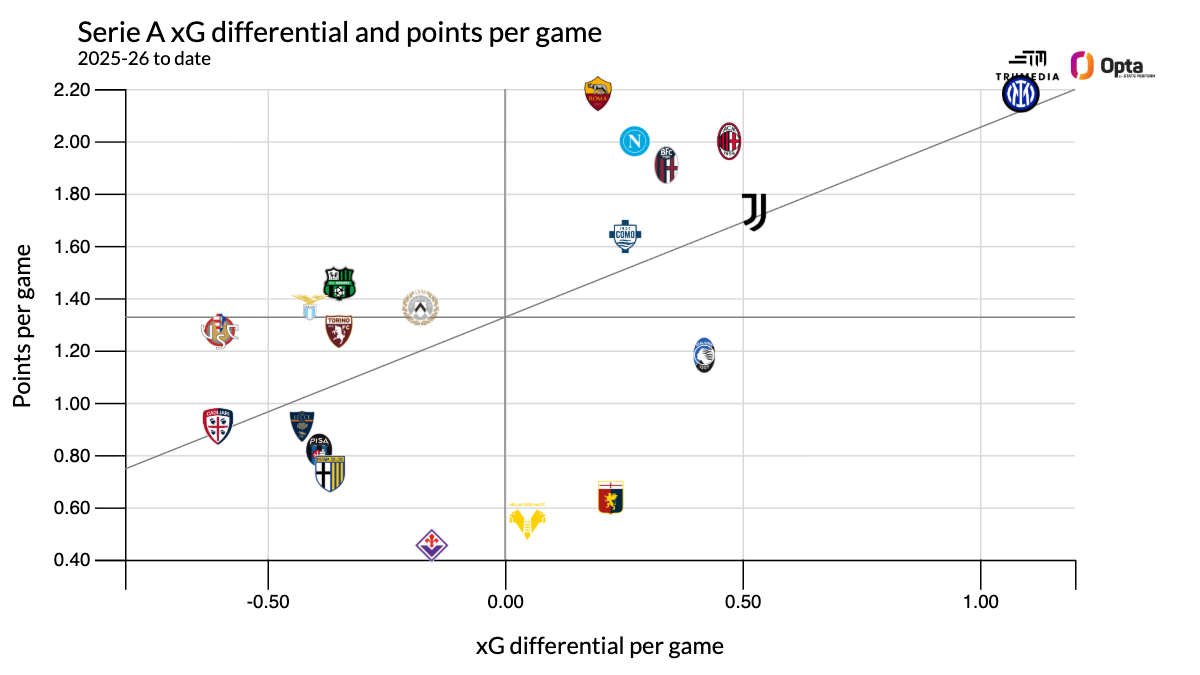
Despite a respectable xGD, Juventus is struggling in sixth place, while Atalanta is underperforming with seven draws. Both teams have made significant changes in their coaching staff recently.
Interestingly, Genoa currently rests in the relegation zone, yet boasts a better xGD than Roma. Despite the illogical standings, the potential for a dramatic shift remains as performance numbers suggest that certain teams are poised for improvement.
With the current Opta projections suggesting strong chances for multiple teams to vie for the top positions, Serie A is likely to provide competitive excitement as the season progresses.
 Ligue 1: Marseille appears as serious contenders … but will it matter?
Currently, there’s skepticism about Ligue 1’s competitiveness until at least March or April. Paris Saint-Germain remains the overwhelming favorite despite holding only a two-point lead over Marseille and Lens, as they possess a 93.6% probability of securing their 11th title in 13 years.
This prediction is based on their remarkable talent level, compounded by a slew of injuries and a rotation strategy that has seen many players start fewer than ten matches. However, even with these challenges, PSG continues to lead the league, underscoring their strength.
Marseille, conversely, has been consistently impressive, maintaining an xGD nearly two goals higher than PSG’s and achieving significant wins despite their occasional inconsistency. They have had notable performances but also faced issues against weaker teams.

While Marseille is showing promise, dethroning PSG seems unlikely. However, they may stay competitive for a while longer.
Having explored the Big Five leagues, let’s take a brief look at Portugal’s Primeira Liga and the Netherlands’ Eredivisie, particularly focusing on Ajax.
Ajax has been in a slump lately. After consistently finishing first in the Eredivisie from 2018-19 to 2021-22, they fell to third in 2022-23, and fifth in 2023-24, struggling in UEFA competitions. Initially, they seemed poised to compete for the league title last season but stumbled in the final matches.
The issues continue this season, with Ajax yet to earn points from their four Champions League games and struggling domestically as well.
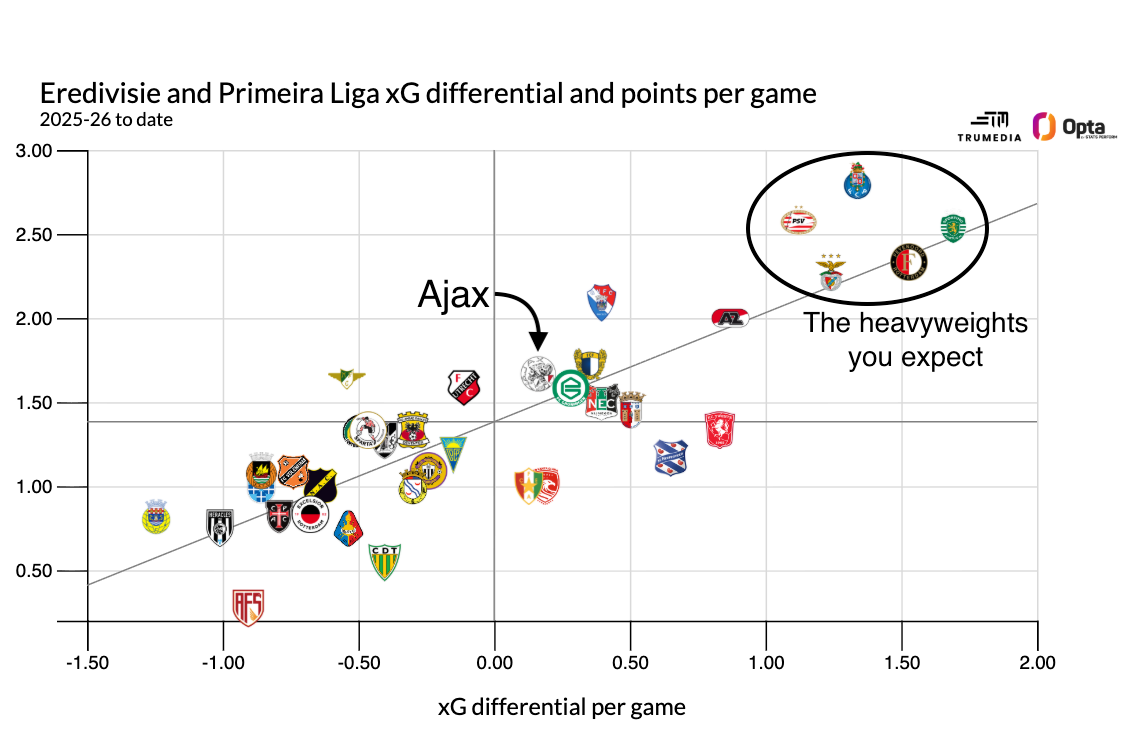
Currently ranked fourth in their league, Ajax has fallen significantly behind PSV, who lead by 11 points, and they are even behind in their xG differential, leaving their future looking bleak.
Overall, Ajax’s current state is alarming, reminiscent of their struggles in the mid-1960s.