



-

Sam Tighe
In March 2025, we presented the fourth edition of our Premier League MVP rankings, tackling the pivotal issue: Which players are the most crucial for the top clubs in the league?
We evaluated players based on their skills and tactical significance to their teams, ranking the top 15 accordingly. Unsurprisingly, the most accomplished, consistent, and regularly available players rose to the top, while the most tactically essential individuals also earned recognition.
Now, we return for the fifth installment, eager to see how the landscape has changed. Football teams often face numerous challenges over half a year, adjusting and evolving around injuries, absences, and form fluctuations.
Thus, we have updated our rankings for players at England’s “Big Six” clubs, taking stock of developments since March. Which players have improved their stocks, and who has experienced a decline? First, let’s share some notes on our methodology.
Why 15? With 11 first-team players on the pitch during matches, this number accommodates positions that may not be fully secure. Any significant long-term injuries will be acknowledged separately and excluded from rankings.
Who qualifies? The cut-off for minimum minutes stands at 300, which is relatively modest. For context, most key players who have maintained their fitness surpassed the 1,000-minute threshold. Previously, we considered only Premier League minutes, but this season we also factored in Champions League play. This adjustment reflects the need for top teams to rotate their lineups across competitions to ensure player health. For Manchester United, the prior rule of 300-plus Premier League minutes remains applicable as they currently lack European competition.
How are players evaluated? The rankings are inherently subjective, though expert consultations on each club influenced our assessments in alignment with our methodology.
Are statistics involved? We utilized stats effectively to support our insights, employing data from Opta and Gradient Sports. Note that unless specified, all statistics referenced (such as minutes played, goal contributions, and tackles) encompass Premier League and Champions League fixtures.
How challenging is it to rank players? Some rankings are evident, while others lead to extensive debate. Comparing players across different positions poses challenges, but within a squad context, it’s possible to gauge who is most integral.
I strongly disagree with your ranking of X below Y. Will you amend it? Disagreements are natural, and while subjective opinions will arise, this is designed as light-hearted fun.
With that established, let’s dive into the rankings.

Arsenal significantly invested in the summer transfer window, approximately £250 million on eight new players, aiming to intensify the title race against Liverpool and Manchester City. Mikel Arteta’s core team remains intact, now bolstered by a wealth of exceptional options, giving this ranking a fresh perspective compared to previous evaluations.
MISSED THE CUT: Most notably, Martin Ødegaard is absent from this list. It’s an odd situation considering he’s the club captain, but injuries in 2025 have cost him his minimum minutes (300) needed for inclusion. Other dropouts include Kai Havertz, Ben White, and Ethan Nwaneri due to lack of sufficient minutes, while Thomas Partey has left the club. Meanwhile, players like Myles Lewis-Skelly, Piero Hincapié, and Christian Nørgaard also didn’t feature enough to be included. This dynamic shakes up the rankings significantly due to the influx of new signings.
15. Cristhian Mosquera (New!)
Mosquera was brought in with an eye toward the future, as Arsenal’s center-back duo of William Saliba and Gabriel Magalhães has proven effective when healthy. Some early injury struggles for Saliba granted Mosquera the opportunity to play over 400 minutes, including 85 minutes at Anfield in September, where he performed commendably.
14. Noni Madueke (New!)
A two-month knee injury dampened Madueke’s promising start with Arsenal, but upon his return, he showed his versatility on both the left and right wings, especially excelling during the 3-0 win over Nottingham Forest in September. He’s eager to regain his form after injury.
13. Gabriel Martinelli (-7)
Martinelli’s secure position as a starter has diminished due to minor injuries and increased competition, resulting in a significant drop from sixth to thirteenth in the rankings, indicating his current role as more of a substitute.
12. Eberechi Eze (New!)
A heartwarming signing last summer, Eze expressed “unfinished business” at Arsenal, having been released at age 13. His contribution of one goal and two assists this season may not attract headlines, but he has seamlessly stepped in to advance the Gunners’ play, filling in for Ødegaard.
11. Mikel Merino (+2)
Merino has established himself as an “ultimate squad player,” displaying versatility in various positions. His contributions have been invaluable, covering multiple roles in midfield and even playing up front when needed, while also demonstrating athleticism and tactical understanding.
10. Leandro Trossard (+1)
Unlike Martinelli, Trossard has improved in response to Arsenal’s signing of new forwards. He has maintained his role as a dependable contributor to the squad, leading the team with seven goal contributions.
9. Viktor Gyökeres (New!)
Arsenal’s significant summer transfer acquisition of Gyökeres for €63 million plus add-ons set high expectations, yet the Swedish international has only managed six goals in 13 matches so far. There’s considerable room for improvement in both scoring and overall game impact.
8. David Raya (-2)
Raya’s drop to eighth despite being among the league’s best goalkeepers stems from a stellar performance by Arsenal’s outfield players, who have made crucial contributions to keeping matches uneventful from his perspective.
7. Riccardo Calafiori (+7)
After overcoming injuries, Calafiori is now showcasing his skill set as a left-back, providing dynamism in attack and a powerful presence in midfield, marking him as a significant asset to the team.
6. Jurriën Timber (+4)
Timber has become a standout fullback not just for Arsenal but across the entire Premier League, demonstrating intensity and contribution in both defensive and offensive phases of play.
5. Martín Zubimendi (New!)
Zubimendi’s arrival seems to fill a crucial gap in Arsenal’s midfield, demonstrating versatility and effective passing to manage the game’s tight situations while also recording impressive statistics for distance covered and assists.
4. William Saliba (-1)
Saliba’s ranking drop is notable due to a disrupted start to the season caused by injuries. Despite this, he remains an integral part of the team, especially with his high performance levels in previous seasons.
3. Declan Rice (+2)
Arteta’s praise for Rice as a “total footballer” reflects his growing influence on the midfield dynamics, as he excels in both defensive situations and advancing play through progressive passes.
2. Gabriel Magalhães (+2)
Gabriel’s notable contributions on set pieces and solid defensive partnerships have solidified his value to the team. His performance even led him to rank high in several key statistics while logging extensive minutes on the pitch.
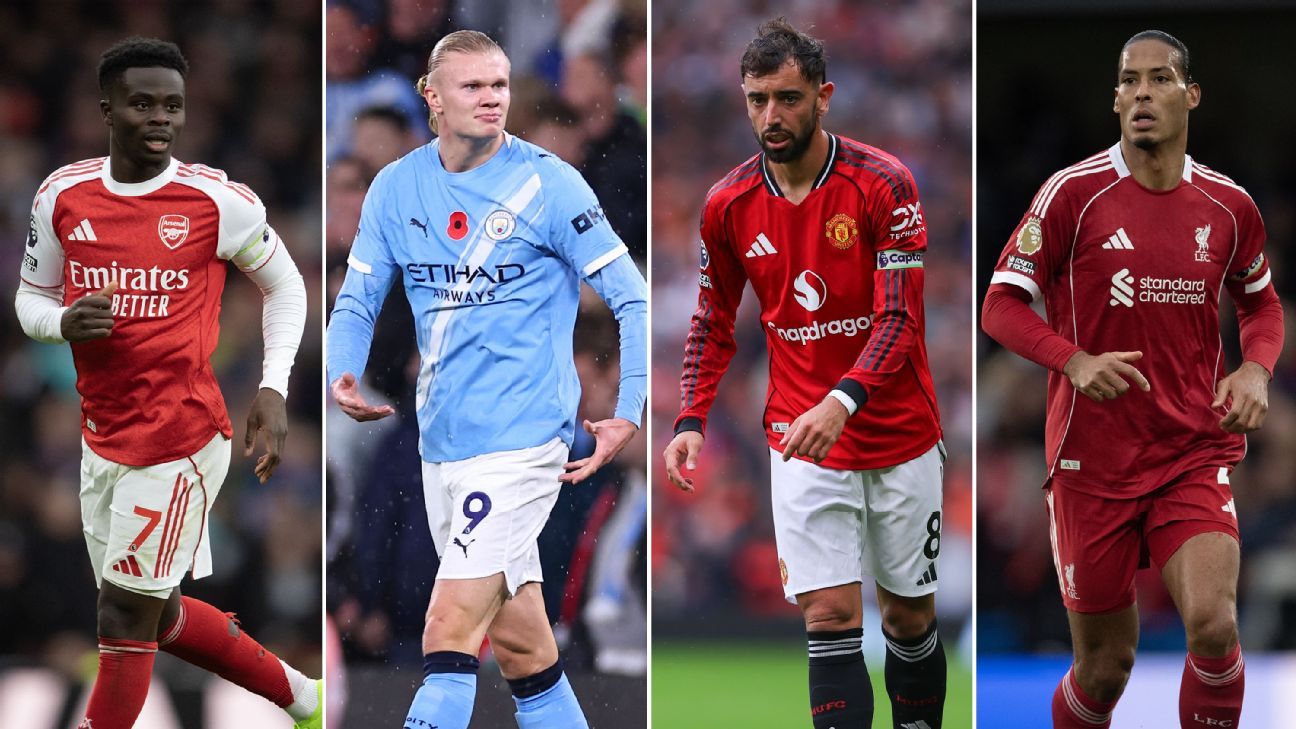
1. Bukayo Saka (+1)
With Ødegaard out injured, Saka has stepped up as Arsenal’s key scorer and playmaker. His ascendancy into the team captaincy demonstrates his growing leadership and influence on the field.

Chelsea broke their cycle of managerial turnover by retaining Enzo Maresca for a second consecutive season, but it hasn’t led to a period of stability. The Blues are integrating a number of young talents while making hefty changes to their squad, especially considering the unique challenges posed by winning the recent FIFA Club World Cup.
MISSED THE CUT: The notable absence of Chelsea’s standout talent, Cole Palmer, is due to injuries sidelining him below the minimum minutes threshold. Also dropping off are Jadon Sancho, Noni Madueke, and Nicolas Jackson, who have moved on from the club. Injuries have further affected Levi Colwill, and Roméo Lavia has also been sidelined, while several others have failed to accumulate necessary minutes to feature. The focus shifts to new recruits stepping up as Chelsea looks to make a significant impact this season.
15. Jamie Gittens (New!)
Gittens enters the rankings in place of Jadon Sancho, having appeared in 12 matches without securing a first-team role consistently yet. His explosive skills are still developing, making him better suited to contribute from the bench for now.
14. Andrey Santos (New!)
Santos is not yet a critical starter for Chelsea, but due to injuries within the squad, he has seen more game time than expected, solidifying his presence as an emerging fourth central midfielder.
13. Tosin Adarabioyo (+1)
Adarabioyo’s acquisition on a free transfer in 2024 has served Chelsea well, especially as he has filled defensive gaps amidst numerous injuries to others, showcasing strong performances consistent with Premier League standards.
12. Robert Sánchez (-1)
Sánchez’s mixed performance in goal has led fans to question why Chelsea didn’t pursue a new signing last summer. Although he has improved slightly, recent displays have resulted in inconsistent outcomes, including a notable red card against Manchester United.
11. Alejandro Garnacho (New!)
Garnacho began his Chelsea chapter slowly but is now settling and demonstrating promise, securing starts in crucial matches and notably contributing to a 3-0 victory against Wolves.
10. Malo Gusto (+1)
Gusto has adapted well to his role, showcasing versatility while often playing alongside Reece James, contributing valuable minutes across positional shifts from right-back to central midfield.
9. Trevoh Chalobah (New!)
Chalobah’s rapid ascent at Chelsea has been noteworthy; he’s appeared in several games following a successful loan, establishing himself as a valuable player despite prior setbacks.
8. Estêvão (New!)
Estêvão’s return has been highly anticipated and rewarding. Following a successful debut season, he scored the winning goal against Liverpool, embodying his potential to be a significant contributor.
7. Wesley Fofana (+2)
Fofana’s consistent selection indicates his importance to the team, and his impressive defensive skills, including a top aerial win rate, solidify his standing as a first-choice center-back.
6. Bernardo Silva (-2)
Silva’s impact has waned, leading him to average fewer significant passes per game. Still, he remains an essential player, leveraging experience and teamwork to navigate the season.
5. Nico González (+2)
González has settled well into Chelsea’s lineup, finding his groove after integrating properly and rising to fulfill a critical role in midfield. His strong performances have showcased his adapting ability.
4. Rúben Dias (-1)
Dias’s established role as a defensive anchor plays a pivotal part in maintaining Chelsea’s strong performance. His ability to log valuable minutes makes him essential within a frequently changing squad.
3. Phil Foden (+2)
Foden’s return to form has bolstered his standing, demonstrating consistency and versatility as he embraces a new deeper midfield role while maintaining offensive threats when needed.
2. Joško Gvardiol (=)
Gvardiol has excelled in a dual role, enhancing his value as a center-back, bolstered by Chelsea’s recent acquisitions focusing on more traditional defensive duties.
1. Erling Haaland (=)
Despite turbulence around other positions, Haaland remains Chelsea’s top player. With outstanding scoring statistics, his absence is highly felt, marking him as vital to Chelsea’s aspirations in the league.