



-

Ryan O’Hanlon
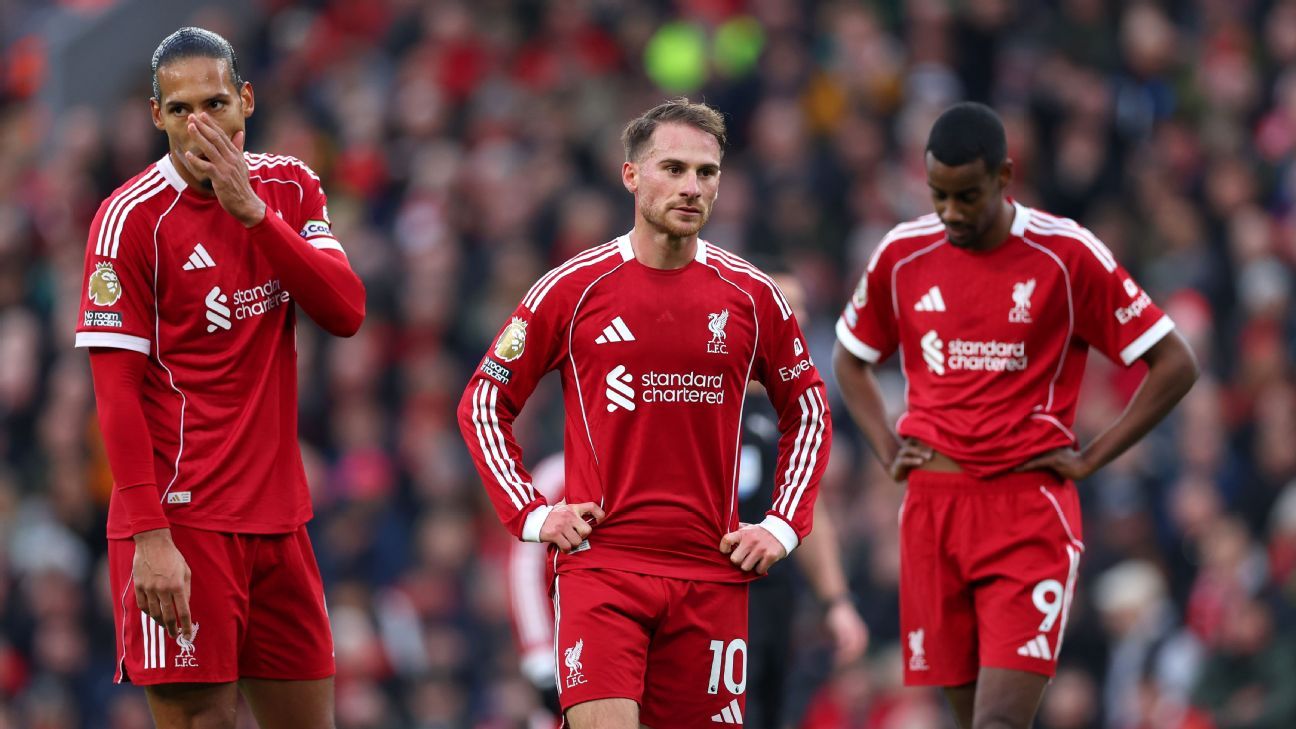
Liverpool has been, to put it bluntly, underwhelming. Their performance has been so poor that they can hardly be counted on. After an impressive league victory and an expenditure surpassing half a billion dollars on new players this summer, they currently sit in 12th place. They’ve let in 20 goals and maintain a negative goal differential—historically, only four teams have recorded fewer points at this stage following a title win. They trail the league leaders by 11 points and are just seven points clear of relegation.
If you’d like statistics, here’s another: this season marks the highest number of goals conceded by Liverpool through 12 Premier League matches since 2008-09. When they clinched the Champions League in 2018-19, they had allowed a mere five goals at this point. Last season, which ended in a league triumph, they conceded 8 goals in their first 12 matches. Yet, with the same center-backs, identical midfielders, and two new full-backs who were expected to enhance the defense, they have only managed to keep fewer goals out than the four clubs at the bottom of the table. Despite assembling a reportedly deep roster of attackers, they’re struggling to reach even 20 goals in the first 12 matches, a feat they haven’t failed to achieve in the last decade.
The two most expensive signings in English football history, Alexander Isak and Florian Wirtz, have produced a collective tally of zero goals and one assist. In fact, Hugo Ekitike is surprisingly regarded as Liverpool’s standout signing of the summer—despite being a center forward with just three goals to his name as we approach Thanksgiving! Last season’s star, Mohamed Salah, who was often considered the world’s best player, is now assisting and scoring at a rate lower than that of Casemiro.
One can only wonder if Liverpool can eventually correct their dismal trajectory. They have to, right? But, even if they manage to turn things around, their title defense is practically over. Current betting markets and advanced projection models indicate they have about a 5% chance of surpassing the 11 teams currently ahead of them by the end of May. They may have a chance, but we’ll believe it when we see them not losing 3-0 at home against a team that has already sacked two different managers.
While this year’s collapse is particularly striking, it aligns with a broader trend in the Premier League: teams that win the title commonly struggle in the subsequent season.
– Assessing Man United’s improvement under Amorim
– A look at the USMNT’s prospective World Cup starters
– Can coach Arne Slot address Liverpool’s woes?
What Makes It Difficult to Win Consecutive Premier League Titles?
Since the prominent clubs in English football opted to keep the lion’s share of television revenue to themselves in the early ’90s, only 11 out of 32 completed Premier League seasons have seen a repeated champion.
The 11 clubs that have achieved this record share a few characteristics:
☑ Managed by Sir Alex Ferguson
☑ Backed by a Russian oligarch
☑ Currently under investigation by the Premier League for 115 potential violations of financial regulations
Manchester United accomplished this feat six times, Manchester City four times, and Chelsea once. Essentially, to retain the title in the Premier League, you’d need to be either coached by arguably the best manager ever while also generating absurd revenue or be owned by someone whose financial resources are essentially unlimited.
Among those 11 champions, only five actually improved their point totals in their repeat title season. Moreover, just four managed to enhance their goal differentials. The following teams achieved both:
• Manchester United, 1999-2000: from 79 to 91 points and from plus-43 to plus-52
• Manchester United, 1993-1994 (42-game season): from 84 to 92 points and from plus-36 to plus-42
• Manchester City, 2021-2022: from 86 to 93 points and from plus-51 to plus-73
• Manchester City, 2023-24: from 89 to 91 points and from plus-60 to plus-61
While we’re discussing statistics, let’s also consider the worst title defenders. Four champions have seen their performance drop by 25 points or more and also suffered a goal differential decrease of 25 or more:
• Blackburn Rovers, 1995-96: from 89 to 61 points and from plus-41 to plus-14
• Liverpool, 2020-21: from 99 points to 69 points and from plus-52 to plus-26
• Chelsea, 2015-16: from 87 points to 50 points and from plus-41 to plus-6
• Leicester City, 2016-17: from 81 points to 44 points and from plus-32 to minus-15
The statistics surrounding Blackburn are slightly misleading since the league transitioned from 42 to 38 matches after their championship win in 1994-95. However, the overarching point remains: a greater number of teams have performed worse than those that have slightly improved. In fact, nearly half of all title-winning teams (15) dropped by at least five points and five goals in goal differential the season after securing the league.
On average, a Premier League champion finishes with 87 points, scores 82.7 goals, and concedes 32.1 goals. The stats for the following season typically read like this: 78.5 points, 76.9 goals scored, and 35.2 goals conceded.
The defensive decline is slightly larger relative to the offensive output (10% more goals conceded and 7% fewer scored), which results in a 10% drop in total points for teams following their league victory.
Why is it so Challenging to Repeat as Champions?
If we take a look at the year just before a team wins a title, here are the average statistics:
• 80.3 points
• 76.8 goals scored
• 32.8 goals conceded
The general trend for a title-winning club over three seasons features a seven-point increase followed by an eight or nine-point decline: starting from approximately 80 points, peaking at around 87, then dropping to about 78 or 79.
This pattern makes sense: winning the Premier League requires consistent excellence over multiple seasons, but the title is often clinched in a year filled with fortunate events. There’s often not a drastic difference between teams earning 80 points, 87 points, or 79 points; minor factors like fortunate rebounds, perfectly struck shots, subpar goalkeeping, or controversial refereeing can separate similarly skilled teams by a few points.
Thus, we arrive at a fundamental truth: it’s exceedingly difficult to successfully defend the Premier League title; the prerequisites for winning the league usually necessitate an extraordinary convergence of conditions.
Consider Liverpool’s success last season: every key player remained healthy, the new manager’s tactics seamlessly complemented the prior manager’s blind spots, both center-backs performed at Peak levels, Salah achieved a career-best season, and the two holding midfielders, Alexis Mac Allister and Ryan Gravenberch, both had breakout seasons.
However, this season has seen multiple injuries (including Gravenberch), manager Arne Slot still trying to adjust tactics to the new personnel, and neither Salah nor Mac Allister currently approaching the previous heights they achieved. Additionally, data from Gradient Sports indicates that Ibrahima Konaté has made the second-most defensive errors among Premier League center-backs this season, compared to ranking 28th last year.
While this doesn’t completely account for Liverpool’s staggering decline this season, it certainly provides insight.
1:49
Is Florian Wirtz ‘lacking confidence’ since the transfer to Liverpool?
Craig Burley reflects on Florian Wirtz’s current form with the German national team and its connection to his move to Liverpool.
Moreover, external factors often play a significant role in a team’s success. Consider Manchester United’s campaigns in both the 2011-12 and 1998-99 seasons: despite improving their point totals and achieving a 15-goal better goal differential on both occasions, they still failed to secure back-to-back titles.
The opposite can also apply—teams like Arsenal have repeatedly faced declines in point totals during title defenses yet failed to retain the crown. Last season, Liverpool benefitted from key injuries and declines in form from challengers such as Manchester City and Arsenal, both of which suffered significantly, with neither team securing over 74 points after previously not finishing lower than 85 points in prior seasons.
Was this decline predictable? If so, there was considerable profit to be made early in the season when most sportsbooks ranked Liverpool as favorites, only to progressively adjust their odds downward as Liverpool managed to scrape together wins.
Nevertheless, predicting outcomes in sports tends to be more complicated than merely spotting what won’t occur. Historically, teams that successfully defend their title often share traits such as finishing either second or first in the season leading to their championship, realizing only modest improvements of fewer than seven points in their title-winning season, and typically amassing 87 points or more during victory.
Of the past 32 league winners, 11 met at least one of these criteria, but only one (2017-18 Manchester City) managed to maintain their championship status after earning a historic 100 points.
Reflecting back on Liverpool’s last season, they merely added two points from their previous campaign, achieving an overall score of 84 points and finishing third prior to their victory—a scenario that casts doubt on their future dominance.
This all suggests that Liverpool’s current struggles were not entirely unforeseeable, indicating that they were always likely a team on the downward slope and unlikely to secure another Premier League title.