



-

Jeff Kassouf
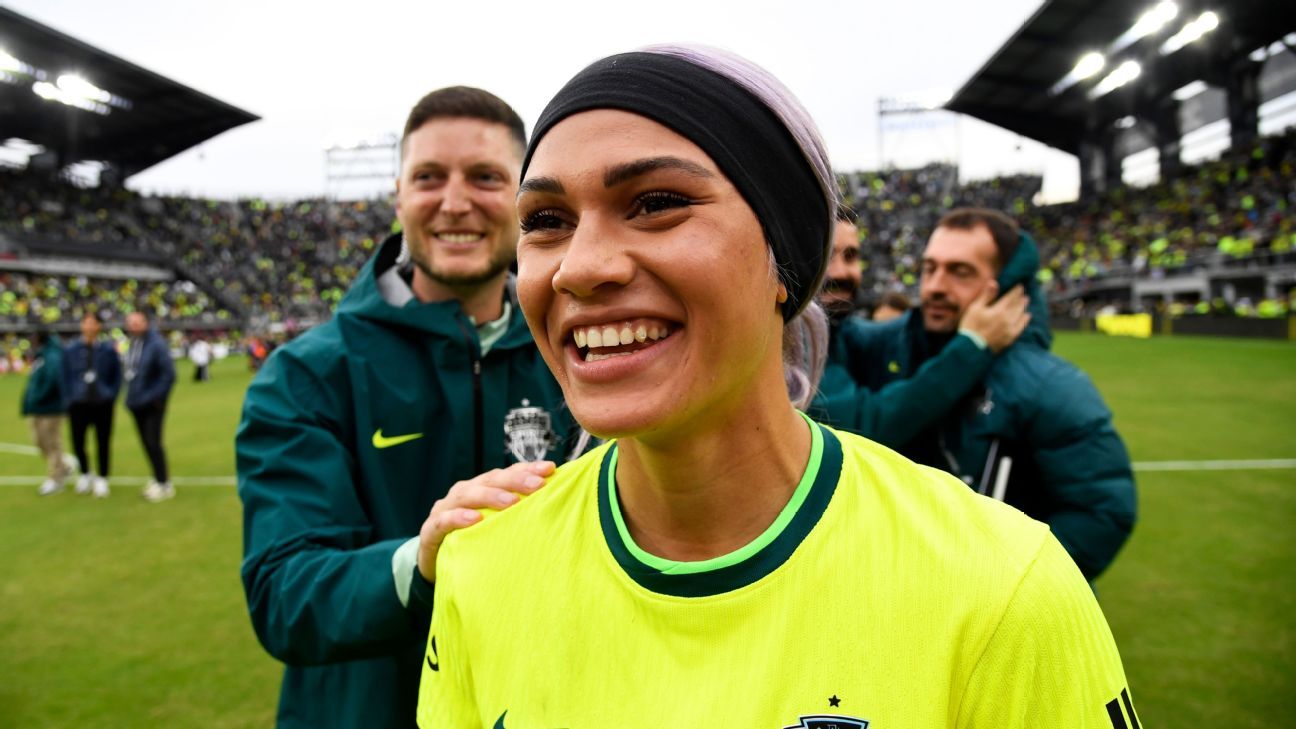
The National Women’s Soccer League Players Association (NWSLPA) has lodged a grievance against the NWSL, claiming the league breached the collective bargaining agreement when it blocked a record-setting contract offer from the Washington Spirit for star forward Trinity Rodman.
The grievance was filed on behalf of Rodman on Wednesday, asserting that the league’s rejection of the agreement violated her free agency rights and at least five sections of the CBA.
The NWSL contends that the contract arrangement between Rodman and the Spirit went against the “spirit” of the league’s competitive regulations, according to documents reviewed by ESPN.
Rodman and the Spirit had reportedly agreed on a multiyear contract that would include backloaded compensation in the later years, as mentioned in the grievance.
Sources familiar with the deal indicated that it was intended to be a four-year contract with escalators that would average over $1 million annually, potentially making it the largest contract in NWSL history.
The NWSL has also accused Rodman of “salary cap circumvention” in relation to the grievance.
However, the players’ association maintains that the deal complies with the CBA regulations and falls within the projected salary cap for upcoming seasons.
A spokesperson for the league provided ESPN with a statement saying, “We aim to ensure that the best players in the world, including Trinity, remain with this league. We will leverage all available avenues to keep Trinity Rodman here.”
The resolution of this issue is critical not only for Rodman, NWSL’s marquee player, but also for the league’s salary cap framework. Rodman’s prior contract is set to expire at the month’s end, making her decision the center of attention following the NWSL’s recent championship match, in which she and the Spirit participated.
With the NWSLPA’s grievance filed, the league has a 14-day window to respond in writing.
If a resolution is not achieved within this period, a grievance committee made up of one appointee from the league and one from the players’ association will evaluate the situation.
If the committee is unable to reach a conclusion, the dispute could be escalated to arbitration, although both parties may mutually decide to proceed directly to that stage.
Since being selected by the Spirit as the No. 2 pick in the now-defunct draft in 2021, Rodman has been with Washington.
She played a pivotal role in leading the Spirit to their first NWSL Championship that year, with the team finishing as runners-up in the finals for 2024 and 2025. After her rookie season, she signed a new four-year deal worth a total of $1.1 million.
Michele Kang, the Spirit’s owner, has consistently stated this year that she and the team “will do everything in our power” to retain Rodman.
Kang reiterated this to ESPN earlier this week, while new president of soccer operations Haley Carter labeled Rodman “a top priority.”
Earlier reports indicated that Rodman has received numerous offers from European clubs that surpassed what NWSL teams could afford under the league’s salary cap, which was set at $3.5 million for 2025 after adjustments for revenue sharing.
The CBA, ratified in the summer of 2024, mandates that the NWSL’s team salary cap will increase each year until 2030. By 2029 — the last year of Rodman’s proposed four-year deal — the base cap will be $4.9 million.
This number is expected to rise substantially once revenue-sharing adjustments are factored in, as the 2025 base was originally set at $3.3 million.
With the NWSL’s four-year, $240 million media rights deal set to conclude after the 2027 season, sources across the league anticipate a significant increase in the next rights agreement, which would also enhance the salary cap.
The Spirit’s backloaded offer to Rodman hinges on this anticipated cap increase but, according to the grievance, aligns with the existing NWSL regulations.
Additionally, the Spirit could restructure or exit any potential contract if future cap compliance becomes problematic.
According to Section III.7.c of the NWSL’s competition manual, each team has the ability to buy out one player’s contract per season without affecting the salary cap.
A league source, speaking anonymously due to the sensitivity of the issue, stated that NWSL would likely have no objections to a $1 million annual contract.
As part of a single entity structure, all player contracts are managed by the NWSL rather than individual franchises.
Section 8.16 of the CBA specifies that the stated salary cap figures are minimums and grants the “NWSL may in its discretion, after consultation with the NWSLPA, reduce or eliminate” salary cap charges.
The failure of NWSL commissioner Jessica Berman and the league’s board of governors to raise the cap has been a contentious topic in recent weeks.
In the lead-up to last month’s NWSL Championship, Berman expressed, “We want Trinity in our league and we will fight for her.”
However, she also emphasized that “the NWSL is not a charity” and that “the value proposition” of the league extends beyond mere salaries — reiterating points previously made.
Section 13.6 of the CBA, mentioned in the grievance filed on Wednesday, asserts that “a player’s free agency rights as defined herein take precedence over any contradictory NWSL rules, regulations, handbooks, or competition guidelines.”
The CBA does not establish a maximum salary, and the league’s intervention regarding Rodman could essentially create one, according to the NWSLPA.
A recent anonymous survey of general managers indicated significant concern within the NWSL regarding the league’s ability to attract top players under current salary cap expectations.
One GM suggested the league should “identify a means to compensate top talent while minimizing disruption to the overall ecosystem,” akin to the designated player rule in MLS.
This idea has already been discussed by the NWSL’s governing board, as previously reported by ESPN, though the timeline for implementation remains unclear.
The potential loss of Rodman to an overseas league would be another setback for the NWSL following the unexpected move of USWNT forward Alyssa Thompson from Angel City FC to Chelsea in September.
Bloomberg first reported the rejection of Rodman’s proposed contract by Berman and the subsequent grievance filing by the NWSLPA.