



-

Ryan O’Hanlon
Last weekend’s now-viral rant from Mohamed Salah on Norwegian television revealed his frustration, suggesting he feels scapegoated. He’s not entirely off-base; many critics have singled him out as a key factor in Liverpool’s stark decline this season, jeopardizing their hopes of consecutive Premier League titles well before the holiday season.
Conversely, others attribute the team’s struggles to the manager Salah implied he used to have a good rapport with but claims he now has no connection with. Although Arne Slot guided Liverpool to their second title last season with relative ease, detractors argue that his success was largely due to riding the momentum created by Jurgen Klopp’s remarkable tenure.
Now, Slot is facing uncertainties with his squad. After spending a British-record €482.9 million on six new players who were widely praised, the team’s performance has plummeted rather than improved. Slot frequently alters lineups, yet even with a two-match winning streak, the results remain disappointing.
Liverpool’s current challenges serve as a perfect illustration of soccer’s intricate dynamics.
A tactical shift or player change on the left flank can disrupt the attacking effectiveness of the right winger. As key players age, what was once a solid midfield might quickly transform into a liability. New strategies from opponents can turn a strong team into an average one, and a drop in player fitness can render a previously successful tactical method ineffective.
In the face of such tangled cause and effect at Anfield, taking a step back to reassess fundamental beliefs about the game can be helpful. To quote modern soccer’s pioneer, Johan Cruyff: “If your players are better than your opponents, 90% of the time you will win.”
Liverpool is winning significantly less than last season, and many of their current players are different from those who contributed to last year’s success. It raises the question: perhaps the new recruits like Florian Wirtz, Alexander Isak, and others aren’t as exceptional as initially thought. Perhaps that’s where the true fault for Liverpool’s misfortunes lies.
– O’Hanlon: How the 2026 World Cup killed the ‘group of death’
– Salah’s Liverpool outburst echoes Ronaldo’s Man United exit
– Top 50 USMNT players, ranked by club form with a surprise No. 1
How many stars are needed to win the Premier League?
Generally, winning the Premier League requires three or four star-level attacking players, a trend that has persisted since the 2017-18 season.
By “attacking players,” we refer to those who not only score but can also create opportunities. We define “star-quality” as players who generate a minimum of 0.6 non-penalty expected goals and assists per 90 minutes. This threshold, 0.6 npxG+xA, highlights about 20 players each season who meet this criterion, focusing on expected metrics over actual ones to better represent true talent rather than one-off performances.
The data showcases the number of players with over 900 minutes logged who reached this mark across the last eight championship-winning teams, according to FBref. Here’s a summary:
• 2017-18 Manchester City (4): David Silva, Gabriel Jesus, Raheem Sterling, Sergio Agüero
• 2018-19 Manchester City (7): David Silva, Riyad Mahrez, Kevin De Bruyne, Leroy Sané, Raheem Sterling, Sergio Agüero, Gabriel Jesus
• 2019-20 Liverpool (3): Roberto Firmino, Sadio Mané, Mohamed Salah
• 2020-21 Manchester City (2): Raheem Sterling, Kevin De Bruyne
• 2021-22 Manchester City (6): Riyad Mahrez, Phil Foden, Kevin De Bruyne, Ilkay Gündogan, Gabriel Jesus, Raheem Sterling
• 2022-23 Manchester City (2): Erling Haaland, Kevin De Bruyne
• 2023-24 Manchester City (4): Phil Foden, Julián Álvarez, Kevin De Bruyne, Erling Haaland
• 2024-25 Liverpool (4): Darwin Núñez, Luis Díaz, Diogo Jota, Mohamed Salah
While there are standout seasons—like the 2018-19 Manchester City team pressured by the eventual European Cup champions, Liverpool, or the unusual COVID-affected 2020-21 and 2022-23 seasons—data analysis indicates that, on average, four “star” attackers contribute to each championship-winning team, a figure that Liverpool achieved last season.
Throughout this eight-year span, Liverpool has maintained competitiveness due to consistently having at least three players capable of both scoring and creating chances effectively:
• 2017-18 (4): Salah, Mané, Firmino, Philippe Coutinho
• 2018-19 (3): Salah, Mané, Firmino
• 2019-20 (3): Salah, Mané, Firmino
• 2020-21 (3): Salah, Mané, Jota
• 2021-22 (5): Salah, Mané, Jota, Firmino, Díaz
• 2022-23 (5): Salah, Jota, Firmino, Díaz, Núñez
• 2023-24 (5): Salah, Jota, Díaz, Núñez, Gakpo
• 2024-25 (4): Salah, Jota, Díaz, Núñez
However, nearing the midpoint of the 2025-26 season, only one Liverpool player meets that star threshold. Surprisingly, it’s not any of the new signings or the reigning Premier League Player of the Year—it’s Cody Gakpo.
Why Liverpool need much more from Florian Wirtz and Alexander Isak
Let’s examine Liverpool’s top 10 players based on expected goals and assists per 90 minutes this season, excluding those with fewer than 450 minutes played—otherwise you’d see Federico Chiesa, who is averaging an impressive 1.5 xG+xA per 90 across a modest 150 minutes:
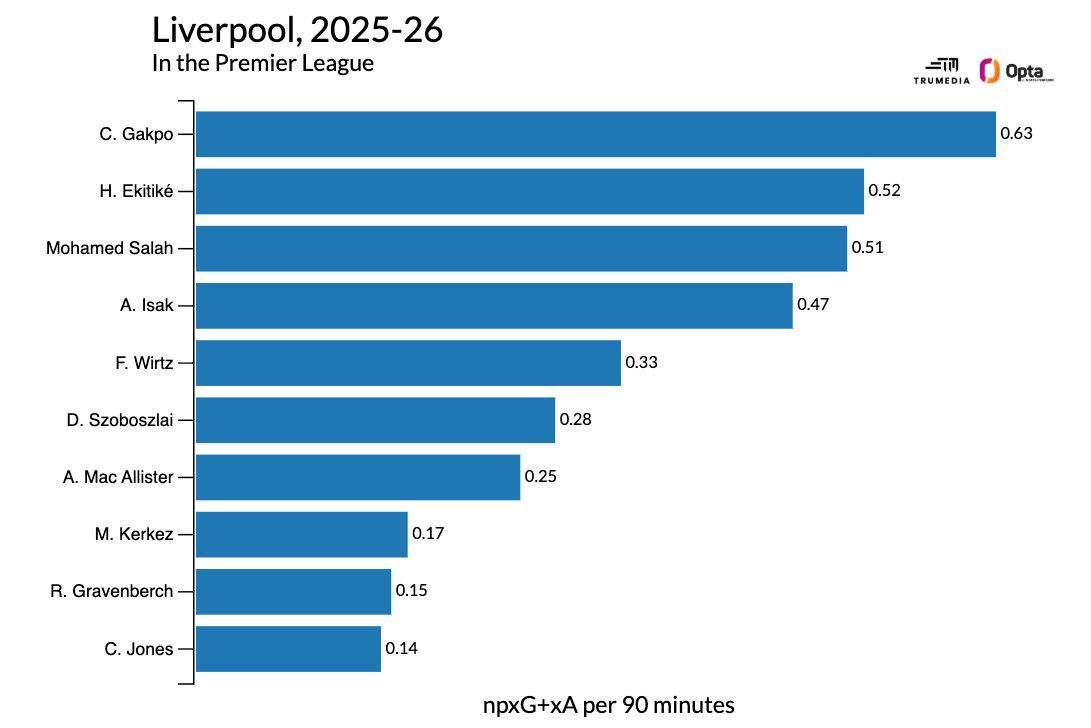
Salah has recorded an average of 0.75 xG+xA per 90 minutes throughout his Liverpool tenure. His lowest season came during the COVID-impacted 2020-21 campaign when he managed 0.61. Currently, he significantly trails both averages and especially last season’s 0.87. However, examining the trend of his season, we can perceive some positive signs—though it requires a close look.
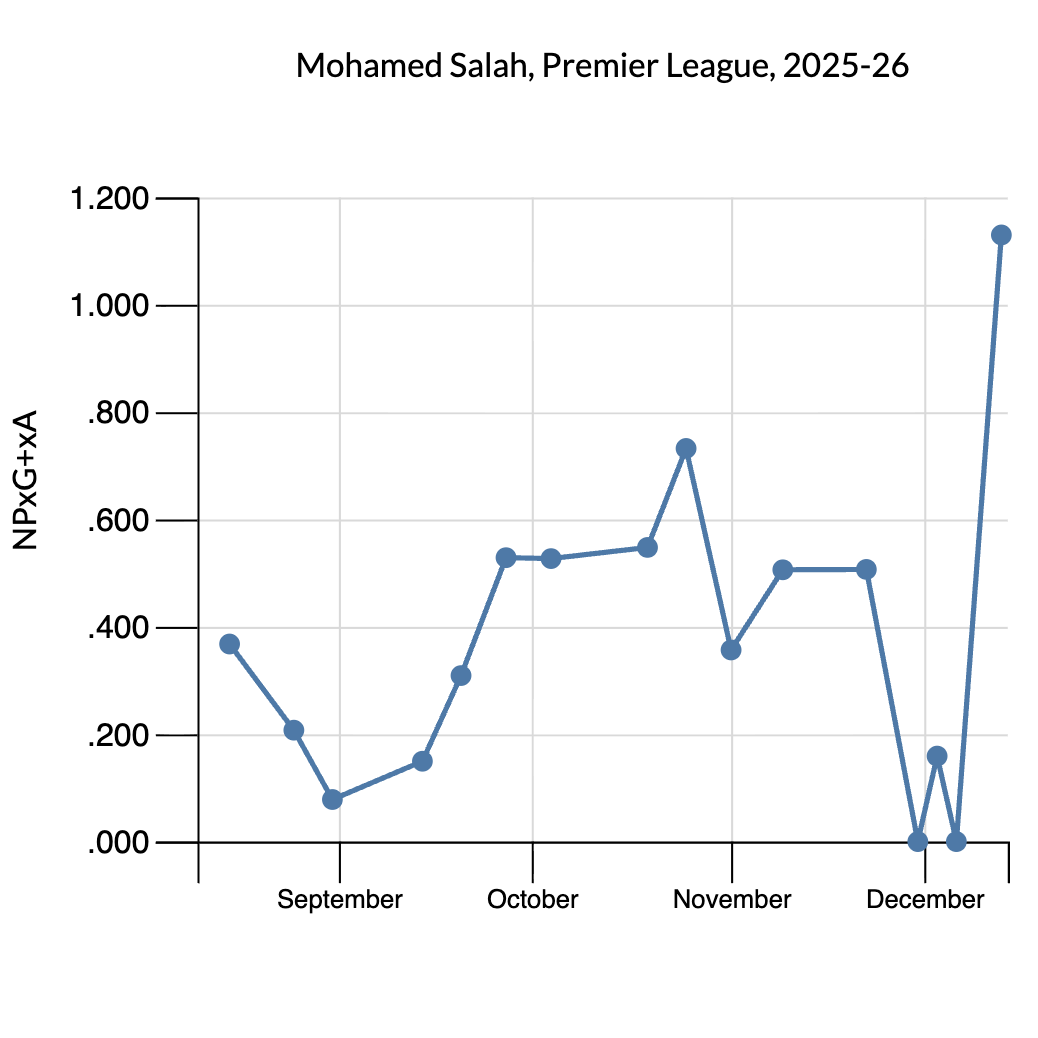
Interestingly, Salah’s worst five games this season coincided with the club’s five consecutive victories at the season’s beginning. Perhaps Salah’s annoyance stems from not being substituted until after he was criticized for underperforming. Upon returning against Brighton most recently, he appeared more threatening than he had been all season.
After excluding those initial five matches, Salah’s xG+xA rises to 0.68 per 90 minutes, still below his past performance levels. Yet, given he is now 33 years old, he remains capable of contributing to a top team. However, the players brought in during the summer were intended to support both him and eventually take over his role as his career progressed.
That transition hasn’t materialized—saving for Hugo Ekitike, who scored twice in the recent match, elevating his goal+assist rate to 0.83 per 90 minutes. Among Premier League starters, only Haaland surpasses this productivity.
However, Ekitike has been inconsistent throughout the season—boasting three spectacular games but a series of mediocre performances. He can create opportunities but often makes poor shooting choices:
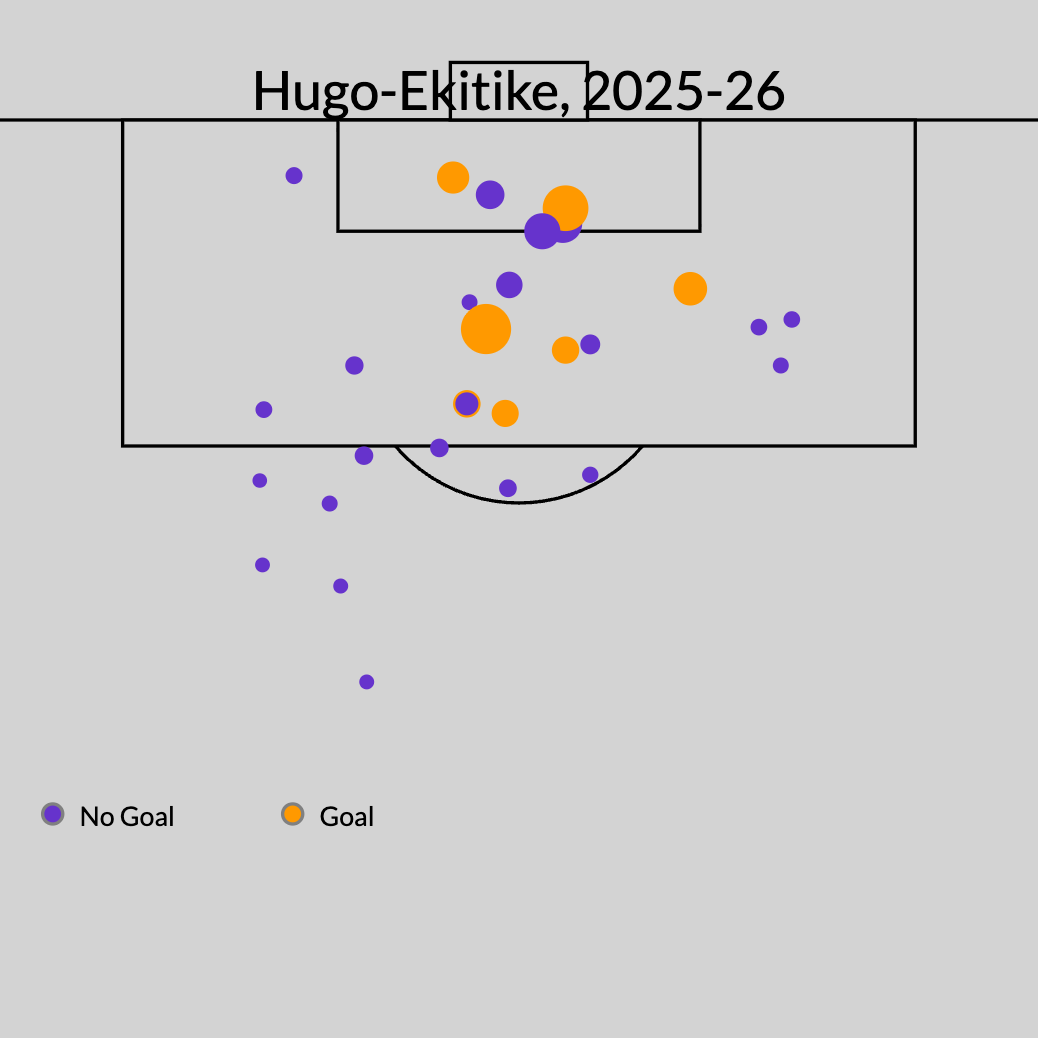
Despite the inconsistency, his potential shines through each match. Although his underlying numbers aren’t stellar yet, the level of output he provides is noteworthy, especially considering Liverpool invested significantly less in him than in Wirtz or Isak, the latter being the current record signing in Premier League history.
Wirtz has yet to score or assist in the Premier League, but Liverpool would undoubtedly make the €125 million acquisition again in a heartbeat. Approaching 23 years old, he boasts exceptional prior performance in one of Europe’s top leagues, but the impact hasn’t yet been felt in England. He regularly demonstrates skills to progress the ball effectively; however, Liverpool didn’t sign someone solely for midfield support.
The expectation was to secure elite attacking production—a scenario akin to what David Silva and Kevin De Bruyne achieved for Manchester City. Sadly, Wirtz has delivered effective ball progress but average attacking results (having generated 3.7 combined expected goals and assists in the league despite no actual contributions).
Worse still is Isak’s performance: a striker acquired for a historic fee, has only managed one goal and one assist across 16 appearances and has taken a mere 14 shots all season. Furthermore, his contribution beyond goal production is negligible, attempting merely 12 passes per 90 minutes—subpar compared to teammates who average over 20.
To compound matters, Isak, at 26, is in the prime of his career. In contrast to Ekitike and Wirtz, who joined from leagues requiring adaptation, Liverpool desperately needs Isak’s output now due to his Premier League experience since 2022.
Significantly, no evidence exists that Isak and Ekitike can effectively collaborate on the field. In their joint start during the recent 1-0 victory over Inter Milan, they failed to connect on a single pass. Liverpool invested a combined €240 million on two strikingly similar players, and presently, the younger, less expensive Ekitike appears to be the superior option.
Initially, signing Isak for a record amount post-Ekitike appeared irrational—after all, two strikers in today’s game is a rarity. However, given Liverpool’s data-driven approach in transfers, one would presume they had a plan. Perhaps they envisioned exploiting defensive weaknesses created by the rarity of two-striker setups.
But if there was a strategy, its execution remains unobserved.
It’s not entirely Slot’s fault
That said, this isn’t to absolve Slot of responsibility.
While he has experimented with various lineups, he often abandons them after just one or two games, hampering the crucial development of team cohesion that characterized last season’s success.
It seems Slot has perhaps received too much credit for last year’s title and is now enduring excessive blame for their current struggles. The club’s nomenclature indicates this: Slot is referred to as “head coach,” not “manager.”
Much of Liverpool’s past success was attributed to how the club identified undervalued talent and how Klopp embraced these views. This was likely a key factor during Slot’s hiring process, ensuring he would align with this philosophy. However, once you lessen a manager’s role, returning to center him when difficulties arise can prove problematic.
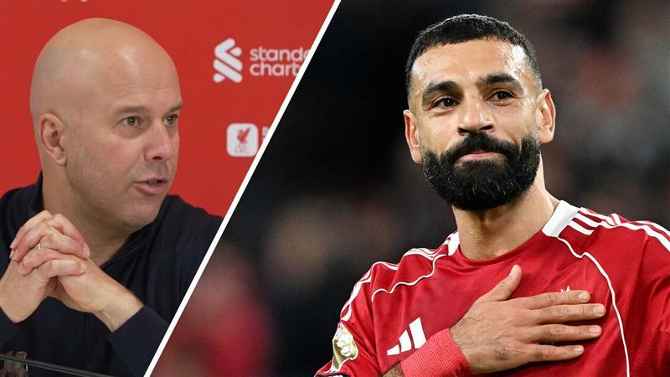
2:13
Slot on Salah’s future at Liverpool: ‘You already know the answer’
Arne Slot speaks about Mohamed Salah’s future at Liverpool after his performance vs. Brighton.
Both Wirtz and Ekitike align with Liverpool’s signing strategy: acquiring pre-peak talents with elite underlying statistics and outstanding physical attributes. Their pairing should ideally result in a scorer-creator dynamic. While Ekitike delivered as a quality creator for a scorer, Wirtz’s impact in the box has lagged behind, marking it as one of the few positive aspects of the season. According to Stats Perform’s expected possession value metric, quantifying the impact of each on-ball action on goal-scoring chances, Wirtz’s passes to Ekitike registered as the most valuable connection for Liverpool this season, even amid their frequent absences from the starting lineup.
Beyond these two, however, the rationale for the rest of the acquisitions falters. Isak, despite being prone to injuries and having limited experience on a high-caliber team like Liverpool, emerges as the most perplexing signing, especially considering he is older than other costly recruits.
Milos Kerkez, who joined along with Isak, Wirtz, and others, represents another red flag after being signed previously by Richard Hughes at Bournemouth. Meanwhile, Jeremie Frimpong, a left-back from Bayer Leverkusen, came into a team where the role was previously nonexistent.
If these players were meant to mesh with last season’s style, their fit appears deeply flawed. With an emphasis on attack and two center-forwards, the squad composition contradicts the previous configuration praising Salah’s success with fewer defensive obligations.
Alternatively, the club might have planned a transition to a back three with wing-backs, which fell through after failing to secure center-back Marc Guéhi on transfer deadline day. But if so, hinging the tactical framework on a single player’s acquisition raises significant questions about their planning.
Ultimately, it appears Liverpool’s front office may have overreached in acquiring players like Wirtz and Isak without adequately considering their integration. Perhaps development into a cohesive unit is left to Slot and his staff, but expectations for a €482.9 million investment demand results far earlier than they’ve shown.
Talent is crucial, yet identifying the right talent is equally essential. Furthermore, maximizing that talent into a functional team dynamic is paramount. Johan Cruyff encapsulated this notion well: “Why couldn’t you beat a richer club? I’ve never seen a bag of money score a goal.”