




-

Sam Tighe
Aston Villa is enjoying an extraordinary run of form, propelling them into the Premier League‘s top three: the team has won 10 of their last 11 league matches, including nine straight victories across all competitions. Within this stretch, they have defeated league leaders Arsenal and second-place Manchester City, and they have secured wins in every league game following midweek European fixtures—typically a challenging feat.
With a match against Manchester United looming this weekend, and Unai Emery’s squad just three points shy of the top spot and five ahead of fourth place, fans are starting to ponder: Are Villa truly contenders for the 2025-26 title?
While a definitive answer may not emerge until March or April, it’s essential to understand how they reached this position.
A turbulent summer
The fact that Villa sits third in the standings is even more impressive given their initial struggles, failing to win any of their first five matches this season. During that stretch, they suffered defeats to Brentford and Crystal Palace, and drew with Newcastle United, Everton, and Sunderland, managing to score only once throughout this period.
A disappointing summer transfer window undoubtedly contributed to this rocky start. In July, Villa was fined by UEFA for violating its cost-control regulations—the club overspent relative to its revenue—and subsequently entered into a settlement agreement requiring them to end the summer with a positive transfer balance. This necessitated the club to post a £15 million profit for the transfer window, making it extremely challenging to sign top-tier players, leaving the future of every player at Villa uncertain until the window closed.
The £39 million (potentially rising to £43 million) sale of homegrown midfielder Jacob Ramsey to Newcastle United was key to achieving the required revenue. However, reports indicated that dissatisfaction lingered within the dressing room over how that deal, along with the summer in general, unfolded. England international defender Ezri Konsa even remarked
The turning point came during their UEFA Europa League opener against Bologna, where Villa, lacking confidence, managed a narrow 1-0 win in late September. This victory was followed by their first Premier League success, a 3-1 win over Fulham, setting off a sequence of positive results.
A pivotal change was the reintroduction of Pau Torres, the club’s most skilled passing center-back, to the defensive lineup after a period on the bench. The Spain international’s ability to quickly advance the ball and retain possession is critical to Emery’s possession-based strategy.
Torres injected composure into Villa’s play, establishing a stronger foundation for improvement across the squad.
Subsequently, key players began to hit form. Attacker Morgan Rogers found his rhythm, producing the best football of his career with five goals and three assists in his past 11 matches. Other players also made vital contributions, including defender Matty Cash and midfielder John McGinn, both scoring crucial goals, while forward Emi Buendía has had a significant impact off the bench on multiple occasions.
Statistics tell a different story
There are concerns regarding the sustainability of Villa’s form; if they defeat Manchester United this weekend, Emery would become the first Villa manager in over a century to achieve two distinct streaks of 10 consecutive home victories. Moreover, underlying statistics tell a starkly different tale compared to their current league standing.
The Premier League’s expected goals differential (xGD) metric places Villa in 14th position. This calculation subtracts their total xG (16.7) from their expected goals against (21.4), resulting in a negative xGD of -4.7. For comparison, Arsenal leads this table with +16.9, while Burnley sits bottom at -18.0.
Even if we exclude Villa’s dismal start, their xGD would still be -0.34, which ranks them 11th overall—far from a 30 points out of 33 performance level.
What accounts for this disparity? How has Villa amassed points at an unprecedented rate over the last two months, generating whispers of a title challenge while their data paints an average picture, causing analysts to urge caution?
The answer lies largely in the nature of the goals Villa has scored.
Long-range shooting disrupts the model
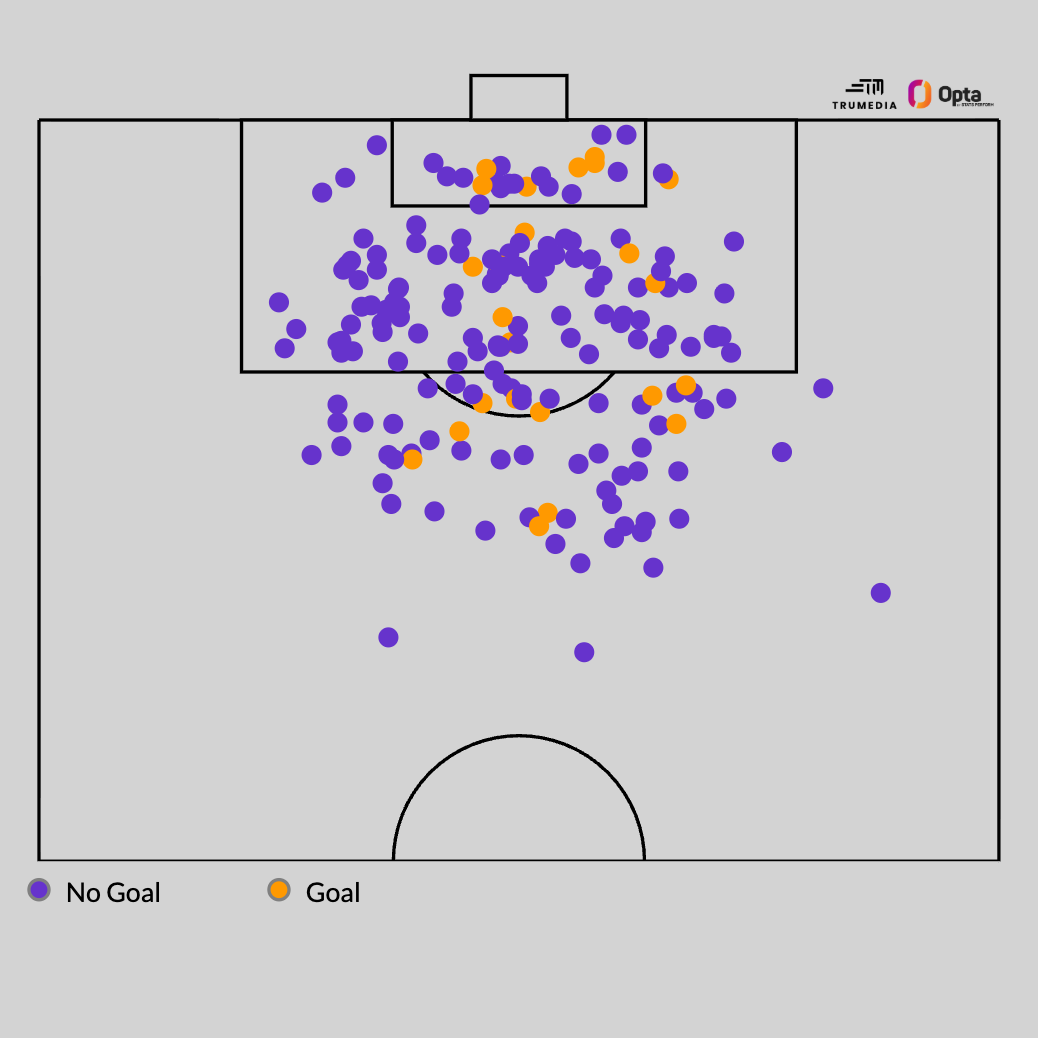
An incredible 40% of Villa’s 25 Premier League goals have originated from outside the box, the highest of any team in Europe this season, with at least two more than any other Premier League team.
In a streak of matches spanning approximately 40 days, from Tottenham Hotspur away on October 19 to Wolves at home on November 30, seven of their eight goals were scored from beyond the 18-yard box. This included two free kicks, a left-footed shot from right-back Cash, and even a goal from defensive midfielder Boubacar Kamara.
After their 1-0 win over Wolves, Emery highlighted this trend as an intentional tactic: “They practice shooting a lot in every training session. When the opposition defends deep, we need to take these shots and be clinical. As a team, we’re responding tactically.”
This approach contrasts sharply with the evolution of modern football, particularly over the last 15 years, as the introduction of xG has unveiled the slim odds of scoring from long range.
Historically, this has led to a marked reduction in long-range attempts. In the 2011-12 Premier League season, a total of 4,829 shots from outside the box were recorded, dropping to just 3,113 by the 2024-25 season—a 35.5% decline. The average distance from which shots are taken has also diminished, from 17.9 yards to 15.8 yards, based on Opta.
By netting goals from long range—like Rogers’ spectacular last-minute winner against West Ham, which had an xG of just 0.04—Villa has exceeded their expected goal tally by 8.3, the highest margin in the league.
While strong teams and talented players generally outpace their xG, it is unlikely to be at such an extreme level.
Are they the Kansas City Chiefs of soccer?
However, Villa’s exceptional results extend beyond the xG numbers. Eight of their ten victories came by a single goal, with only one match—a 4-0 win over AFC Bournemouth—standing out with a dominant scoreline. In stark contrast, Arsenal has secured six Premier League wins by two or more goals (and triumphed 4-0 against Atlético Madrid and 3-1 against Bayern Munich in Europe), while Manchester City has achieved eight such victories (including a 2-1 win over Real Madrid at the Bernabéu). This illustrates a significant difference in performance.
Villa struggles to finish teams off convincingly, often finding themselves defending slim leads as matches near conclusion. It’s important to acknowledge their proficiency in this area, as it could be pivotal to their ascent up the table.
Comparing their composure in these high-pressure situations to teams typically expected to contend for top five placements, such as Newcastle United or Manchester United, highlights stark differences. The Magpies have been plagued with late-game conceding, leading manager Eddie Howe to label it as a psychological issue, while Manchester United has recently squandered leads against West Ham and Bournemouth in the dying minutes.
However, these teams serve as cautionary examples. Football is unpredictable; one-goal advantages are inherently precarious. Statistically, a team engaged in numerous close encounters cannot be expected to win them all consistently—and even if the luck shifts, things can change swiftly.
If we draw an analogy to the NFL, Villa resembles the Kansas City Chiefs, who went 11-0 in one-score games in the 2024 regular season. Many of those victories were astonishing, attributed to blocked field goals or unbelievable final plays as they narrowly maintained their edge.
The concerning aspect for Villa is that in the subsequent season, the Chiefs lost their first five one-score games in a row, only managing to break that streak with an overtime victory over the Indianapolis Colts. This illustrates the reality that close games won’t indefinitely favor one side.
Will squad depth hinder their pursuit?
Since early November, Villa has shown a clear improvement in their underlying creative statistics. The xG registered in victories against Bournemouth (1.7), Leeds United (1.6), and Brighton (2.3) reflect solid performances. Remarkably, the 2.1 xG against Arsenal was the highest any team has achieved against the Gunners this season, surpassing even numbers from Liverpool, Manchester City, and Bayern Munich.
While many of their games have ended with a one-goal margin—most notably the last-minute victory over Arsenal—Emery’s men have begun to display a more formidable attack.
Interestingly, this progress has occurred despite striker Ollie Watkins struggling with only three goals in 16 league outings. Emery has mentioned that Watkins is coping with a knee issue, affecting both his pace and shooting capabilities.
If Villa could unlock their No. 9’s potential—whether Watkins, backup Donyell Malen, or a smart (and budget-friendly) addition in January—they could enhance their final third performance significantly.
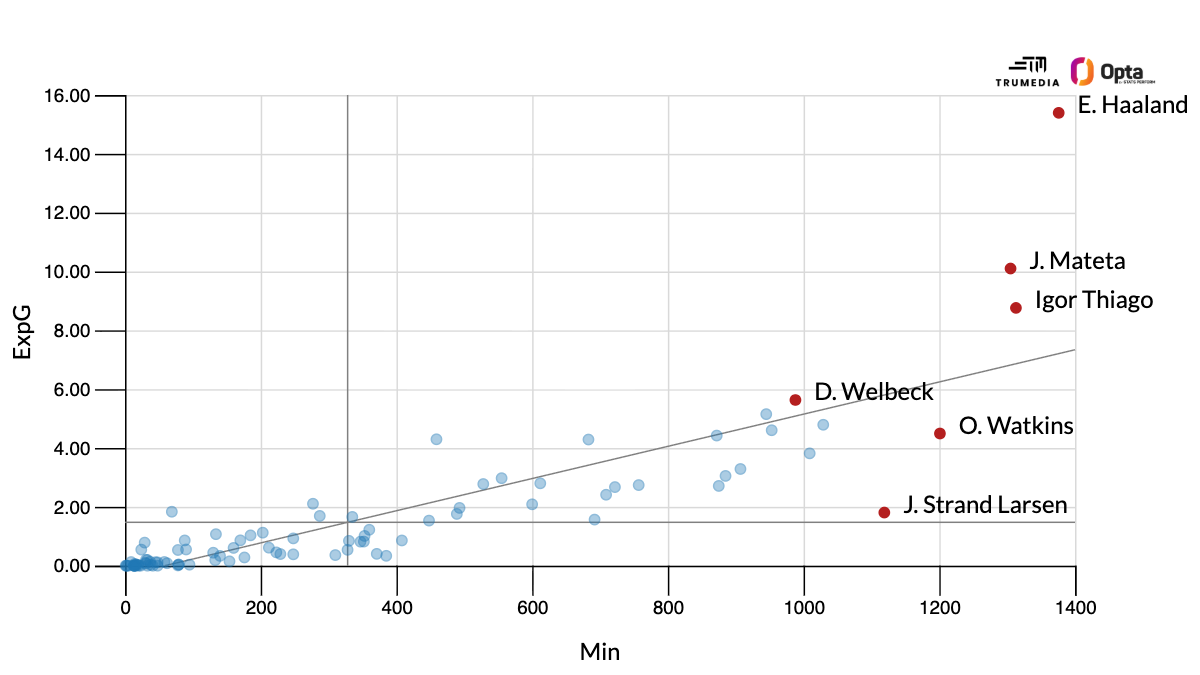
However, a significant challenge lies in Villa’s lack of depth compared to title contenders Arsenal and Manchester City. There’s a noticeable drop-off in quality when comparing substitutes for key players like Rogers and the next attacking options, as well as Konsa and Torres in central defense, and Cash at right back.
This contrasts sharply with Arsenal, who boast two high-caliber players for each position and have demonstrated resilience in coping without vital players like forward Bukayo Saka and midfielder Martin Ødegaard. Similarly, Manchester City employs a fully rotated squad filled with players worth over £40 million across the board.
Realistically, maintaining such performance throughout the entire season will prove difficult for Villa—especially with the added complexity of a Europa League campaign.
Emery’s team has demonstrated remarkable resilience to rise to their current position, yet they fall short of being a dominant force—evident in their scoring, underlying metrics, and average possession data. Furthermore, they lack the depth required to consistently reach the 80-plus points threshold.
This shouldn’t be viewed as a negative. It’s vital for the club to have placed themselves at the forefront of the competition vying for Champions League qualification. They stand 11 points ahead of Newcastle and Tottenham Hotspur and could extend that lead to 10 points over Manchester United with a win this weekend. Should championship aspirations falter while securing a UCL spot, most Villa supporters would likely be satisfied.