



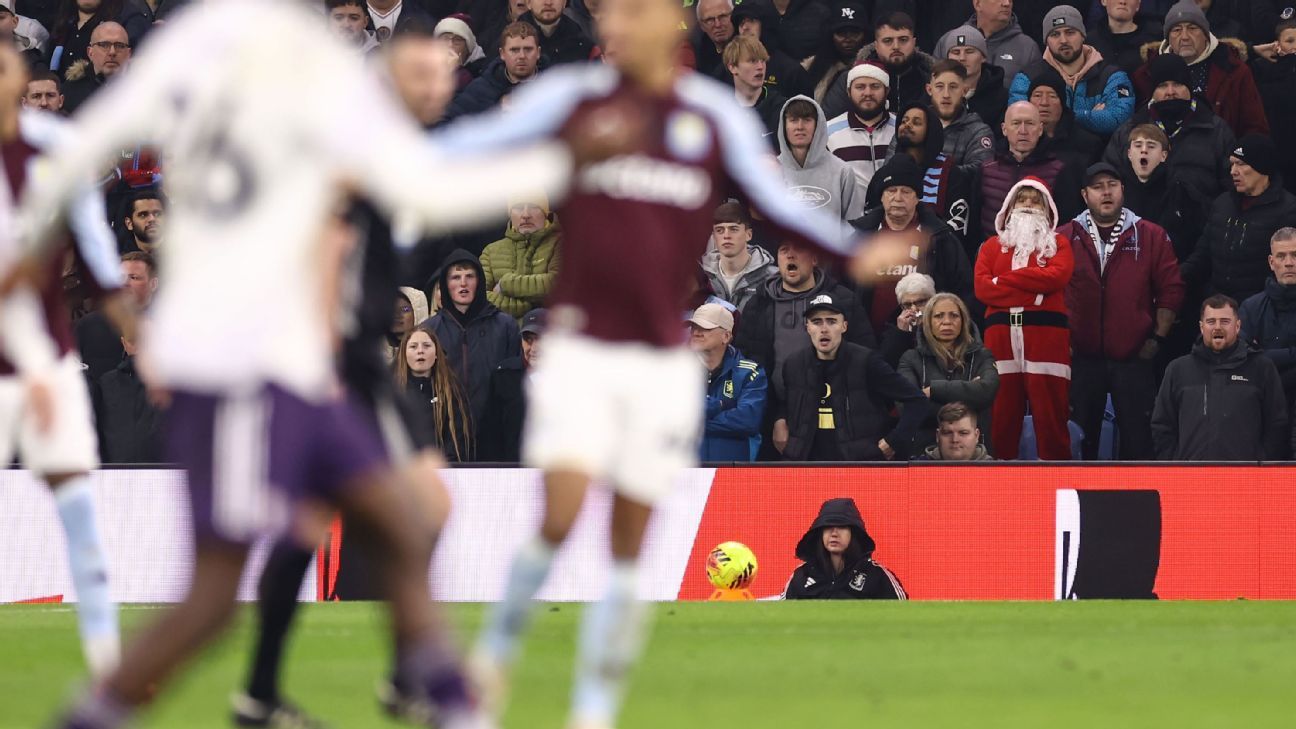
Boxing Day, or St. Stephen’s Day, traditionally heralds a busy schedule of soccer matches during the Christmas and New Year season. This longstanding custom dates back to the inaugural top-flight season in 1888. However, when Manchester United faces Newcastle at Old Trafford on December 26, it will mark the only Premier League match adhering to the Boxing Day tradition in England.
Coaches have often voiced concerns about the demanding fixture load and insufficient recovery time for players during this post-Christmas period. Frank Lampard remarked on the “counterproductive” nature of his Chelsea side having to play Arsenal and Aston Villa on December 26 and 28 in 2020.
The tradition has endured, largely because many teams see significant attendance on Boxing Day, as fans seize the holiday opportunity to escape family gatherings and support their clubs.
Yet, as the global football calendar becomes more packed with expanding European competitions and the newly introduced FIFA Club World Cup, first held in the U.S. last summer, the Premier League opted to spread Matchweek 18 over three days this season instead of cramming all matches into December 26.
Consequently, one of the most significant dates in the English football calendar will feature just a single Premier League game. How did it come to this?
– Arsenal crowned ‘Christmas champions,’ but it might mean little
– Transfer window preview: What do Europe’s elite clubs require?
– Chelsea utilizing Strasbourg as a development team: Is this the new Premier League strategy?
Has the Premier League ever seen such a limited schedule on Boxing Day?
While there has always been Premier League action on Boxing Day, it has never been limited to just one fixture.
Boxing Day has historically seen top-flight matches since Preston North End’s 5-0 victory over West Bromwich Albion in December 1888, though there were exceptions in the years 1948, 1954, 1965, 1971, and 1976 when no such games were played. This year, however, will witness the fewest top-flight matches since 1982, when December 26 fell on a Sunday and the tradition of postponing the games to the next weekday took effect. That practice has waned, leading to matches being carried out on a Sunday if Boxing Day falls on that date.
Has Boxing Day been notable for memorable matches?
Perhaps most famously, Boxing Day 1963 produced an astonishing 66 goals across 10 matches, including a historic 10-1 victory by Fulham over Leicester and Burnley’s 6-1 triumph against Manchester United.
In the Premier League era, notable moments include Thierry Henry’s hat trick that propelled Arsenal to a 6-1 win over Leicester in 2000, as well as Southampton’s 4-0 win against the Gunners in 2015. A thrilling 4-4 encounter between Chelsea and Aston Villa occurred in 2007, and in 1992, Manchester United salvaged a 3-3 draw at Sheffield Wednesday after trailing 3-0, thanks to Eric Cantona’s equalizer.
United holds the best Boxing Day record, claiming 22 wins in the Premier League and a total of 54 victories overall.
What is the Premier League’s stance on this year’s schedule?
The Premier League attributed this year’s decision to feature only one Boxing Day match to the global fixture calendar when announcing the holiday schedule in October.
“The Premier League acknowledges the circumstances that have led to a reduced number of Boxing Day matches this season, impacting an important tradition in English football,” the league stated.
“Various challenges related to fixture scheduling have emerged due to the expansion of European competitions, prompting a review of our domestic calendar last season, including changes to the FA Cup. This has resulted in fewer available weekends, ultimately constraining the League within the bounds of a 33-weekend competition, fewer than in previous seasons, despite it being a 380-match competition since 1995.”
Why is spreading the games over multiple days seen as a solution for congestion?
No clear rationale for this approach has been presented.
The Premier League’s explanation rests on the need to stagger matches to ensure players have adequate recovery time between games. The league mentioned, “As in previous years, specific arrangements are in place to provide more time between matches during the festive period,” allowing for extended recovery periods between rounds 18, 19, and 20, ensuring no team plays within 60 hours of another match.
However, had the Premier League adhered to tradition and scheduled all matches for December 26, every club would have had a minimum of three days to recover before Matchweek 19 commences on December 30.
This season, with December 26 falling on a Friday, the Premier League faced a dilemma. Scheduling all matches on Boxing Day would have created a weekend without fixtures on December 27 and 28, disappointing broadcasters and fans alike.
Consequently, selecting just one game—Man United vs. Newcastle—on Boxing Day provided a compromise to honor tradition while also maintaining viewer interest.
How have fans responded to this shift away from tradition?
While media criticism has surfaced regarding the reduced schedule, fan outrage has been minimal regarding the Boxing Day games.
In recent years, the fixtures have typically spanned over December 26 and 27, causing fans to become accustomed to a spread-out schedule.
When the Premier League announced the Christmas schedule on October 31, the Football Supporters’ Association expressed discontent over the late kickoff time for the United-Newcastle match but did not condemn the overall scheduling of matches over the following days.
Notably, there will still be ample soccer action in England on Boxing Day, with full EFL and National League fixtures available, allowing fans to find local matches to continue the Boxing Day legacy.
What does the future hold for the Premier League on Boxing Day?
Rest assured, the Premier League will return with a full schedule on Boxing Day in 2026.
“The League guarantees that next season will feature more matches on Boxing Day, as the date falls on a Saturday,” the Premier League confirmed.
If you’re eager for live football this year and can wait until 8 p.m. local time (3 p.m. ET) to watch United face Newcastle, consider attending any of the 36 EFL matches—such as Wrexham vs. Sheffield United or Championship leaders Coventry against Swansea—or the 12 games in the National League.
While the Premier League may have only one fixture to offer this Boxing Day, the football spirit continues across England.