



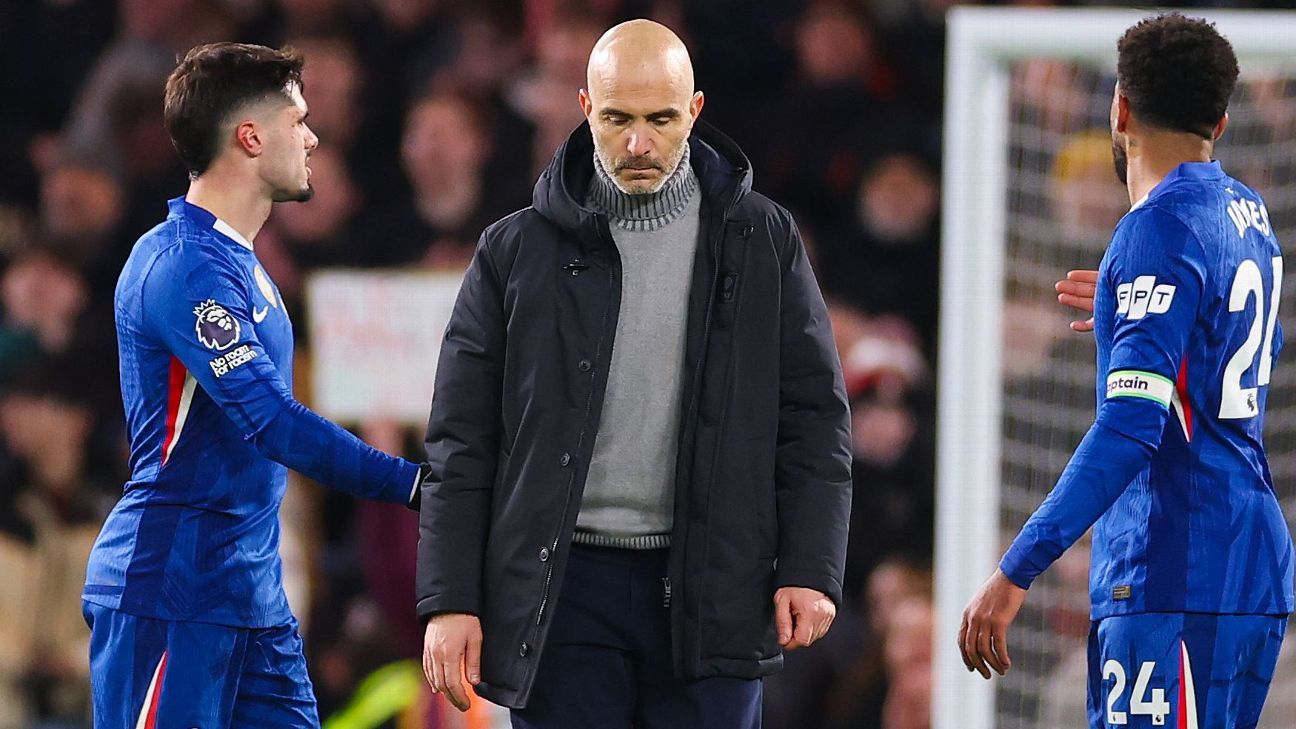
The coach of the current FIFA Club World Cup champions is no longer with the team. Enzo Maresca’s 18-month stint at Chelsea came to an end on New Year’s Day due to a sudden and dramatic deterioration in his relationship with senior club figures at the Premier League club.
Following the announcement, a wave of blame and accusations emerged, leading to a legal dispute over whether Maresca resigned or was dismissed. In a statement released on Thursday, Chelsea chose to use the vague term “parted company” while lawyers debate Maresca’s potential compensation.
Maresca was under contract until 2029, with an option for an additional year, aligning with Chelsea’s strategy of securing long-term commitments from both staff and players to foster stability. This approach included a planned review of Maresca’s performance at the conclusion of the 2025-26 season to protect him from short-term results pressures.
– Sources: Rosenior frontrunner to replace Maresca at Chelsea
– Ogden: Don’t expect Chelsea to hire an elite coach after Maresca split
– O’Hanlon: Ranking Premier League transfer needs for top clubs in January
D uring his time, Maresca won the Club World Cup and the UEFA Conference League, and secured Champions League qualification after a fourth-place finish in his only complete Premier League season, earning him the title of Premier League Manager of the Month in November.
However, the start of 2026 saw Chelsea seeking a new permanent head coach, marking the fifth appointment since the BlueCo ownership took over in May 2022, after a disappointing run of one win in seven matches. The team currently sits fifth in the Premier League, trailing leaders Arsenal by 15 points. So, what went wrong?
Maresca’s Structural Challenges at Chelsea
Reports from sources indicate that Chelsea’s organizational structure is modeled after that of Premier League champions Liverpool, emphasizing a collaborative approach where the head coach is one of many voices rather than the singular authority. This method is intended to ensure that the club’s identity remains intact despite managerial changes, contrasting with Manchester United’s turbulent transitions post-Sir Alex Ferguson.
Multiple sources within the club have indicated that Maresca understood this structure when he took over for Mauricio Pochettino in summer 2024, after leading Leicester City to a Championship title. Initially, it seemed suitable for Maresca, who was relatively inexperienced within this framework. The head coach typically receives feedback from a technical team after each game, with ownership involvement from figures like Behdad Eghbali.
Maresca brought six staff members from Leicester, but Chelsea insisted that he would not have full control over player selection, medical operations, or recruitment strategies. With the addition of Dave Fellows as of November 2025, Chelsea now has five sporting directors, led by Paul Winstanley and Laurence Stuart, alongside Joe Shields and Sam Jewell.
As time passed, sources mentioned that Maresca expressed increasing frustration with the limited influence he had beyond his personal staff. He felt entitled to a more significant role in decision-making, given his successes, including a Champions League qualification and winning the Conference League, followed by an unexpected triumph at the Club World Cup.
Nevertheless, Chelsea remained resolute about maintaining their established structure, and Maresca’s distractions became public. He aired his discontent over the club’s unwillingness to recruit a center back after Levi Colwill‘s knee injury. Then, in December, he signaled the end of his tenure by describing the lead-up to Chelsea’s 2-0 victory over Everton as the “worst 48 hours” of his time at Chelsea.
This statement surprised many of his staff, prompting Maresca’s agent, Jorge Mendes, to contact the club for clarification. Amid a lack of further explanation from Maresca in subsequent press conferences, speculation intensified, and just 19 days later, Chelsea announced his departure.
1:51
Laurens: Enzo Maresca played poker with Chelsea board and lost
Gab Marcotti and Julien Laurens discuss the split between Enzo Maresca and Chelsea FC.
Maresca vs. Chelsea’s Medical Department
Sources indicate that Maresca’s reference to the “worst 48 hours” involved ongoing tensions with the club’s medical department.
A crucial aspect of Chelsea’s model is that the medical department functions independently of the head coach, providing advice on player management and injuries that is expected to be followed to prioritize player health.
Conflicting accounts have emerged about how this played out. Some sources suggest that Maresca sometimes disregarded medical recommendations. While he would argue that he never jeopardized a player’s health, concerns were raised about his management of players recovering from injuries. He would receive instructions to limit playing time for certain individuals but reportedly deviated from those guidelines multiple times.
A source close to Maresca claimed he felt that the advice he received during feedback sessions felt overly prescriptive, infringing on his autonomy regarding team selection and substitution decisions. However, this contention was countered by club sources, who strongly refuted any notion that Maresca lacked control over team selections.
The “worst 48 hours” comment specifically pointed to this persistent conflict. Following a draw against Arsenal in November, when asked if Reece James would be able to replicate a stellar performance in the coming game, Maresca bluntly answered “No” during his media appearance.
He chose the week of a critical victory, his first in five matches, to make this statement, feeling a lack of internal support. This was not an isolated incident.
1:56
Why Enzo Maresca can’t complain about young talent project at Chelsea
Steve Nicol and Gab Marcotti discuss Enzo Maresca’s future possibilities following a challenging stretch at Chelsea.
Fan Engagement and Links to Man City
Maresca struggled to gain genuine support from the Chelsea fanbase, even during his moments of success. His name was rarely chanted, and during José Mourinho’s return with Benfica in late September, it was apparent that Mourinho received more affection from fans than Maresca had ever experienced.
While Maresca cited a “lack of support” amid those “worst 48 hours,” sources from Cobham informed ESPN that he indeed had backing from the club’s hierarchy during tough times this season. The management acknowledged the challenges of the demanding 65-game schedule across various competitions and highlighted their history of refraining from impulsive reactions to short-term results, using Pochettino’s end-of-season review as a recent example.
Internally, there was a belief that the club’s public support for Maresca could not be reiterated at every setback, as that could diminish its significance over time. However, concerns arose regarding his media interactions, with the club reacting critically to a profane outburst directed at critics after securing Champions League qualification in May. Additionally, his harsh criticism of FIFA after a match delay in the Club World Cup drew surprise.
Both internal and external sources suggested that some club members felt Maresca needed to manage his emotions more effectively and mature in aspects of his role, particularly in handling people and communication.
This communication issue was further complicated by suspicions of interest from Manchester City. Although City has denied any vacancy, sources reported that Chelsea believes Maresca may have explored opportunities with City in recent months. He is also rumored to have caught the eye of Juventus.
There are conflicting accounts regarding whether Maresca’s camp was pursuing these City connections—having switched agents from Wasserman to Mendes’ Gestifute—or if legitimate succession planning was taking place. Regardless, Maresca was receptive to these discussions, and Chelsea perceived this as disrespectful, especially since he expressed interest in extending his contract at Stamford Bridge if offered.
Maresca’s media presence also spurred additional tension. Reports emerged that he participated in an event organized by an Italian publication without the club’s consent. Furthermore, after failing to attend media duties following a disappointing result against Bournemouth, Maresca cited feeling “sick” as an excuse, although sources suggested he was reluctant to face the media due to the mounting pressure.
1:58
Can Liam Rosenior really step up to manage Chelsea?
Julien Laurens and Craig Burley discuss the plausibility of Liam Rosenior being the next Chelsea head coach.
Concerning Trends in Performance
This aspect of Maresca’s departure is crucial for understanding the situation. The timing of the Club World Cup meant that Maresca’s performance would not be assessed seriously until the end of his second season.
The club was committed to giving Maresca the time to develop, as evidenced by his long contract through 2029 with an extension option. Yet, the growing fan discontent threatened to undermine progress, particularly after a promising November where they secured a decisive win over Barcelona and drew against Arsenal despite being down to ten men.
Maresca faced criticism for his rotation strategies, which were partially driven by the club’s young recruitment policy that aimed to provide opportunities for growth and potential contract incentives. Nonetheless, Chelsea has dropped 20 points from winning positions this season, raising concerns about Maresca’s in-game management.
While there was no immediate expectation for him to challenge for the title this season, the blend of promise and poor performances—such as the unacceptable 3-1 loss at Leeds United—paved the way for his exit. Still, he leaves Chelsea as a world champion and could still find himself in contention for Guardiola’s position should he depart City. Ultimately, both parties reached a point where their ambitions diverged.