



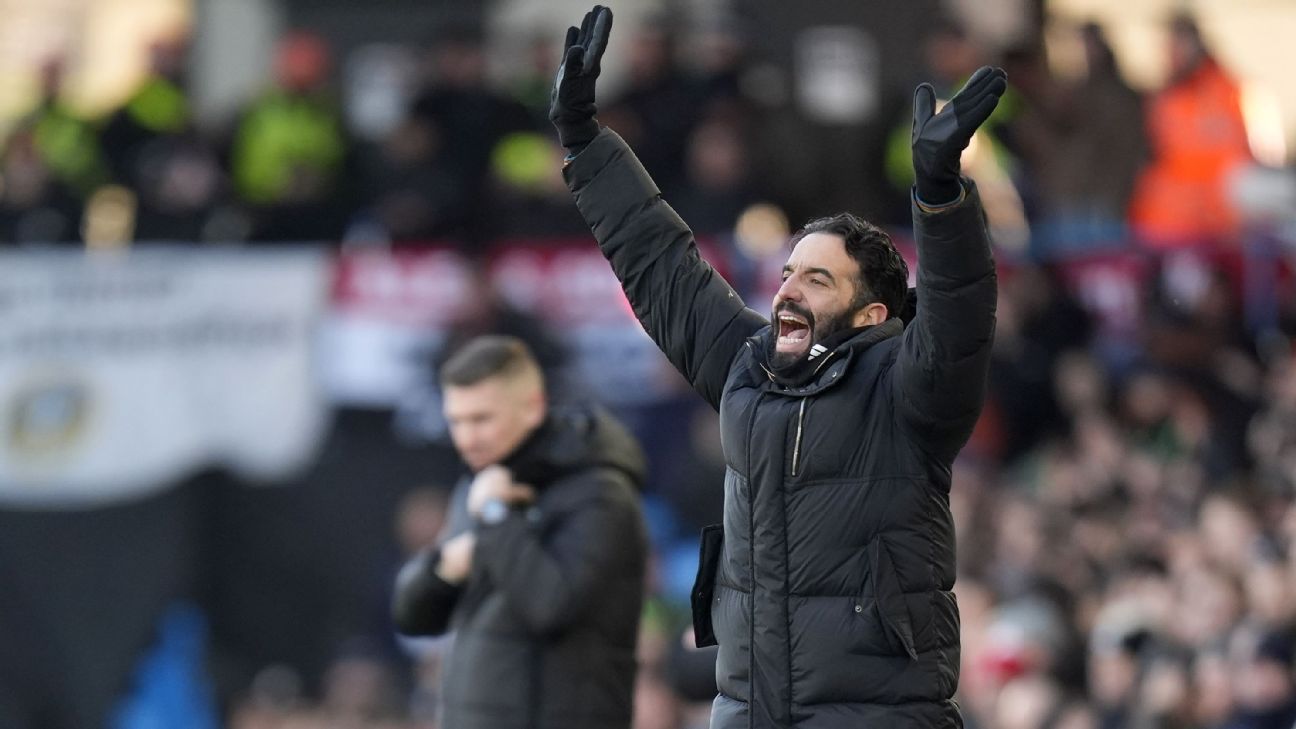
LEEDS, England — Ruben Amorim of Manchester United has thoroughly examined the strategies of Enzo Maresca and has boldly issued a challenge to the club’s leadership.
Whether intentional or not, Amorim’s approach may lead him down the same path as the former Chelsea manager, whose tenure ended on New Year’s Day following several public confrontations with the club’s management.
Maresca, who successfully led Chelsea to qualify for the UEFA Champions League and won the UEFA Conference League last season before securing the Club World Cup in July, refrained from naming specific individuals in his December 14 statement. He expressed frustration, saying it was “the worst 48 hours since I joined the club” due to a lack of support from those around him.
While Maresca’s challenges regarding Chelsea’s complicated structure of multiple owners and sporting directors were evident, he was careful not to explicitly place blame on anyone.
In contrast, Amorim’s post-match press conference following the 1-1 draw against Leeds United was fiery. He urged both the scouting team and sporting director Jason Wilcox to “do their jobs,” while asserting his desire to be recognized as the “manager, not just the coach.”
Although Amorim officially joined United as “head coach” from Sporting CP in November 2024, his insistence on being called “manager” signifies a power struggle. By targeting those in charge of player recruitment, Amorim has ignited a fierce internal conflict.
There is no ambiguity in his statements, and Amorim is alert to the implications.
The 40-year-old is urging United’s leadership, including Wilcox, CEO Omar Berrada, and minority owner Sir Jim Ratcliffe, to make new signings for his struggling squad this month to bolster their chances of securing a Champions League berth next season.
However, after losing out on Bournemouth’s Antoine Semenyo, who is set to join Manchester City for £65 million this week, Amorim stated on Friday that there would be no further attempts to sign players.
Though the funds were available for Semenyo, Amorim’s disappointment stems from the club’s unwillingness to pursue any other targets. After expressing his frustrations in a pre-match press briefing, he reinforced those sentiments in the press area at Elland Road.
This matter clearly weighs heavily on him, and his choice of words reflects his mounting dissatisfaction at Old Trafford.
“I noticed that you [the media] receive selective information about everything,” he remarked when asked to clarify his earlier comments.
By alleging that United reporters receive “selective information,” Amorim seems to suggest that there is a deliberate effort to undermine his communications with the media—an unhealthy dynamic for any head coach.
When he referred to himself as the “manager, not the coach,” while naming peers like Thomas Tuchel, Antonio Conte, and Jose Mourinho, Amorim is advocating for the level of authority that his current title does not grant him.
This scenario mirrors Maresca’s experience at Chelsea, where he faced challenges with the medical team’s opinions and recruitment efforts, feeling unable to bring in the players he deemed necessary for improvement.
Amorim finds himself in a similar predicament now.
After finishing 16th last season, Amorim has surpassed expectations this term by getting United back in the hunt for a Champions League spot. With a European qualification within reach, he is pushing for the addition of a midfielder and wing-back to enhance the squad as they navigate a busy schedule in the new year.
Amorim is advocating for the club to spend to improve, yet the hierarchy is hesitant due to financial constraints and the potential for better deals in the summer.
This could mean two things: first, United might prefer to wait until the end of the season to avoid navigating a market with limited options. Second, it might indicate that Wilcox, Berrada, and Ratcliffe are losing confidence in Amorim and are wary of signing players who may not fit a future manager’s vision.
If Amorim suspects a “selective” information campaign, he may also interpret the latter scenario, prompting him to publicly express his discontent in what feels like a “back me or sack me” ultimatum.
Maresca attempted a similar strategy but ended up failing dramatically.
Now Amorim might be facing a parallel outcome, particularly as he has voiced his concerns publicly and results have begun to falter; the draw against Leeds marks just one victory in their last five league matches.
For any manager, grappling with poor results along with tensions with the club’s hierarchy creates a perilous situation. Amorim has exposed himself to considerable risk at United by speaking out so openly.