



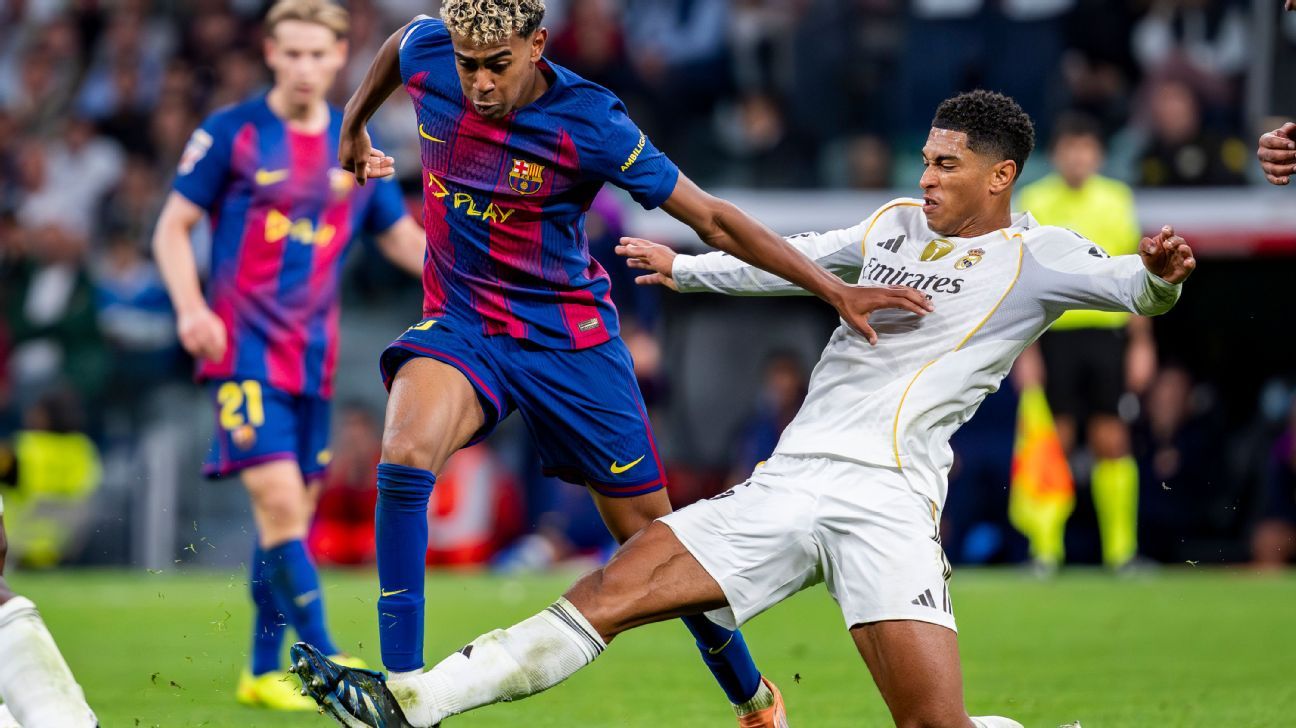
On Sunday, Barcelona and Real Madrid will clash for the second Clásico of the season in the Spanish Supercopa final, to be held in Saudi Arabia, with the first domestic trophy of the season on the line. (Catch it LIVE on ABC)
The reigning champions, Barcelona, advanced to the final with a convincing 5-0 victory over Athletic Club on Wednesday. Real Madrid followed suit with a tense 2-1 win against Atlético Madrid the next day.
This marks the fourth consecutive year these two teams have faced off at this stage. While it may not be as significant to either club as LaLiga or the Champions League, recent finals have often signaled a turning point for the second half of the season.
The last four winners, Madrid (2022 and 2024) and Barça (2023 and 2025), have utilized their Supercopa success as a springboard to later win LaLiga.
ESPN’s Sam Marsden and Alex Kirkland delve into the critical themes heading into the showdown at King Abdullah Sports City in Jeddah.
Is the Clásico momentum swinging back to Barça?
Barcelona dominated last season’s matchups, winning all four encounters while claiming a domestic treble under Hansi Flick. However, momentum shifted to Madrid in October when Xabi Alonso saw his team secure a 2-1 victory in his first Clásico, placing them five points atop LaLiga.
Since then, however, things have changed. While Madrid’s form has been inconsistent, Barca is currently enjoying a nine-game winning streak across competitions and holds a four-point lead in the league. Even though they aren’t performing at their peak according to Flick — who critiqued their recent 2-0 win against Espanyol — their emphatic win against Athletic showcases their attacking prowess when in sync.
This resurgence can largely be attributed to the return of key players. Raphinha, who scored twice against Athletic, has injected fresh energy into the attack; Pedri has regained control in midfield; and keeper Joan García has made critical saves in defense. With only long-term absentees Gavi and Andreas Christensen sidelined, Barça enters the final not only in rich form but also with a significantly healthier squad than in previous months. — Marsden
Alonso facing pressure: What do wins or losses mean for him?
At Madrid, coaches are evaluated based on trophies, and the Supercopa is the first up for grabs this season. “It’s the most important tournament we have right now,” Alonso stated on Wednesday before the semifinals. “Over time, it may not rank as high, but it is currently our top priority.”
Following a disappointing 2-0 loss to Celta Vigo on Dec. 7, Alonso felt his job was on the line. Since then, five consecutive victories have provided him some relief, but each win has come with varying levels of uncertainty.
Last year’s 5-2 defeat to Barcelona in the Supercopa final marked the beginning of the end for his predecessor, Carlo Ancelotti. While it wasn’t the sole defeat, it was particularly striking as Madrid conceded four goals in quick succession.
In a high-profile final that takes place before a global audience, such performances are intolerable for the club. Ancelotti’s eventual exit was inevitable, and a repeat performance could spell similar trouble for Alonso. While his dismissal may not be immediate, a significant turnaround in the latter half of the season will be essential for him to avoid a similar fate. — Kirkland
Kylian Mbappé returns to the Madrid squad. What impact will this have?
1:53
Will Kylian Mbappé play vs. Barcelona in the Supercopa final?
Gemma Soler and Craig Burley discuss reports on Kylian Mbappé’s potential return to the Real Madrid squad to face Barcelona in the Supercopa final.
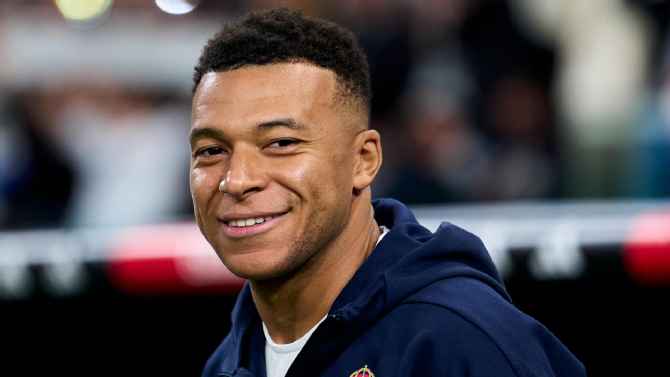
Coach Alonso casually revealed the news in his post-match press conference on Thursday. “Kylian travels tomorrow,” he stated, smiling. “All signs are positive, and if he’s in the squad, he could certainly play.” After suffering a sprain to his left knee that kept him out of Madrid’s first two games of 2026, it’s uncertain how fit he is; however, if Alonso’s comments are to be believed, he will be available on Sunday.
This news is undoubtedly a boost for Real Madrid.
As their top player, Mbappé’s 29 goals this season highlight his importance. While 21-year-old Gonzalo García made an impressive impact with a hat trick against Betis last weekend, he struggled against Atlético, failing to register a shot. Mbappé’s presence will add a new threat to Madrid’s offense, and his track record against Barcelona is encouraging.
In just five Clásicos, Mbappé has netted six goals, including one in last year’s Supercopa final that initially gave Madrid an advantage.
While Mbappé alone hasn’t turned Madrid into an elite team this season, he has contributed to 44% of the side’s goals in LaLiga. His anticipated return is a positive sign for Alonso. — Kirkland
Flick faces a delightful dilemma in attack
This season, Flick’s lineup often seemed predetermined due to injuries, but that is starting to change.
The German manager now enjoys the luxury of selecting from a variety of attackers who have stepped up in recent matches, allowing for impactful substitutes off the bench.
Players like Fermín López, Dani Olmo, and Robert Lewandowski had significant impacts in the match against Espanyol last week, where the starting players were not even needed given the 4-0 halftime lead against Athletic Club.
Yamal missed the semifinal due to a stomach issue but is expected to return for the match against Madrid. The Spain winger leads the team with 19 goal contributions so far this season. He is among six players who have surpassed ten goal contributions, including Rashford, Ferran Torres, Fermín, Raphinha, and Lewandowski.
So, who is likely to start for Flick in the Clásico? Raphinha and Yamal are expected to take the wide positions, with Ferran and Lewandowski contending for the central role, potentially accompanied by either Fermín or Olmo in a supporting role. Raphinha has also excelled in the No. 10 role at times, providing an option for Rashford on the left.
Flick’s array of choices will keep Alonso on his toes up to kickoff. — Marsden
Can Madrid’s makeshift defense hold up?
In the final 20 minutes against Atlético, Madrid’s defensive lineup featured: Federico Valverde, Aurélien Tchouaméni, Álvaro Carreras, and Ferland Mendy. Essentially, this consisted of a pair of midfielders and two players not traditionally in their positions. Miraculously, they secured the win, but it hardly instills confidence ahead of a Clásico against a formidable attack featuring Raphinha and Yamal.
Antonio Rüdiger, who lobbied to play on Thursday despite an injury, is likely to miss the final. Dean Huijsen was not deemed fit enough to feature at all against Atlético. Éder Militão is out for the long haul. Raúl Asencio should be available, but the identity of his center-back partner remains uncertain. It could potentially be Carreras, who has been solid in the position previously, or Tchouameni, whose inclusion would leave a gap in the midfield.
Regardless, the player to watch for Madrid will be goalkeeper Thibaut Courtois, known for his ability to perform under pressure in finals. — Kirkland
Has Barça fixed their defensive vulnerabilities?
While statistics indicate a slight improvement in their defense, it’s premature to conclude that there has been a significant change. Barcelona has let in 20 goals over 19 LaLiga fixtures, which is more than any other top five team, alongside conceding 11 in six Champions League matches due to a recurring vulnerability to swift counterattacks behind their high defensive line.
Nevertheless, they are currently enjoying a run of five consecutive clean sheets across all competitions for the first time since 2020. Their last streak of this length occurred back in 2016, when they went eight matches without conceding. Stability in their backline may be a contributing factor. Flick has generally preferred a defense of Jules Koundé, Pau Cubarsí, Gerard Martín, and Alejandro Balde in recent weeks, although Eric García stepped in for Martín against Athletic and is likely to remain against Madrid.
Most significantly, though, is the return of goalkeeper García from injury. During the span of these five games (four featuring García and one featuring Marc-André ter Stegen), Barça recorded an expected goals against (xG) of 5.57, primarily registered in their last three outings against Villarreal (1.69), Espanyol (1.6), and Athletic (1.75). García’s notable performance — including an outstanding save from Pere Milla against Espanyol — has been season-defining.
“I must thank Joan for that performance,” Flick remarked with a sigh of relief after Barcelona came away with a late victory. — Marsden
What do the predictions say?
Kirkland: The win for Madrid in October could have signified a positive shift; however, it now feels merely like a temporary glimmer of hope. Unless Madrid exhibits a vast improvement from their previous performance, they are likely to face a substantial defeat. Barcelona 3-1 Madrid.
Marsden: In situations where Clásicos begin with a perceived one-sided advantage, it’s common for outcomes to defy expectations; however, I find it challenging to dispute this particular scenario. This fixture has recently produced a flurry of goals, and I’m optimistic for a continuation of that trend. Barcelona 4-3 Madrid.