



-

Emily Keogh
Arsenal faces a critical series of matches this month, with eight “must-win” games across four competitions that could determine the outcome of their season.
As their chances in the Women’s Super League title race dwindle following a slow start, the added burden of an expanded fixture schedule arrives at the worst possible time. The reward for capturing the UEFA Women’s Champions League (UWCL) title last summer was a spot in the inaugural FIFA Women’s Champions Cup, which brings with it two additional fixtures in late January and early February.
Due to Arsenal’s challenging start to their UWCL title defense, they find themselves in the playoffs, adding two more matches against Belgian side OH Leuven as they aim for a place in the knockout stages.
This means Arsenal must navigate four intense weeks with four more games than title challengers Chelsea and WSL leaders Manchester City, and two additional matches beyond those faced by Manchester United, who are also contending in the UWCL playoffs.
Each of these upcoming matches bears significant implications, either as crucial knockout rounds or victories needed to keep Arsenal’s WSL title ambitions alive, with the team currently trailing City by 10 points.
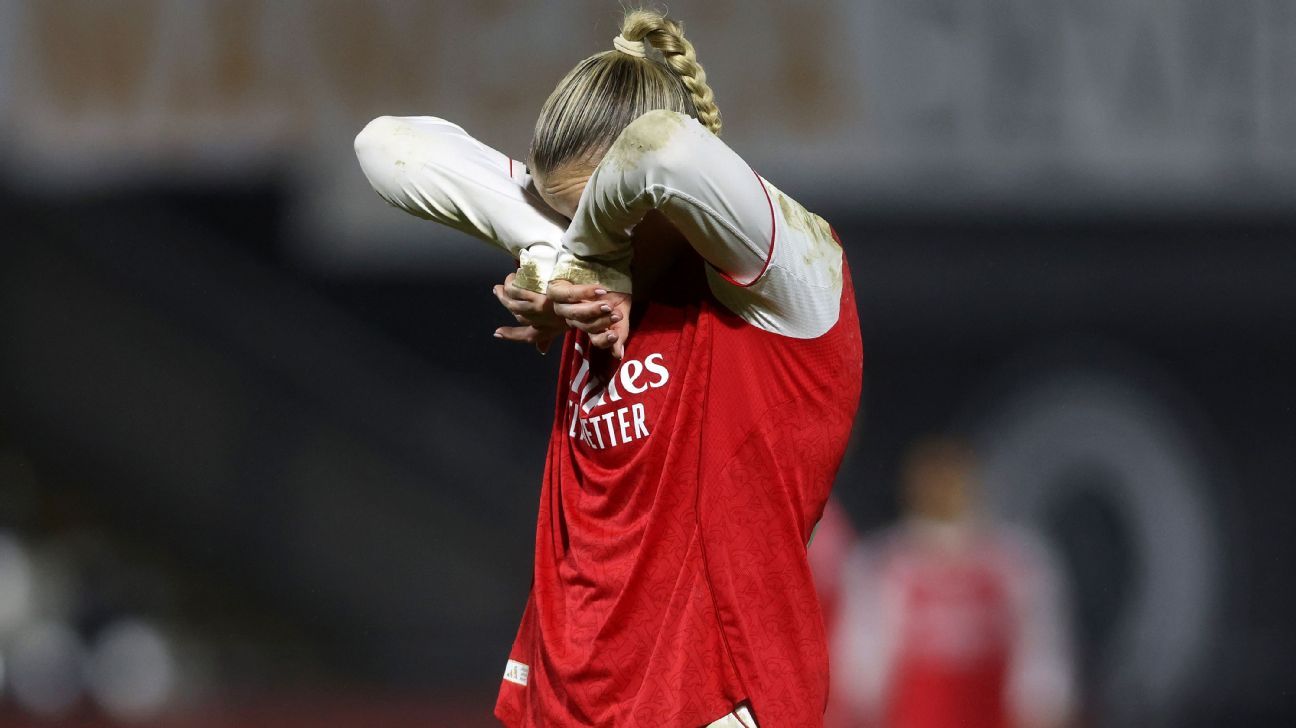
Arsenal’s journey through five competitions from January 18 to February 18 is now at risk after their recent 1-0 loss to Manchester United in the League Cup semifinals, marking a loss of their first chance at hardware this season following a frustrating performance. Next up are Chelsea and Manchester City in the WSL, along with two Champions Cup fixtures and forthcoming FA Cup matches, adding even more strain.
– Keogh: Key takeaways from League Cup semifinals as United and Chelsea advance
– Keogh: Arsenal must support Slegers following contract extension
– January transfer window: Analyzing major signings in women’s soccer
Striving to Stay Afloat in the Women’s Super League Title Race
A defeat against Chelsea on Saturday would further distance Arsenal from the title and jeopardize their chances for next season’s Champions League, where a top-three finish is needed for qualification.
The Gunners currently sit third with 23 points, equal with Tottenham, trailing Chelsea by four points. More pressingly, they are 10 points behind leaders City, who have yet to drop any points since the season’s opening match.
This makes the upcoming match against Chelsea a “must-win” scenario — an all too familiar phrase for Arsenal fans in recent years. The team has struggled with consistency, failing to address the ongoing issues that hinder their pursuit of a true title challenge. Even last season’s second-place finish came with a considerable gap, as they finished 12 points behind champions Chelsea.
The Gunners are already at a disadvantage after key player Olivia Smith received a second yellow card in the League Cup semifinal, leading to a one-match suspension for the Chelsea match. The previous WSL encounter with Chelsea last November was marred by controversial officiating decisions, leading to a 1-1 draw that many felt undersold Arsenal’s efforts after two disallowed goals.
Despite having taken just three points from their top-four rivals this season, the pressure is mounting. Arsenal not only needs the points for standing but must also restore faith in a skeptical fan base regarding their ability to compete at the highest level.
If they manage to beat Chelsea, another crucial test looms against Manchester City on February 8. A loss there could effectively seal the title fate, leaving Arsenal’s status as one of the elite in women’s football in precarious condition.
Facing Global Competition in the Champions Cup
Arsenal’s Champions Cup journey kicks off on January 28 against AS FAR, the champions of Morocco and victors of the CAF Champions League. AS FAR has dominated their domestic league since 2016, and a win would set up a final against either NWSL side Gotham FC or Brazilian club Corinthians in the final on February 1 — coinciding with a WSL clash between Chelsea and Manchester City.
This Champions Cup was organized after FIFA announced the postponement of the Women’s Club World Cup until 2028, a move that drew mixed reactions from the football community.
Initially planned to be held on the west coast of the U.S. despite conflicting with the English domestic calendar, Arsenal successfully lobbied for a relocation to London, with semifinals at Brentford’s Gtech Community Stadium and the final at the Emirates Stadium.
While Arsenal enjoys a significant edge in resources over AS FAR and Corinthians, Gotham FC presents a closer comparison in terms of development. However, the American team has been inactive since their season ended in November, which might leave them short on match fitness despite recent European tours for preparation.
All three competitors are within reach for Arsenal, yet each presents their unique challenges.
While the Champions Cup adds more games to an already ravaged schedule and raises concerns over player fatigue, the chance to claim silverware makes it a vital opportunity. After a disappointing start to the season, avoiding another trophy-less campaign is crucial, as success could shore up morale within the team.
With supporters losing enthusiasm amidst lackluster results, and several first-team players already made aware they won’t receive new contracts next season — a situation that may affect squad dynamics — achieving a mid-season victory could unify both the team and the fan base.
The question remains whether the potential benefits outweigh the risks involved in jeopardizing their ongoing campaign.
Charting Through the Champions League Playoffs
Arsenal aimed to secure a top-four finish in the UWCL to evade the playoff round and lessen their busy schedule. Alas, they only have themselves to blame, having complicated matters with losses against Bayern Munich and OL Lyonnes, which resulted in an arduous path ahead.
Two playoff matches against OH Leuven resulted from Arsenal’s shaky start, characterized by inconsistency and resilience issues.
As debutants in the UWCL, Leuven has never before reached qualifying rounds and are the lowest-ranked team in the competition. Arsenal secured a smooth 3-0 victory during the league phase, but the extra travel, preparation, and mental burden of two more matches pose greater challenges. While they are expected to advance barring an upset, the familiar challenge of Chelsea looms in the quarterfinals.
By the time these quarterfinals roll around — scheduled for March 24-25 and April 1-2 — Arsenal could find themselves without a WSL title and only the FA Cup (with a match against Bristol City on February 22 and quarterfinals on April 5) left to pursue. If they fail to defend their European title as well, defining this season as successful may prove difficult, even with potential victories in the Champions Cup or FA Cup.
A Season on the Edge
Last season, fan morale took a hit when Arsenal exited both the League Cup and FA Cup quickly, resulting in a title race collapse by spring, with their only consolation being a successful UWCL run.
However, with critical matches approaching once again — following the League Cup exit and the disappointing outcomes of the past — supporter confidence and player mentality will face significant trials well before the season wraps up.
Arsenal has recognized a lack of resilience within the squad, contributing to their recent setbacks — a factor influencing the desire for Slegers’ contract extension. Even with the pressure mounting, evidence of the necessary perseverance to thrive in multiple competitions at a high level, as Chelsea has done, remains to be seen.
This next month will be pivotal for Arsenal, with implications that extend beyond mere trophies.