



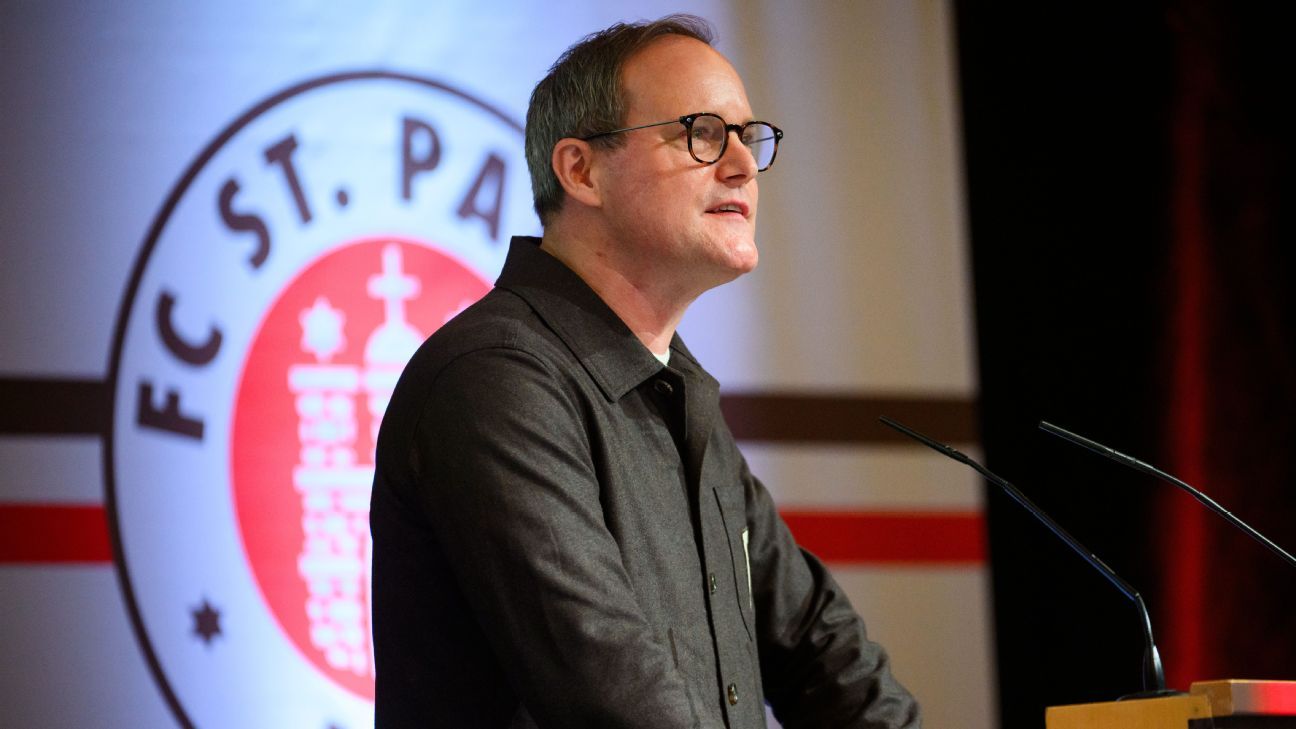
A member of the executive committee of the German soccer federation has indicated it may be time to contemplate a boycott of the World Cup due to actions taken by U.S. President Donald Trump.
Oke Göttlich, who is the president of Bundesliga team St. Pauli and serves as one of the vice presidents of the German federation, stated in an interview with the Hamburger Morgenpost on Friday that “the moment has arrived” to “seriously discuss and consider this possibility.”
Trump has created friction with Europe through his attempt to acquire Greenland—a semi-autonomous territory of NATO ally Denmark—and his subsequent threats to levy tariffs on eight European countries opposing the move. This has fueled concerns among long-time American allies about a potential schism with Washington that could jeopardize the NATO alliance.
“What were the reasons behind the boycotts of the Olympic Games in the 1980s?” asked Göttlich. “In my view, the current potential threat is greater than it was back then. We must engage in this conversation.”
The United States is set to co-host the World Cup alongside Canada and Mexico from June 11 to July 19. Fans are concerned about expensive ticket prices, and travel bans instituted by the Trump administration are preventing supporters from certain competing nations from attending.
Göttlich, who advocates for defending values, may encounter pushback from federation president Bernd Neuendorf and FIFA president Gianni Infantino regarding calls for a boycott.
Earlier this week, France’s sports minister, Marina Ferrari, stated that while her country is currently not considering a boycott over the Greenland situation, it has not been ruled out for the future.
“At this time, there is no intention from the ministry to boycott this significant, eagerly awaited event,” she commented to reporters on Tuesday. “However, I cannot predict what may happen down the line.”
The German federation had previously expressed opposition to Qatar hosting the 2022 World Cup.
Germany faced setbacks in that tournament, and the subsequent coach, Julian Nagelsmann, emphasized his preference for avoiding political distractions moving forward.
“The political context of Qatar was overwhelming for everyone, and now we’re expected to be completely apolitical? That truly concerns me,” Göttlich remarked.
“As organizations and as a society, we’re losing touch with how to establish taboos and boundaries and how to uphold values,” he added. “Establishing taboos is vital to our position. Is a taboo violated when someone threatens? Is it crossed when someone is attacked? When lives are lost?”
“I would like to know from Donald Trump when he considers a taboo crossed, and I would like to hear the thoughts of Bernd Neuendorf and Gianni Infantino on this matter.”
St. Pauli, based in Hamburg, is known for integrating sports with politics, especially given its left-wing stance. The club’s iconic pirate skull-and-crossbones symbol was initially adopted by nearby squatters and later embraced by fans identifying as punks.
Göttlich dismissed concerns that a boycott could adversely affect St. Pauli’s national team players, including Australia’s Jackson Irvine and Connor Metcalfe, and Japan’s Joel Chima Fujita.
“The career of a professional player holds no greater value than the lives of countless individuals in regions that are being directly or indirectly threatened or attacked by the World Cup host,” he asserted.
The Associated Press contributed to this report.