



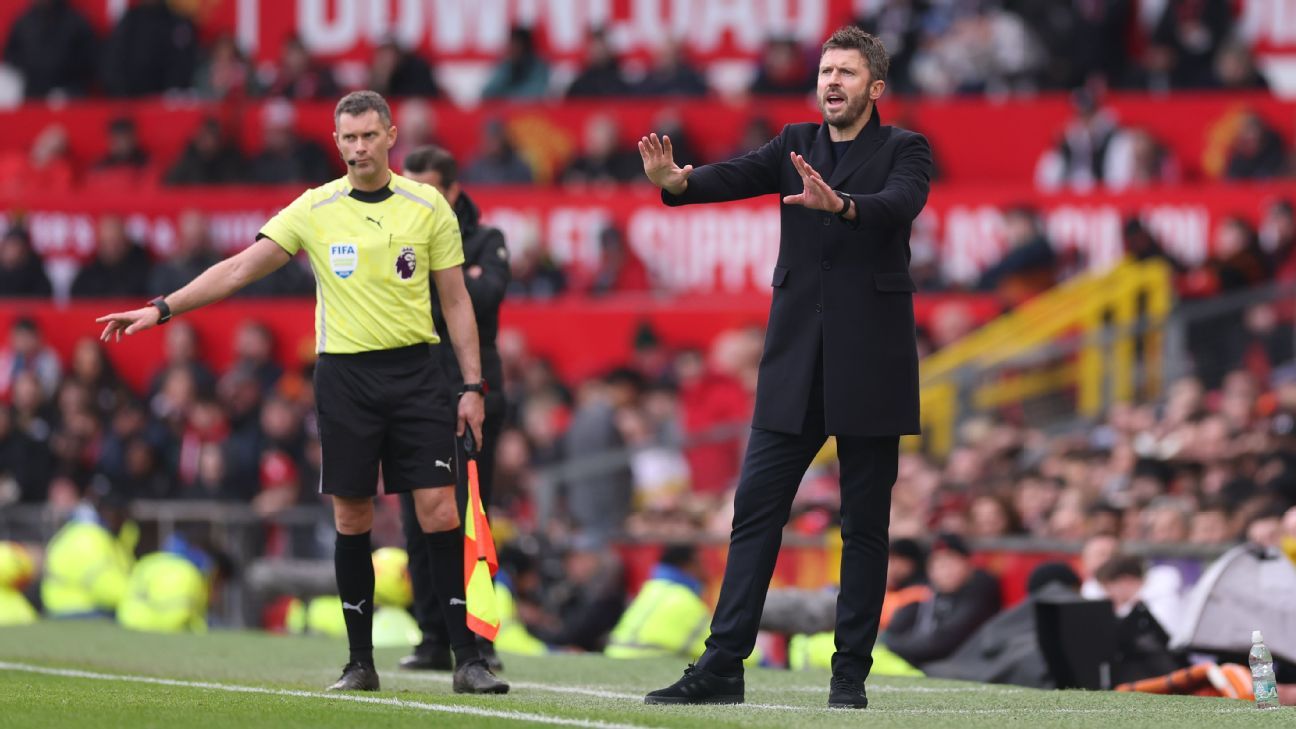
MANCHESTER, England — Michael Carrick has reintroduced a sense of simplicity to Manchester United, yet he will always face the challenge of managing the chaos. After witnessing Benjamin Sesko score a dramatic stoppage-time goal to secure a 3-2 victory over Fulham, it was a blend of simplicity and chaos.
United appeared to be on track for a comfortable win at Old Trafford, leading 2-0 with goals from Casemiro and Matheus Cunha. However, a penalty by Raúl Jiménez in the 85th minute, followed by Kevin’s remarkable equalizer in stoppage time, threatened to undermine Carrick’s promising start.
Yet, in the 94th minute, Sesko’s winning strike—a precise turn and shot from a Bruno Fernandes cross—turned the tide and clinched the victory for United.
This was a classic “Fergie Time” moment, celebrated in front of Sir Alex Ferguson, exemplifying United’s determination to pursue a win rather than settle for a point. Despite the chaos, it was Carrick’s calm and strategic approach that set the foundation for this triumph.
In Carrick’s first three matches as head coach—expected to last until the season’s conclusion—United has achieved three successive victories over Manchester City, Arsenal, and Fulham, putting them back in contention for UEFA Champions League qualification.
There’s been talk of Carrick revitalizing United’s “DNA” and honoring its tradition of attacking football, but what stands out in his brief stint is his ability to eliminate the confusion and complexity left by Amorim, streamlining the team’s play.
When Sesko scored the decisive goal after earlier hitting the post, it highlighted Carrick’s practicality in making like-for-like substitutions—something Amorim rarely executed.
A similar scenario unfolded in last week’s 3-2 victory at Arsenal, where Cunha netted the winner after being subbed in for Bryan Mbeumo.
Carrick has been consistent in his squad selections; in his third match, he made his first substitution due to an injury, bringing Cunha on for Patrick Dorgu. Instead of overhauling the tactics, he simply adjusted Sloan’s position to fill the void left by Dorgu, who is out for approximately 10 weeks.
Carrick has maintained the same back four—unlike Amorim, who favored a back three in almost all of his 63 games—and consistently utilized the midfield duo of Casemiro and Kobbie Mainoo.
Mainoo has emerged as a standout performer under Carrick, despite Amorim opting against starting the talented 20-year-old England international in the Premier League until now. By deploying Mainoo in a defensive midfield role, Carrick has freed Fernandes to operate in his preferred No. 10 position further up the field.
Amorim’s tactics often neglected to showcase Fernandes’ strengths, leading to inconsistencies and ultimately, his defeat as head coach.
In attack, Carrick has benefited from having Mbeumo and Amad available post-AFCON, significantly impacting the team. Their success is also a testament to Carrick’s approach to positioning players to maximize their effectiveness.
For a long time, United stuck with Amorim despite his unpredictable strategy, frequent tactical shifts, and tendency to swap out defenders during tense moments. This method led to player uncertainty and disappointing results.
In contrast, Carrick’s approach cultivates freedom and confidence among the players, yielding results that were elusive under Amorim. He takes calculated risks by opting for like-for-like substitutions, illustrating his intention to win and his trust in the players’ ability to execute both attacking and defensive responsibilities—trust that was missing under Amorim.
It remains uncertain if Amorim is contemplating his missed opportunities back in Portugal, but he likely avoids watching United, which serves as a reminder of what might have been.
Carrick is focused on seizing the moment, pursuing victory through simplicity and calculated risks, which is why United is thriving at present.