



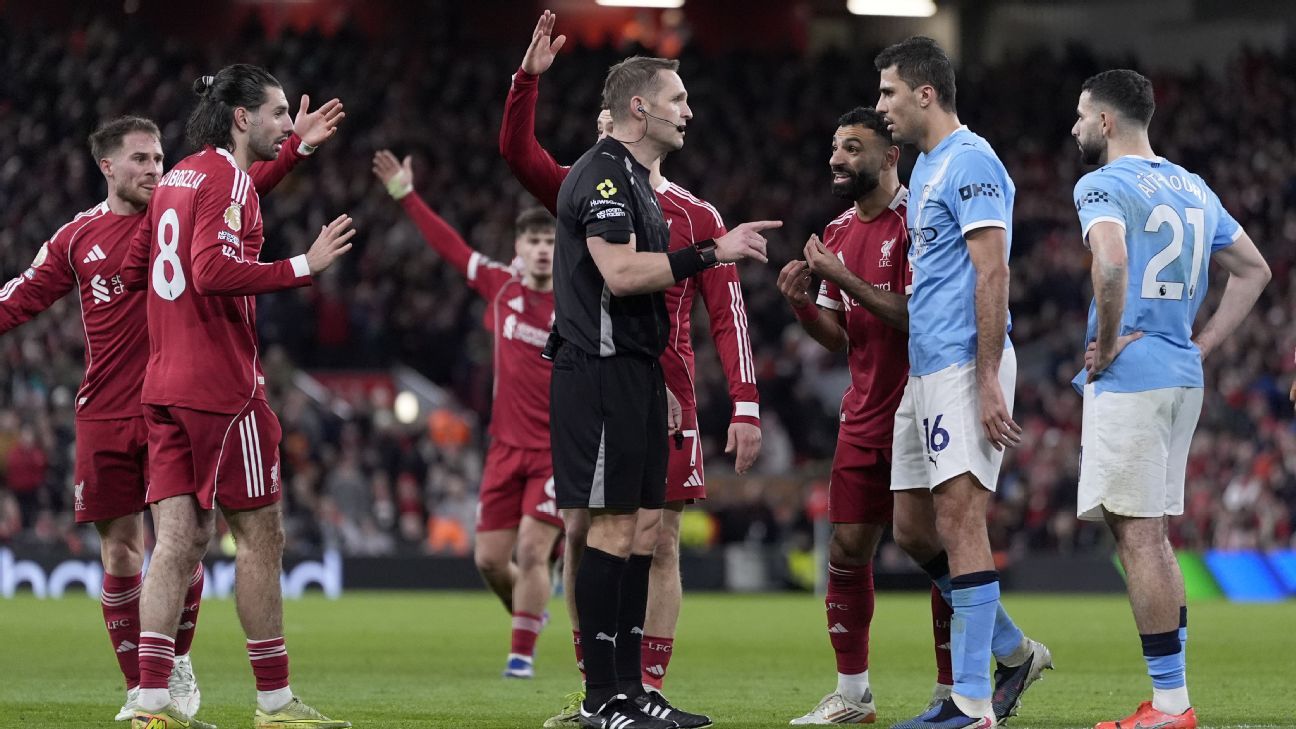
The video assistant referee (VAR) evokes debate in the Premier League each week. But how are decisions reached, and are they made correctly?
This season, we will analyze significant incidents to clarify the decision-making process, focusing on VAR protocols and the Laws of the Game.
Image credit: NBC
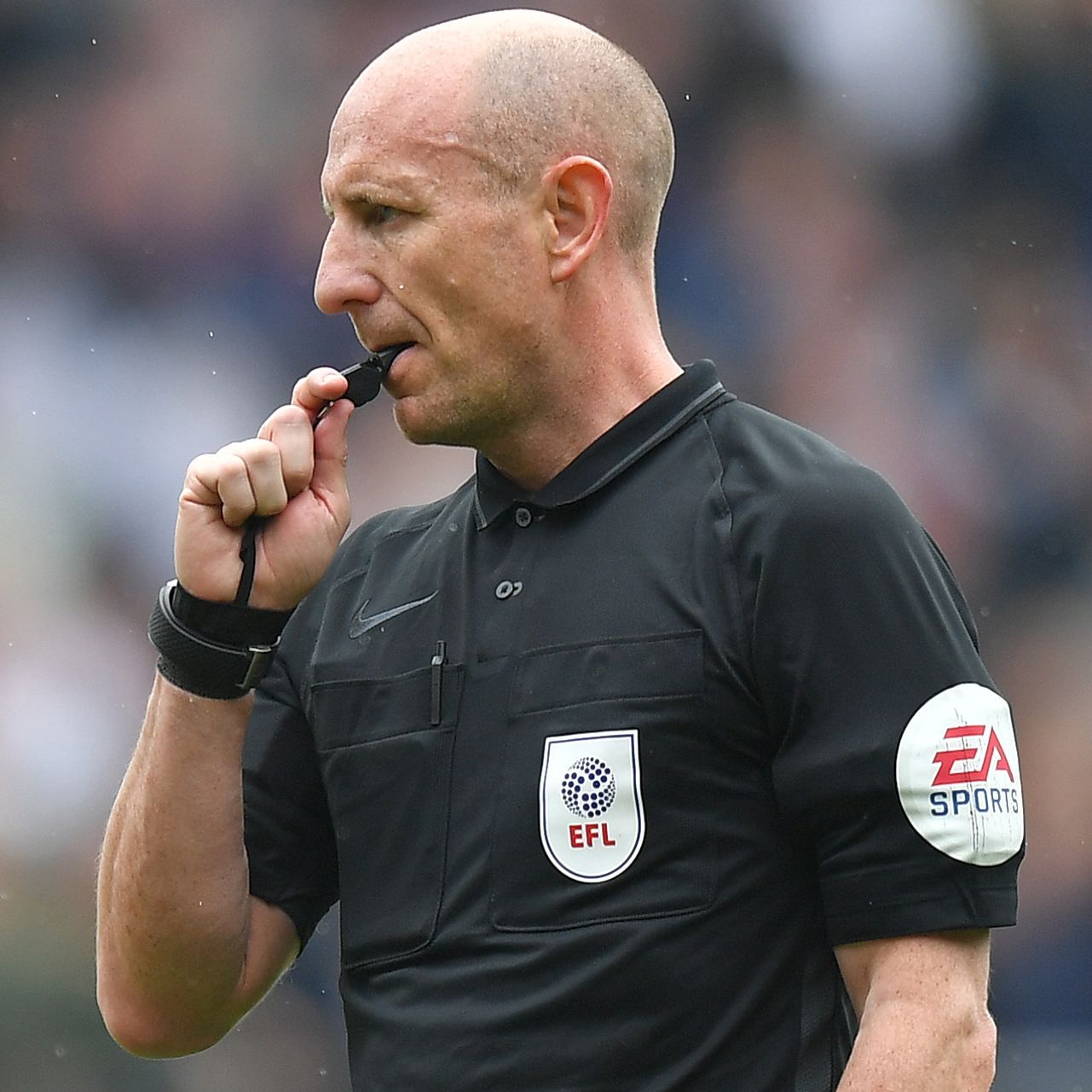 Andy Davies (@andydaviesref), a former Select Group referee with over 12 seasons of experience in the Premier League and Championship, offers his insights on VAR processes and protocols, drawing from his extensive experience at the elite level.

Referee: Craig Pawson
VAR: John Brooks
In a thrilling match, Liverpool initially took the lead, but Manchester City managed a comeback, winning 2-1 and altering the dynamics of the Premier League title race. This outcome proved detrimental to Liverpool’s hopes of Champions League qualification.
The match featured high stakes, with several crucial decisions influencing its outcome. We will examine three key incidents that required major decisions from the referee and VAR.
Time: 68th minute
Incident: Possible red card for Manchester City’s Marc Guéhi for DOGSO (denial of a goalscoring opportunity)
What happened: Mohamed Salah was passed the ball by teammate Dominik Szoboszlai, breaking through the Man City defense. Guéhi then pulled Salah down as he moved toward the goal. Referee Pawson issued a yellow card and awarded a free kick to Liverpool, prompting protests for a red card, which were dismissed by VAR as well.
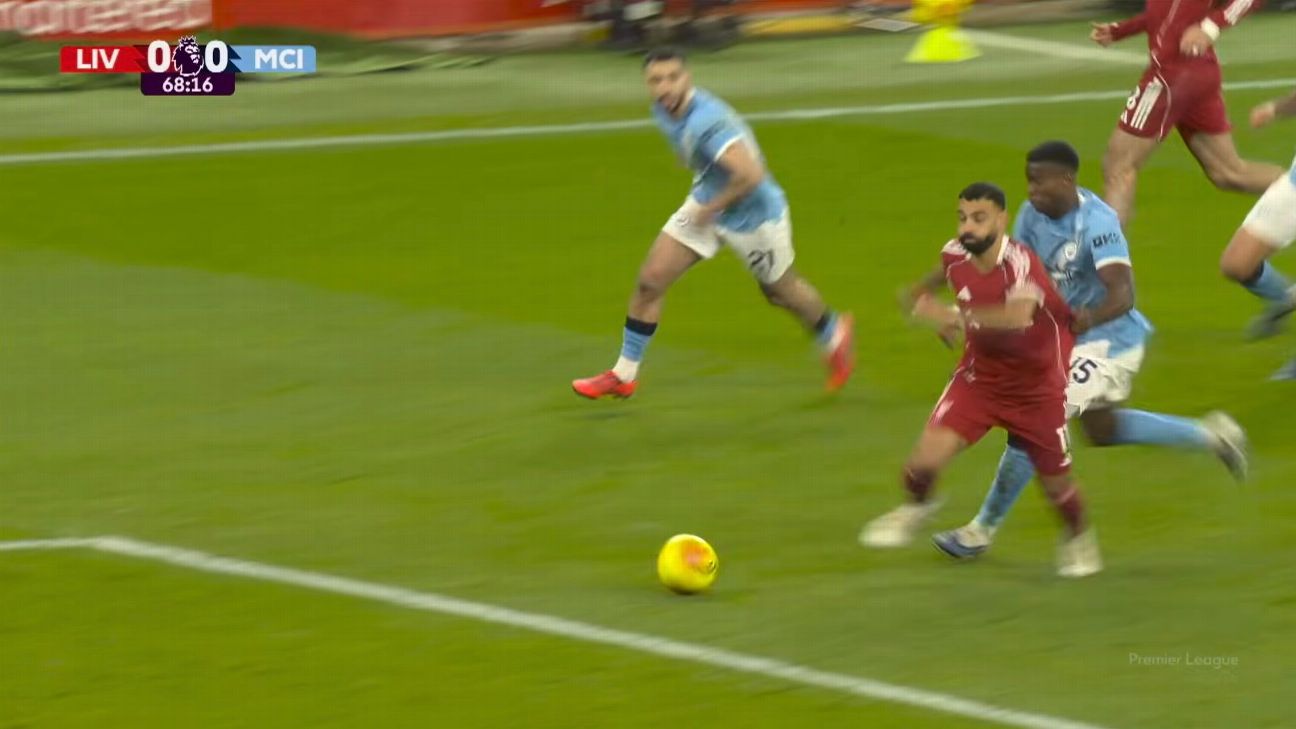
VAR decision: The VAR confirmed Pawson’s call of a free kick and yellow card, concluding that the foul occurred outside the penalty area and there was a covering defender present, negating the DOGSO claim.
VAR review: The rationale provided by the referee on the field was central to this review. For a VAR intervention, there must be clear evidence that the holding offence denied an obvious goal-scoring opportunity, not just a probable one. The play’s dynamics and positioning contributed to the VAR’s determination, allowing the referee’s decision to stand.
Verdict: This scenario is marginal, and it aligns with what I’d consider a “ref’s call” given the circumstances. Factors influencing the officiating team included Salah’s potential opportunity for a quick shot and the presence of a covering defender. In ambiguous DOGSO situations, referees rely on instinct, and in this instance, the VAR appropriately opted not to intervene.
Time: 90th+1 minute
Incident: Penalty awarded to Manchester City
What happened: Man City’s Matheus Nunes suffered a collision with Liverpool goalkeeper Alisson Becker after Nunes flicked the ball past him.
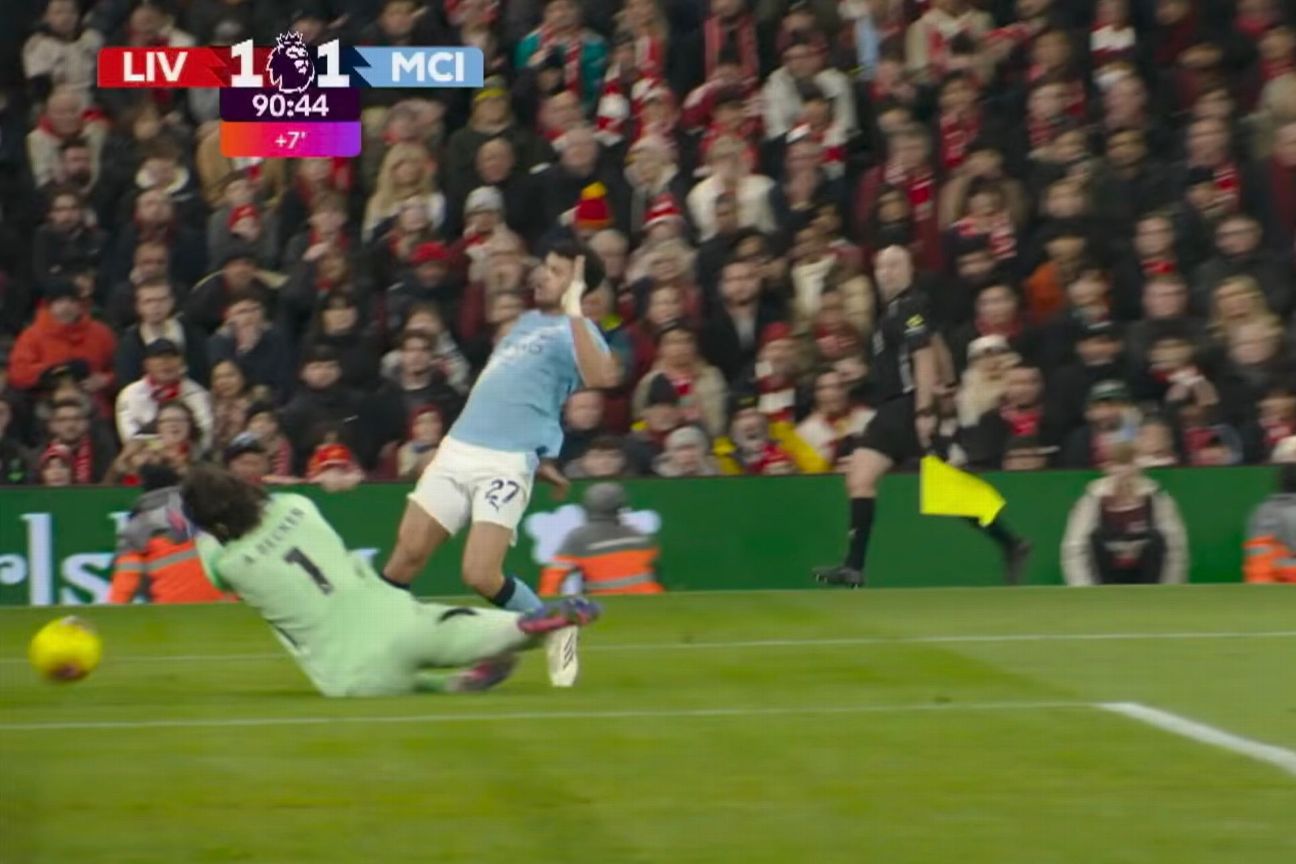
VAR decision: The VAR confirmed Pawson’s penalty call, establishing that Alisson made significant contact with Nunes without touching the ball.
VAR review: This review was simple for VAR John Brooks. Their communication with Pawson clarified what the replays showed, allowing for a swift confirmation of the penalty decision. The main aspect to verify was whether the ball was in play when Alisson collided with Nunes.
Verdict: The penalty awarded to Manchester City was correct, as Alisson’s late challenge, which did not involve ball contact, warranted a penalty.
Time: 90th+10 minute
Incident: VAR intervened to disallow a Manchester City goal and send off Liverpool defender Dominik Szoboszlai for DOGSO.
What happened: As Liverpool’s goalkeeper pushed forward searching for an equalizer, Manchester City forward Rayan Cherki shot at an empty net. Szoboszlai and City’s Erling Haaland raced for the ball, which clearly favored Haaland.
When Szoboszlai pulled down Haaland to avoid him scoring, Pawson permitted play to continue as the ball was on course for the net. Attempting to block the goal, Szoboszlai was then held back by Haaland, and the ball rolled into the net. Referee Pawson initially awarded the goal to Manchester City.
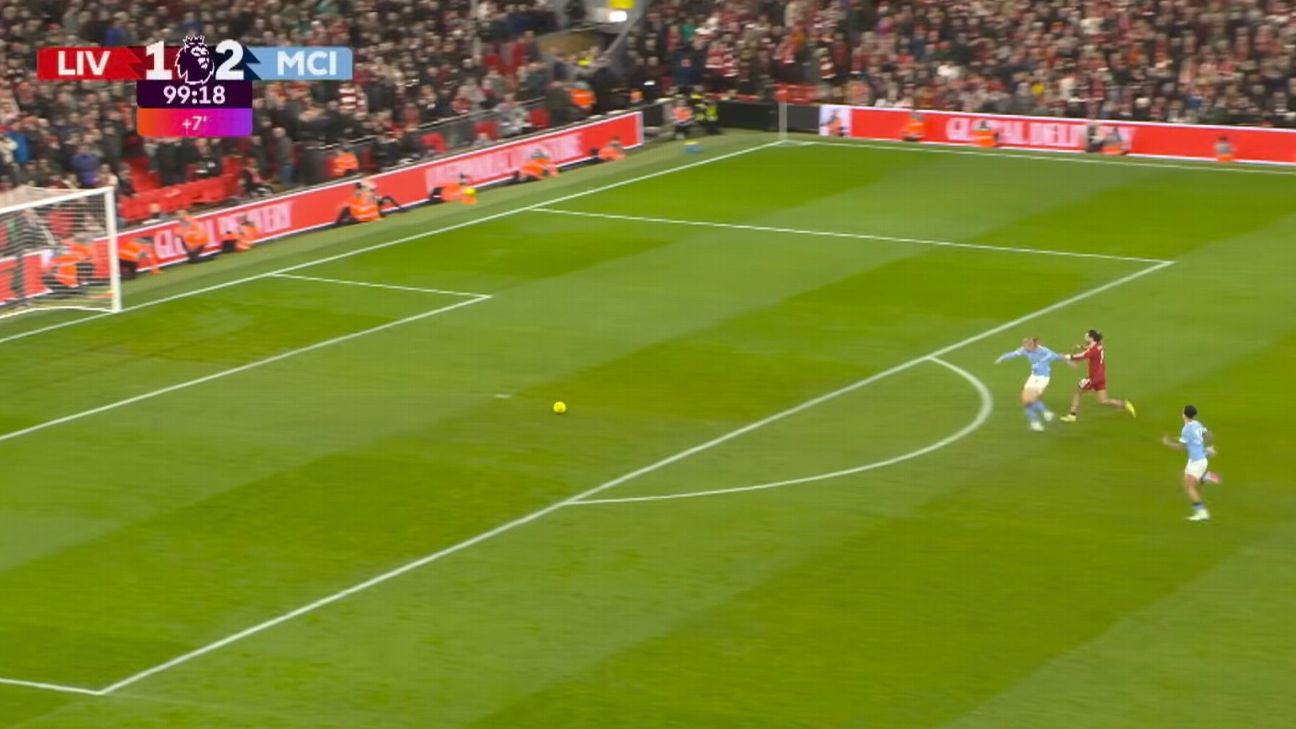
VAR decision: Following a VAR review, Pawson reversed the goal decision for Manchester City.
His official announcement was: “After review, there is a careless foul by Erling Haaland that pulls Szoboszlai’s shirt. Prior to this, Szoboszlai’s holding foul denied an obvious goal-scoring opportunity. The final decision is a direct free kick to Manchester City and a red card.”
VAR review: John Brooks recognized the complexity of this review, as two separate fouls occurred. Each foul was analyzed independently, scrutinizing the on-field rationale for the goal versus the factual plays shown in replays. As Haaland’s foul was undeniable, the initial goal could not stand. Following the overturn, the VAR prompted Pawson to review Szoboszlai’s offense, resulting in a red card.
Verdict: This situation is complex and might not be well-received by fans. However, the Laws of the Game dictated that VAR and the referee had no viable alternatives. Haaland’s pulling of Szoboszlai warranted a penalty, which consequently led to the identification of Szoboszlai’s red card for the DOGSO.
The difficulty of this situation would not have gone unnoticed by the officials, especially with the narrative following the match in mind. Yet, failing to apply the law in favor of a perceived fair outcome, particularly in a game where Man City had the upper hand, was not an option—especially considering how pivotal that goal could be in the title race.