



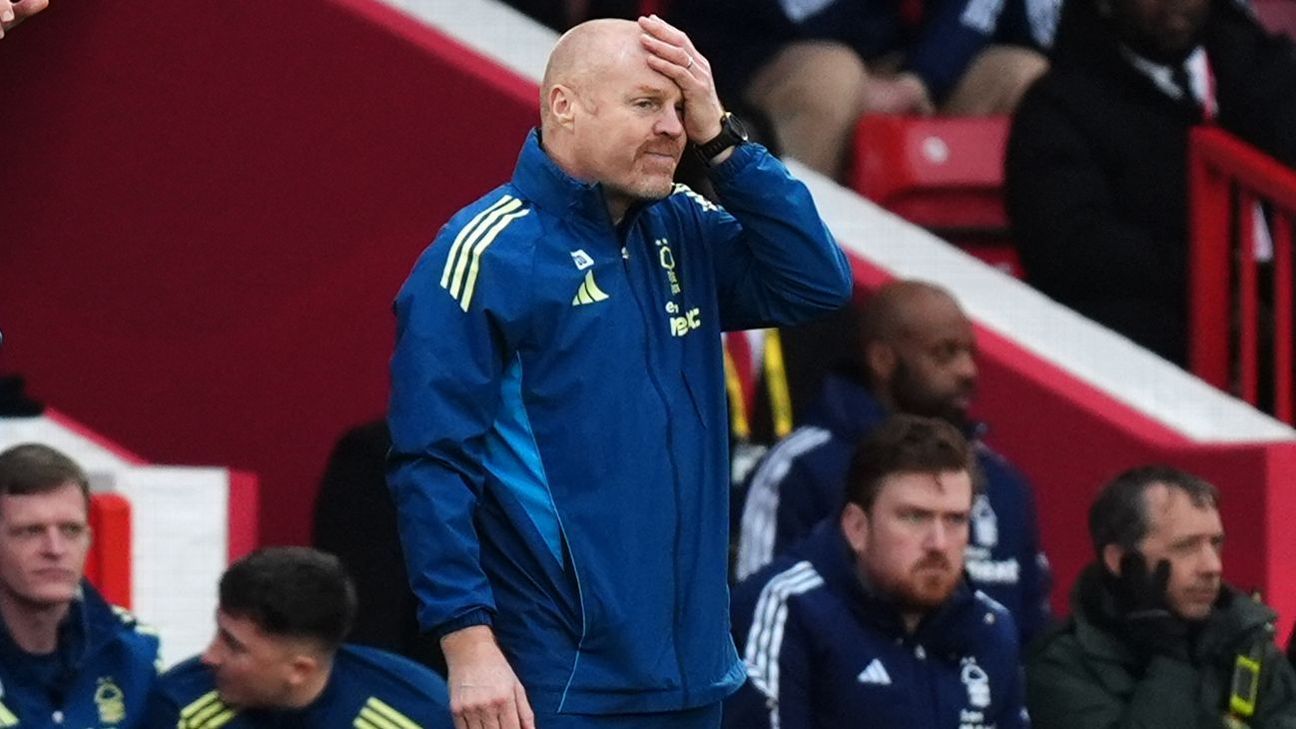
Nottingham Forest is currently seeking a new manager after the board decided to part ways with Sean Dyche, who held the position for just 114 days. This decision followed a disappointing 0-0 draw against last-place Wolverhampton Wanderers on Wednesday.
Dyche had been nominated for the Premier League Manager of the Month award for January after guiding the team to seven points from 12 possible. However, his dismissal comes just weeks into February, leaving Forest precariously three points above the relegation zone.
At the start of the 2025-26 season, Nuno Espírito Santo was at the helm after leading the team to Europa League qualification the previous year. His tenure, however, lasted only three matches before a public fallout with owner Evangelos Marinakis led to his replacement by Ange Postecoglou. Postecoglou’s time was equally disappointing, spanning eight games without a win, prompting the appointment of Dyche in October while the team languished in 18th place.
– Frank’s Spurs role was too challenging, but firing him won’t resolve the club’s issues
– Who might step in for Frank at Tottenham?
– Ranked: The best and worst manager jobs in football
As of now, Forest sits in 17th place with 12 matches left in the league. According to sources, Vitor Pereira, former Wolves coach, is the top choice to become Forest’s fourth permanent manager this season, which would set a Premier League record once confirmed.
While Forest’s fate this season is still uncertain, there is a history of Premier League clubs frequently changing managers within the same season. To date, there have been 21 instances (including Forest) of teams employing three permanent managers during a single campaign. Here’s a look at how those situations unfolded.
Successful Managerial Changes
Crystal Palace, 2014-15 (Tony Pulis, Neil Warnock, Alan Pardew) – Finished 10th
The Eagles began their season poorly after Pulis left just before the opening match, leading to Warnock’s appointment. Warnock won only three out of 18 matches and was dismissed after a defeat against Southampton on Boxing Day. Pardew arrived in January and revitalized the team, eventually guiding them to a mid-table finish.
Swansea City, 2016-17 (Francesco Guidolin, Bob Bradley, Paul Clement) – Finished 15th
Despite not having a spectacular season, Swansea managed to escape relegation by successfully rotating through three head coaches. Results improved significantly after Clement took charge in January, leading to three consecutive wins towards the season’s end.
Ineffective Managerial Changes
Leicester City 2001-02 (Peter Taylor, Dave Bassett, Micky Adams) – Finished 20th
Amidst financial difficulties, Leicester started the season poorly, sacking Taylor before September’s end. Several managerial changes followed, but nothing worked as the team struggled throughout, eventually facing relegation.
Portsmouth 2004-05 (Harry Redknapp, Velemir Zajec, Alain Perrin) – Finished 16th
Despite a decent start, Redknapp’s controversial departure led to Zajec stepping in. However, results plummeted, prompting the hiring of Perrin in April, who barely managed to keep the club in the league.
Southampton 2004-05 (Paul Sturrock, Steve Wigley, Harry Redknapp) – Finished 20th
Sturrock resigned after a brief tenure and was replaced by Wigley, who failed to change the team’s fortunes. Redknapp’s attempt to salvage the season fell short, and Southampton ended up relegated.
Portsmouth 2008-09 (Harry Redknapp, Tony Adams, Paul Hart) – Finished 14th
After winning the FA Cup, Portsmouth’s fortunes changed when Redknapp left mid-season. Adams’ initial success faded, leading to a string of losses, but fortunately, other clubs performed worse, allowing Portsmouth to avoid relegation.
Fulham 2013-14 (Martin Jol, Rene Meulensteen, Felix Magath) – Finished 19th
Fulham’s season quickly turned dire, finding themselves in the relegation zone by September and remaining there throughout the campaign.
West Brom 2017-18 (Tony Pulis, Alan Pardew, Darren Moore) – Finished 20th
West Brom’s poor form led to reshuffling of management, yet they remained entrenched in the relegation zone, despite a few surprising victories near the season’s end.
Fulham 2018-19 (Slavisa Jokanovic, Claudio Ranieri, Scott Parker) – Finished 19th
Fulham struggled to establish themselves in the league, often finding themselves in the relegation zone, even during Parker’s brief revival.
Watford 2019-20 (Javi Gracia, Quique Sánchez Flores, Nigel Pearson) – Finished 19th
After a rocky start to the season, Gracia was sacked, but his replacement couldn’t change the team’s trajectory, leading to relegation.
Watford 2021-22 (Xisco Muñoz, Claudio Ranieri, Roy Hodgson) – Finished 19th
Watford’s chaotic managerial changes failed to achieve any stability, resulting in relegation after multiple disappointing performances.
Leeds United 2022-23 (Jesse Marsch, Javi Gracia, Sam Allardyce) – Finished 19th
Leeds struggled and ultimately fell into the relegation zone during multiple coaching shifts, with last-minute attempts to salvage the season failing.
Tottenham Hotspur 2022-23 (Antonio Conte, Cristian Stellini, Ryan Mason) – Finished 8th
After a frustrating end for Conte, Tottenham saw short stints from Stellini and Mason that resulted in a disappointing finish outside European competition.
Southampton 2024-25 (Russell Martin, Ivan Juric, Simon Rusk) – Finished 20th
Southampton’s disastrous season marked one of the worst in Premier League history, managing to cycle through three managers but ultimately facing relegation early.
Unsuccessful Managerial Changes
Crystal Palace 1997-98 (Steve Coppell, Attilio Lombardo/Thomas Brolin, Ray Lewington) – Finished 20th
Palace’s promising start quickly fell apart following a management overhaul, with interim player-managers Lombardo and Brolin unable to stem the tide of poor performances, leading to relegation.
Sunderland 2002-03 (Peter Reid, Howard Wilkinson, Mick McCarthy) – Finished 20th
Sunderland struggled throughout the season after enduring a hectic managerial change, resulting in plunging straight to the bottom of the league after Reid’s departure.
Charlton Athletic 2006-07 (Iain Dowie, Les Reed, Alan Pardew) – Finished 19th
A disjointed season for Charlton saw rapid changes in management, with Dowie and his successor failing to pull the team out of relegation trouble, ultimately leading to a drop.
Newcastle United 2008-09 (Kevin Keegan, Joe Kinnear, Alan Shearer) – Finished 18th
Newcastle faced a rough season filled with fights between management and board members, resulting in hasty changes that couldn’t save them from relegation.
Aston Villa 2015-16 (Tim Sherwood, Remi Garde, Eric Black) – Finished 20th
Aston Villa fell to the bottom of the table after multiple managerial shifts failed to revive their fortunes, marking their first relegation from top-tier football in decades.
Chelsea 2022-23 (Thomas Tuchel, Graham Potter, Frank Lampard) – Finished 12th
Following a mid-table start to the season, a controversial management change resulted in a collapse for Chelsea, leading to multiple managerial casualties and a lackluster finish.