



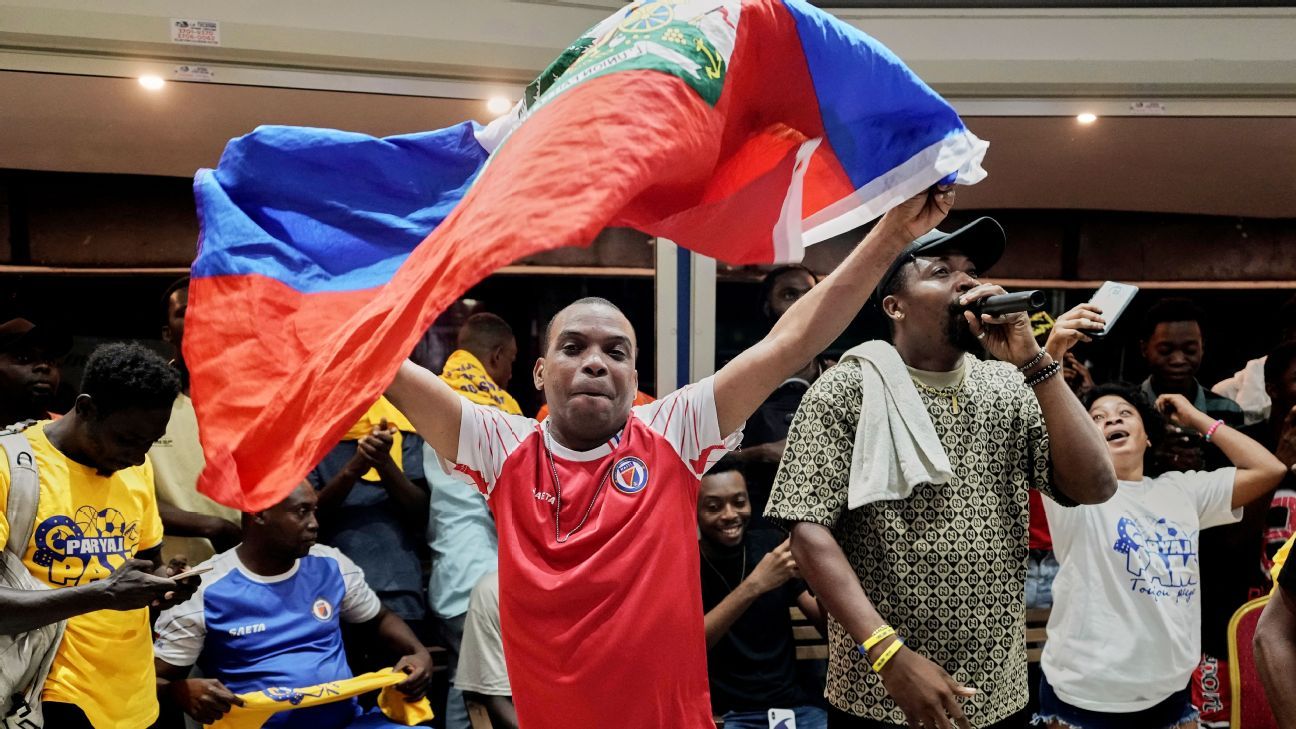
The Haitian men’s soccer team achieved a historic milestone by qualifying for the 2026 FIFA World Cup, marking their first appearance in the tournament since 1974. Regrettably, they did so while unable to play at home or train within their troubled nation.
“This makes our achievement even more incredible. We are immensely proud,” stated Regine Etienne, acting consular general of Haiti in Boston. “Their journey is a testament that hope still exists for Haiti, and that sheer determination and talent can prevail in the face of hardship.”
Qualifying for the World Cup can be a transformative experience for nations facing challenges. Haiti will proudly display its flag alongside those of some of the world’s most influential countries. Unfortunately, many Haitian citizens will be unable to travel to the U.S. to support their team, a bitter reality for those at home and in the diaspora. Due to restrictions from the Trump Administration, individuals from Haiti, like those from Senegal, Ivory Coast, and Iran, face severe travel bans. Despite appeals from these nations, there is currently no sign that President Trump will reconsider or that FIFA will push for an exemption for fans wishing to attend the World Cup.
Starting January 1, the Trump administration expanded its visa suspension to nationals from 39 countries, citing national security and public safety concerns, claiming those nations cannot adequately vet their citizens. Haiti, Senegal, Ivory Coast, and Iran are among these countries, all of which have secured spots in this year’s World Cup, which the U.S., Canada, and Mexico will host.
Under the Presidential Proclamation 10998, players, team officials, and their immediate family members from the sanctioned nations are permitted to obtain visas. While some exceptions may apply, including those deemed beneficial to U.S. national interests, a State Department spokesperson noted that such cases would be rare.
“Obtaining a visa is a privilege, not a right,” the spokesperson stated. “Under President Trump, the State Department is prioritizing the safety of American citizens and enforcing strict visa processes.”
Regine Etienne mentioned that the Haitian government is actively pursuing all potential options for its citizens, yet emphasized that visa authorization remains a sovereign decision of the required authorities.
A glimmer of hope for the affected countries could come from New York City Mayor Zohran Mamdani, a democratic socialist who reportedly had a surprisingly amicable meeting with President Trump at the Oval Office in November.
Mamdani indicated in January that he would appeal to Trump for a special travel exception for the World Cup. While he remained tight-lipped about any private discussions with Trump, he expressed his commitment to advocating for affected communities.
“This is an opportunity for visibility, especially for Haitian New Yorkers who feel connected to their team’s participation in the World Cup as a reflection of their entire community,” Mamdani stated, adding that he will continue to argue that New York is a welcoming city for the world.
A passionate soccer fan, Mamdani recently hosted a watch party for the Africa Cup of Nations final, marking the start of several events aimed at celebrating New York’s immigrant communities.
A White House spokesperson did not provide information on whether Trump had communicated with Mamdani or if he would consider an appeal regarding the travel ban, stating only, “Thanks to President Trump’s leadership, the FIFA World Cup 2026 is poised to be one of history’s most spectacular events right here in the United States. This event will generate billions in economic impact and create hundreds of thousands of new jobs. The President is committed to making this a memorable World Cup while ensuring it is safe and secure.”
Haiti, Senegal, and Iran will each play all their group-stage matches in the U.S., while the Ivory Coast will face its second group-stage match in Toronto, where Canada has a stringent vetting policy but no blanket ban. There is a possibility for teams to advance to knockout matches in Canada or Mexico, which only seems feasible for Senegal.
Sheck Wes, a Senegalese-American hip-hop artist raised in New York City, expressed that the travel restrictions not only limit Senegalese supporters from experiencing the World Cup atmosphere but also deny other Americans the chance to engage with a vibrant community eager to contribute to the occasion.
“America has a history of seeking and offering help, and this World Cup is an excellent opportunity for us to be gracious hosts to these nations,” he noted.
When the Trump administration first implemented the travel bans, it accused individuals from the listed countries of crimes including murder, terrorism, embezzlement, human trafficking, and more.
The administration cited issues such as the unreliability of foreign civil documents and insufficient access to authoritative criminal records, asserting that it must exercise “extreme vigilance” in the visa process.
Critics, including several civil rights organizations and Democrats, have denounced the policy as discriminatory, with Human Rights First labeling it “racist” and a “sweeping act of collective punishment.”
Jonathan Grode, an immigration attorney in Philadelphia, argued that the rigid immigration stance contradicts the Trump administration’s business mindset. “There’s a clash between the commerce side, which understands the significance of sports diplomacy, and the immigration hardliners who refuse to budge regardless of potential financial benefits or the country’s global standing,” he explained.
When questioned about FIFA’s efforts for a travel ban exemption, a representative noted that while FIFA is facilitating an expedited visa process for World Cup ticket holders, ultimately, the U.S. government is responsible for visa decisions, not FIFA.
Notably, some advocates believe FIFA President Gianni Infantino, who has fostered a friendship with Trump and recently received an award from him, should leverage that relationship to push for exemptions.
“The processing of visas is extremely challenging,” stated Lionel Lucien, a Haitian-American community leader in Boston, where Haiti will debut in the World Cup. “There are countless individuals who would love to attend and meet the qualifications. To impose a blanket travel ban on Haiti during the World Cup contradicts FIFA’s mission and is utterly disrespectful.”
An anonymous retired U.S. diplomat emphasized the legitimate concerns regarding vetting visitors from unstable countries for tourist visas. “Historically, Haiti and Iran faced restrictions long before this administration. Tourist visas are exceedingly rare, and logistical issues play a significant role. However, a total ban is an excessive measure,” the diplomat commented.
“There are sensible and measured ways to approach this issue, as opposed to the extreme ideological stance currently taken,” they added.
While Senegal may be economically disadvantaged and face issues like fraud, the diplomat posited that allowing responsible citizens to support their teams is a reasonable request.
Iran’s situation has been complex since the Islamic Revolution of 1979, with the U.S. facing significant challenges in diplomatic relations since then.
“The ramifications of our consular policies have roots in the 1979 crisis, making it hard to trust individuals with Iranian passports,” the diplomat explained.
The Trump administration’s announcement of the visa suspensions included claims that nationals from the listed countries had exploited America’s historical generosity by failing to adhere to their visa conditions. Recent Department of Homeland Security data showed that Haitians who received visas have overstayed their terms at a rate beyond other World Cup participating nations. However, the diplomat remarked that rigid bans are not the solution, but rather a call for comprehensive vetting.
“For Haiti, this opportunity transcends soccer; it is about dignity and recognition,” said James “Reggie” Colimon, a Haitian-American working in global affairs for Mayor Michelle Wu in Boston. “Sports should unite the world, yet Haiti is sidelined. This creates a perception gap; theoretically, we welcome all, but the reality begs to differ.”
“When you single out a specific country while welcoming others, it creates a credibility gap. While security concerns are undoubtedly vital, the inconsistency in these policies is striking. The World Cup already operates under rigorous security measures.”