



The Gaza Strip lies in devastation, with entire neighborhoods reduced to piles of rubble and pressing concerns about restoring essential water and sewage systems, roads, electrical infrastructure, and the agricultural foundations necessary to avert mass starvation.
Yet amidst this destruction, there exists a promise for a new national soccer stadium for a region scarred by over two years of conflict between Israel and Hamas, as assured by the sport’s global governing body.
This unexpected commitment was announced during a dramatic political showcase at the first meeting of President Donald Trump’s Board of Peace in Washington, where nine nations pledged $7 billion to a Gaza relief initiative and five countries agreed to send troops as part of an international stabilization force.
“Our efforts must go beyond just rebuilding homes, schools, hospitals, or roads,” stated FIFA President Gianni Infantino. “We also need to reconstruct people, emotions, hope, and trust. That is what football, my sport, represents.”
FIFA has committed $50 million toward the construction of a new stadium with a capacity of 20,000 to 25,000 spectators, alongside plans for a $15 million FIFA academy. Additionally, the organization plans to invest $2.5 million in 50 small “arena mini pitches” and five full-sized fields costing $1 million each.
Gaza does not have its own national soccer team; a cohesive Palestinian team, which includes players from the West Bank, has represented the region and has been recognized by FIFA since 1998, although it has yet to qualify for the World Cup.
“Football, or soccer as it is known here, transcends borders as a universal language,” Infantino remarked. “It embodies hope, joy, and happiness. It brings people together and unites the world.”
He presented a video that conveyed the message, “A simple ball. A shared field. A reason to believe again,” emphasizing that FIFA and the Board of Peace aim to transform football into a pathway for peace and dignity.
The video included plans for FIFA to establish soccer leagues in Gaza at various levels, including youth and amateur leagues, promising a “comprehensive football ecosystem to support communities and future generations.”
Infantino has frequently appeared at the White House as the World Cup approaches, which will be co-hosted by the U.S., Mexico, and Canada. He has also attended numerous Trump events, including the formal launch of the Board of Peace in Davos, Switzerland, last month.
During his remarks at the Board of Peace event, Trump highlighted Infantino, attempting to mitigate the absence of several key U.S. allies—such as the UK and Canada—who did not participate.
“Nearly all attendees are heads of state,” Trump noted, adding that Infantino, as the “head of soccer,” held a worthwhile position. “I think I like your job the best.”
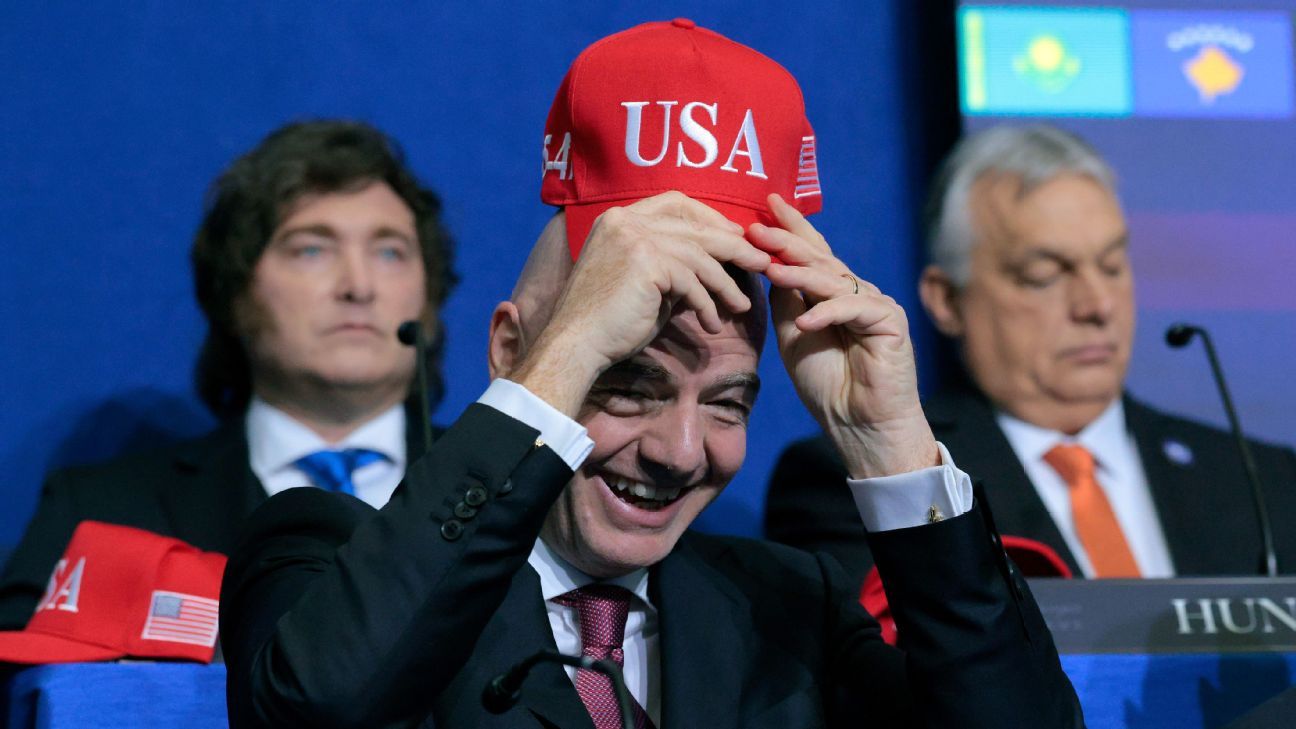
Attendees were given red hats, reminiscent of the “Make America Great Again” slogan, inscribed with “USA” and marked with “45-47,” denoting Trump’s two presidential terms. Infantino donned his hat briefly, as did others present.
Trump expressed admiration for Infantino during various stories covering a range of topics, even explaining how B-2 bombers are equipped with “very big bombs.”
However, Trump’s most enthusiastic comments regarding Infantino were tied to FIFA awarding him a new peace prize last year—after Trump’s campaign for a Nobel Peace Prize was overlooked by the Norwegian committee responsible for its distribution.
“I think they noticed that I was snubbed by Norway,” Trump remarked.