



-

Tom Hamilton
Multiple Authors
In early February, one of my football-enthusiast colleagues, who generally shuns rugby, entered the office grumbling, as he often does this time of year. The Six Nations, Europe’s leading international rugby tournament, kicked off on February 5 and will continue until mid-March, with England set to clash with Ireland on Saturday in a critical match. Amid his expletives, he lamented that his local pub would be flooded with rugby coverage instead of football most Saturdays for the next few weeks. However, whether he acknowledges it or not, some of football’s premier managers are seeking inspiration from rugby.
Prior to England’s match against New Zealand in November, Brighton & Hove Albion manager, Fabian Hurzeler, visited the England training camp. The England players are accustomed to football managers visiting their sessions: figures like Antonio Conte and Gareth Southgate have done so in the past. Likewise, rugby coaches also visit football teams. What particularly struck Hurzeler was the location of rugby coaches during matches — sitting in the stands.
“The head coach observes from a more detached perspective, not getting emotionally involved on the sideline,” Hurzeler noted. “It’s more about overseeing the action as an analyst and making decisions from above. That could be a future trend in football too.”
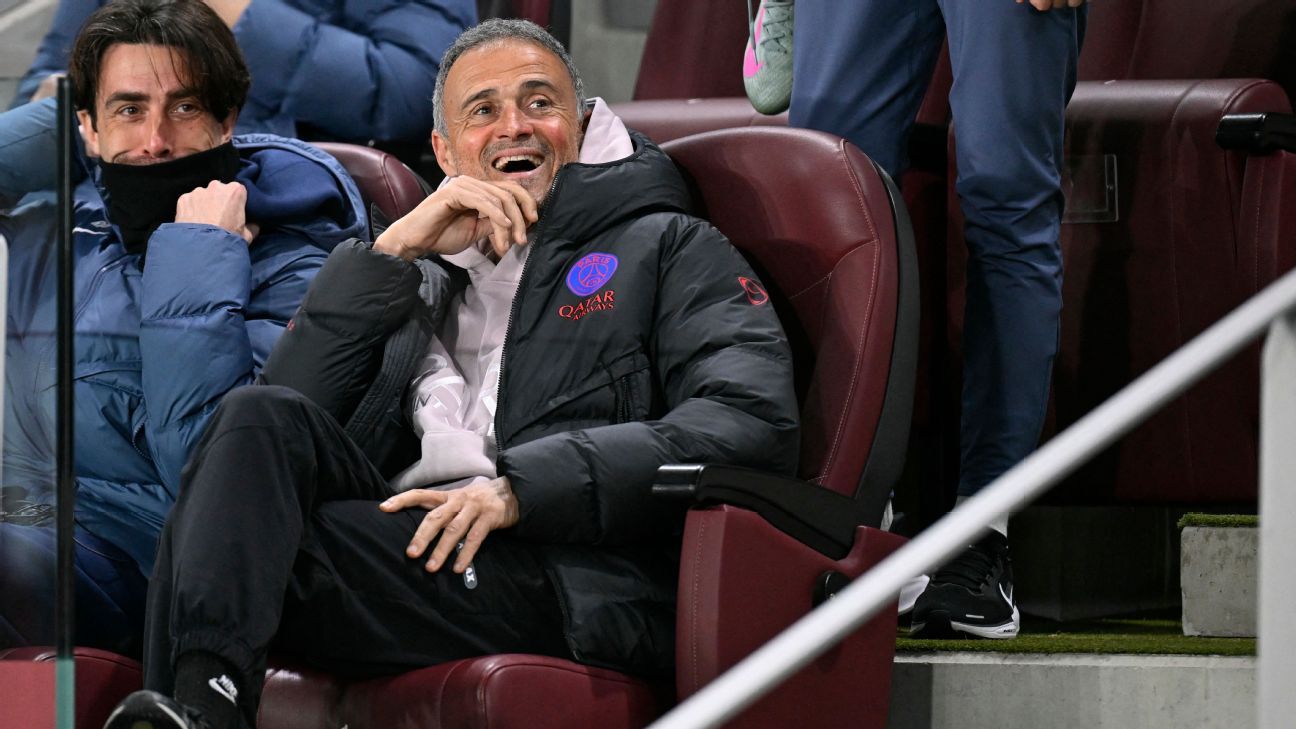
Meanwhile, in France, after Paris Saint-Germain‘s game against Lens last September, PSG manager Luis Enrique has taken to observing the opening 45 minutes of some home matches from the stands. “I’ve long admired how rugby coaches analyze the game from a unique angle,” he explained. “I’ve found it enlightening. Watching from the stands is magnificent; I can oversee everything.” This vantage point has made his halftime discussions significantly more impactful as he witnesses everything unfold in real time.
This practice poses challenges overseas, as Spanish regulations mandate managers remain in the dugout, yet it has influenced how Enrique observes training as well. At the expansive Campus Du Paris-Saint-Germain, he uses a six-meter-high scissor lift to oversee certain training sessions. He stated ahead of their recent Champions League final that this elevation completely shifts his perspective and enhances his “team’s movement.”
Will this trend make its way to the Premier League? Typically, if a manager is seen in the stands, it’s due to a reprimand. Yet, some prefer watching from above — Sam Allardyce practiced this 15 years ago, and he’s not alone; predecessors like Walter Smith, George Graham, and Glenn Hoddle also opted for this strategy at times. Leyton Orient’s Richie Wellens enjoys observing matches from the stands, but Luis Enrique’s first-half perch often brings Allardyce’s influence to the forefront. Allardyce originally implemented this practice during his stints at Bolton, Newcastle United, and Blackburn before discontinuing it at West Ham.
Since the early 2000s, Allardyce has frequently collaborated with the England rugby team, examining their strength and conditioning programs, data utilization, and training methodologies. He also took a keen interest in their team management style. “Our psychologist at Bolton advised me, ‘Get up into the stands, because all you do on the bench is jump around. We set up earpieces and radios to communicate with the bench along with the analyst who coded the game,'” Allardyce said. “This way, we could present visuals to the players at halftime rather than verbally dissecting everything. We had a TV on a 10-second delay for instant feedback, which helps alleviate emotional bias in decision-making. You simply gain a superior view from that height.”
Not all clubs were on board with his absence from the dugout, however. “They complained about me being up there; they insisted I should be yelling at the players down below,” Allardyce recounted. “You can remain firm in your decisions, but if it’s causing friction and making waves in boardroom discussions, you might reconsider and return to the bench. If I were managing today, I would definitely prefer the stands. But the choice isn’t clear-cut.”
– Olley: How Premier League clubs are looking to the U.S. to raise transfer funds
– Onuoha: What players really think when a manager arrives midseason
– Wright: Is it happening again? Arsenal’s stumble in title race follows familiar pattern
Other subtle influences are emerging too, with some managers adopting terms borrowed from rugby; phrases like “bomb squad” and “finishers” now refer to players who enter en masse to shift a match’s momentum. Former England rugby coach Eddie Jones first introduced the term “finishers” instead of calling players “substitutes” in 2017. In March 2023, Arsenal‘s Mikel Arteta began using “impactors” or “finishers” for his bench players. Jones and Arteta once shared a WhatsApp group that also included Green Bay Packers head coach Matt LaFleur and basketball coach Mike Dunlap. “We all come together to discuss our issues and receive advice from one another,” Jones shared. “It’s invaluable.”
Arteta expressed his preference for “finishers” after a 2-0 victory over Athletic Bilbao in September, stating, “I embrace the term, as I am not fond of alternative descriptors for those players. As the game evolves, their importance will only increase. The quality of [their] minutes will likely determine our overall season, without a doubt.”
Despite this shift, not everyone has welcomed the new terminology; former Watford striker Troy Deeney criticized the change as “childish,” suggesting players who don’t play would be left “confused and upset.” You can’t please everyone.
In another example, the Springboks (South Africa’s rugby union team and recent back-to-back World Cup champions) refer to their impactful substitutes as the “bomb squad,” adding physicality and momentum shifts to the game. After England’s 2-0 win over Serbia at Wembley in November, coach Thomas Tuchel became acquainted with this term. “I haven’t named [the players] differently yet, but I’m quite fond of ‘bomb squad’ over ‘finisher,'” he noted.
On other fronts, the television match official in rugby may be seen as a precursor to certain aspects of VAR, both exhibiting flaws and time-consuming attributes. Let’s overlook that for now. As for my disgruntled colleague, when I shared my insights on how rugby is influencing football, he quipped, “What, to take over the pub and ruin my Saturday afternoons?”