



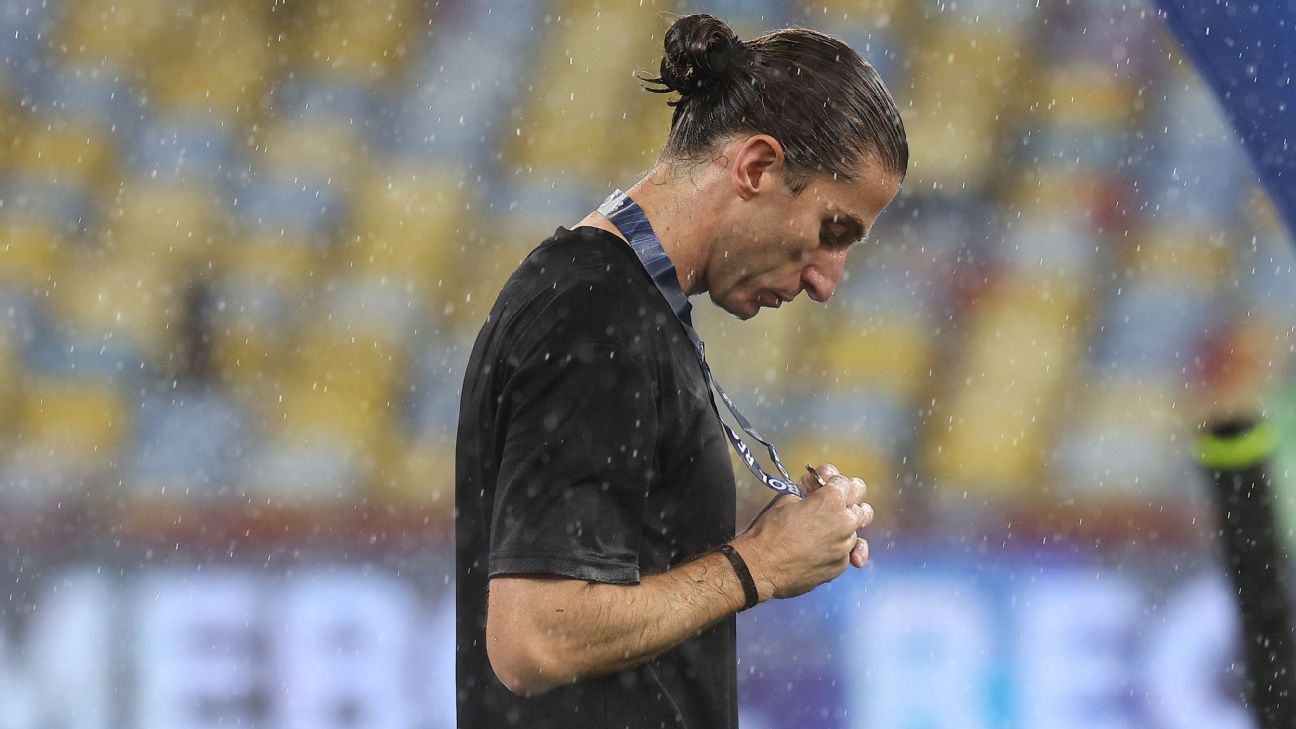
This could be a trivia question in years to come: Which head coach was dismissed shortly after his team won a semifinal match 8-0 following a previous year of four trophy wins?
The answer is none other than Filipe Luís, the former left back for Atlético Madrid, Chelsea, and the Brazil national team. His promising coaching journey with the Rio de Janeiro powerhouse Flamengo came to an abrupt end on Monday night.
At the Maracanã stadium, Filipe Luís’ squad achieved an astonishing 11-0 aggregate victory over Madureira in the semifinals of the Rio State Championship. However, following a brief 30-second discussion in the locker room, he was informed that his services were no longer needed.
This shocking turn of events may haunt Flamengo more than Filipe Luís. He is widely regarded as one of the most promising coaches in the sport. With a disciplined, serious, and intelligent approach, he effortlessly transitioned from player to coach at Flamengo.
After a successful 15 years in Europe, he concluded his playing career with a stellar four-year stint at Flamengo, retiring at the end of 2023 and promptly taking on the role of youth team coach. The following year was eventful, as he advanced from managing the U17s to the U20s, eventually stepping into the first team after former Brazil manager Tite was dismissed after a surprising exit from the Copa Libertadores.
Filipe Luís quickly adapted to his new position and guided the team to the Copa do Brasil and later secured the Rio de Janeiro State title in early 2025. Despite a setback with elimination by Bayern Munich in the FIFA Club World Cup, the team ended the year with significant silverware.
Flamengo secured the Libertadores and shortly thereafter won the Brazilian Serie A. On December 17, they took Paris Saint-Germain, the UEFA Champions League holders, to penalties in the FIFA Intercontinental Cup final.
However, this success marked the beginning of various challenges.
To start with, there was a need to discuss Filipe Luís’ contract. Initially seen as a low-cost interim solution, he had proven himself as an asset deserving of a new contract. This discussion was complicated by rising tensions between him and the club’s directors, with claims that one reason for his dismissal was a conversation he had about the head coach position at Chelsea (Flamengo’s president Luiz Eduardo Baptista later stated). As a result, the club began contemplating a replacement, notably Leo Jardim, a Portuguese coach who performed well with Cruzeiro. Nevertheless, Filipe Luís signed a contract extension until 2027 on December 29.
Secondly, the demanding fixture schedule offered no leeway. Flamengo players faced a grueling lineup of competitive matches through mid-December, followed by an early start to the new domestic season in January, with the national league commencing at the end of the month—much earlier than usual. This left little opportunity for the players to acclimatize, with little time for rest or pre-season training as they were thrust directly into matches under roasting summer conditions.
Filipe Luís’ playing philosophy emphasizes an aggressive approach that demands high intensity and collective pressing to regain possession. Unfortunately, the players lacked the necessary fitness, leaving them vulnerable to counterattacks and resulting in the club experiencing its worst season start in a decade, amassing just four points from their first three games.
Additionally, the success of the previous year raised expectations for continued victories. Flamengo’s identity includes a certain bravado, reflecting their status as Brazil’s version of Real Madrid. Their ambition was further demonstrated by reacquiring 28-year-old midfielder Lucas Paquetá from West Ham United for $49.4 million—setting a record as the most expensive transfer in Brazilian football history.
However, as Paquetá himself remarked, he needed Flamengo more than they needed him, as his desired position—attacking midfielder—is already occupied by Giorgian De Arrascaeta, a club icon and last year’s best player in the Americas. Although Paquetá’s signing was a boon for Filipe Luís, it also posed challenges regarding integration into the team. What Flamengo truly required was a speedy, mobile striker to exploit space behind defenses, rather than another player who thrives on having the ball at his feet.
Compounding these issues were the Super Cups—both domestic and international. While the legitimacy of these titles might be debated, they hold significant value in Brazil.
Last month, Flamengo was defeated by Corinthians in the domestic Super Cup (champions face off against cup winners). Then, in late February, they faced Lanús of Argentina in the two-legged South American Super Cup (the Libertadores champions against the Copa Sudamericana holders). Flamengo was the overwhelming favorite, given Lanús’s status as a small neighborhood club from Buenos Aires. Yet, they lost 1-0 at home and, after conceding two late goals in extra time at the Maracanã, lost the second leg 3-2. Surprisingly, Paquetá, the club’s marquee signing, spent over an hour on the bench.
Fan discontent grew, leading to criticism of Filipe Luís on social media. This situation could have been overlooked if Flamengo secured another title against Fluminense in the Rio State final, but the club’s directors opted to act swiftly to prevent any further consolidation of his position.
Thus, the 8-0 win over Madureira was rendered insignificant; even a 20-0 victory would not have saved Filipe Luís from dismissal.