



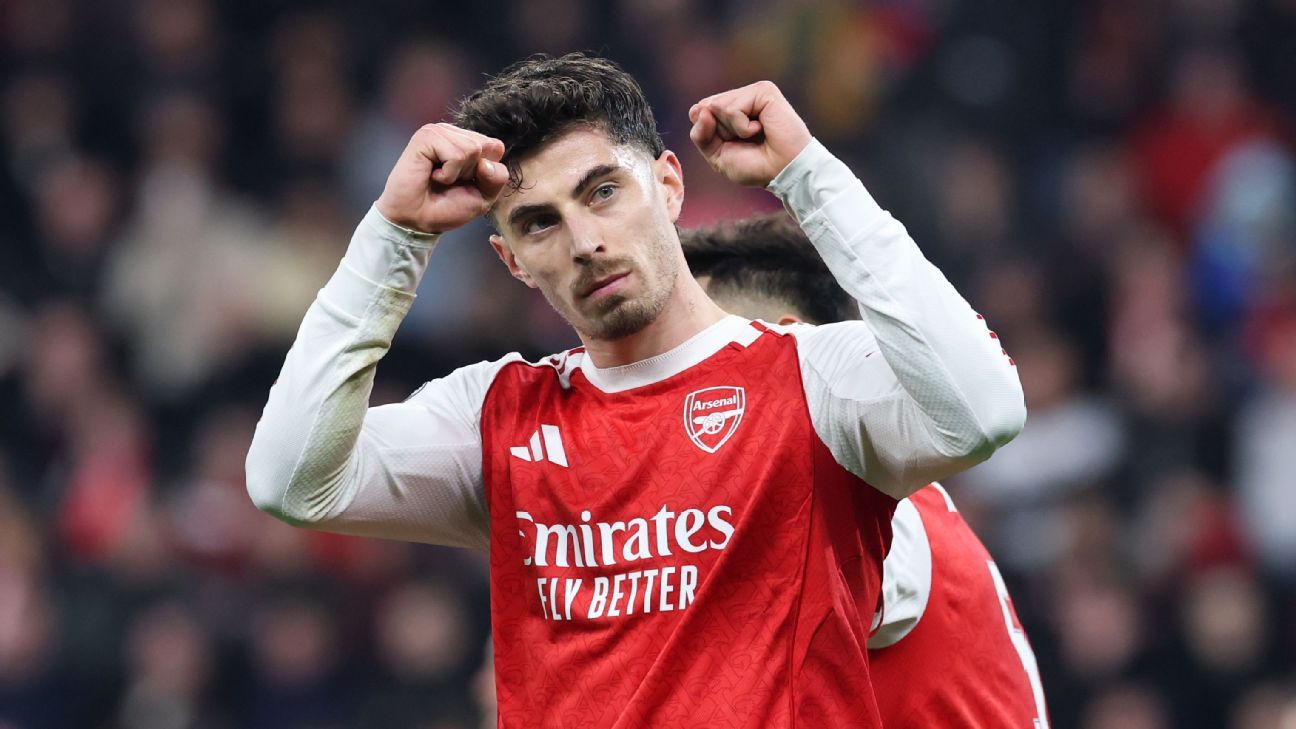
LEVERKUSEN, Germany — Bayer Leverkusen didn’t quite welcome Kai Havertz back as they would have liked. The 26-year-old was greeted with applause as he took the field to celebrate his decade-long association with the club, but immediately turned the evening into a nightmare for them by netting a late equalizer for Arsenal in the 89th minute during a UEFA Champions League clash.
Havertz’s penalty, which was awarded for a slight foul on Noni Madueke by Leverkusen’s Malik Tillman, allowed Arsenal to secure a 1-1 draw, tipping the odds in favor of the Gunners as they aim for a third consecutive appearance in the quarterfinals.
This moment felt particularly significant for both the tie and for Havertz himself. Prior to the match, he received a framed photograph celebrating his time at Leverkusen and shared insights regarding the emotional toll of his recent injury struggles, along with the cherished memories of returning to the club he joined at age 10.
The wait leading up to his penalty must have seemed endless. Yet, Havertz remained composed, sending the ball past Leverkusen goalkeeper Janis Blaswich and salvaging a point for an Arsenal side that looked at risk of leaving empty-handed. Since returning from his knee injury, Havertz has tallied three goals and two assists in just 316 minutes of action.
“Football is a peculiar sport, full of unique stories. For him to come back here after such an extended break, being part of this club, and to net such a crucial goal, feels monumental,” remarked Arsenal manager Mikel Arteta.
Despite the late equalizer, Arsenal’s performance raised questions about their capacity to succeed against top opposition. This slight setback also contradicted Arteta’s pre-match confidence regarding his team’s place among Europe’s elite, particularly after their last seasons’ runs to the quarterfinals and semifinals followed by a perfect record in this season’s group stage.
Throughout the match, Arsenal struggled to create incisive plays. Arteta had to adjust the lineup multiple times, substituting Madueke for the underperforming Bukayo Saka in the 60th minute, followed by Havertz for Viktor Gyökeres shortly after, and later replacing Gabriel Jesus for Eberechi Eze, aiming to inject life into their attack. Madueke was notably effective, paving the way for Havertz’s goal.
Before that, Leverkusen had looked poised to secure a surprising victory after Gabriel Martinelli hit the crossbar during a promising early phase. Leverkusen’s social media team had even taunted Arsenal before the match, posting an image with a “no corners allowed” sign in light of the visitors’ reputation for set pieces.
– Predicting the 2026 UEFA Champions League winner based on past winners
– Best Champions League tifos: Bob Marley, The Beatles, ‘Erling the Great’
– Report: Kai Havertz scores late penalty for Arsenal against former club Leverkusen
The home side clearly relished outsmarting Arsenal using well-coordinated dead-ball routines that earned them the lead. Leverkusen’s quick attack from the kickoff at the second half resulted in a corner taken by Alejandro Grimaldo and expertly converted by Robert Andrich. Arteta mentioned he had shown his players clips of Leverkusen’s attacking strategy, yet they still lacked the necessary alertness.
Leverkusen’s coach, Kasper Hjulmand, and Arsenal’s set piece coach, Nico Jover, engaged in a brief exchange on the sidelines, questioning the fairness of Arsenal’s physicality during corner setups.
“I’m wondering if it’s actually within the rules to body-check players who aren’t involved with the ball. Jover asked if we do it too, and yes, we do, so it’s consistent across the board,” Hjulmand clarified.
Arsenal mustered just three corners throughout the match, with only one coming before the 79th minute, illustrating Leverkusen’s effective defense in stifling their chances. Arteta’s frustration was palpable as he visibly reacted to his team’s failure to maintain possession. He expressed urgency when Rze attempted to connect with Martinelli in the first half, and moments later seemed to vent his frustrations on the dugout.
“There were 10 to 15 minutes in which we lacked urgency and understanding in breaking through their block, but I believe we were more effective in the last 20 to 25 minutes, and I’m glad we found a way to equalize and finish strong,” Arteta commented.
Hjulmand critiqued the penalty call, arguing that referees should avoid issuing marginal decisions and should instead await VAR input, as such close calls rarely get overturned once granted.
Having narrowly avoided a disappointing defeat, Arteta reframed the evening’s performance as part of a learning experience. “We need to improve our execution, and we will in the second leg. We’ll make adjustments and build on this,” he emphasized. “Every match in this competition is a challenge, particularly away from home. It’s essential to acknowledge what we’ve accomplished in winning all eight games previously, a feat never done before.”
“We understood the game’s importance and the challenge posed by our opponents, and now we must wrap things up back in London.”