



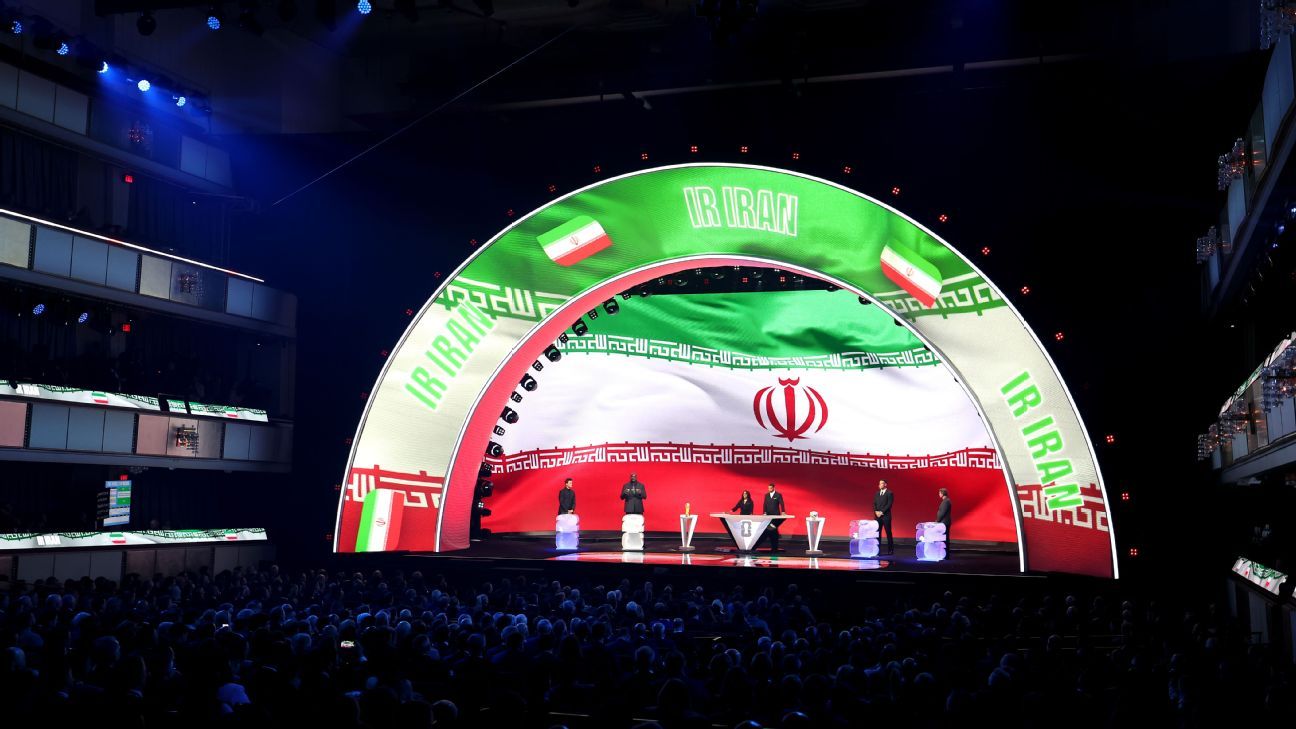
The 2026 FIFA Men’s World Cup is set to kick off in less than three months, with matches scheduled to take place in the United States, Mexico, and Canada. However, escalating tensions in Iran and surrounding areas—stemming from President Donald Trump’s declaration on March 1 regarding “major combat operations” against the Iranian government—have cast doubt on the participation of teams from that region.
The situation worsened with the death of long-time Iranian leader Ayatollah Ali Khamenei in airstrikes in Tehran, followed by Iranian missile and drone attacks directed at Israel and U.S. forces in the region. With Iran scheduled to play in Group G against Belgium, Egypt, and New Zealand, there is now also uncertainty regarding Iraq‘s ability to participate in the upcoming intercontinental playoffs in Mexico.
What does this mean for the World Cup, and when can we expect clarity regarding the teams involved?
Current Status of Iran’s Participation
Following the initial missile strikes on Iran, a senior member of the Islamic Republic of Iran Football Federation (FFIRI) expressed pessimism about the national team’s prospects of attending the tournament, having been the first non-host nation to qualify.
“It is clear that following this attack, we cannot anticipate the World Cup with any optimism,” stated FFIRI official Mehdi Taj, who also serves as a vice president of the Asian Football Confederation.
– World Cup Power Rankings: Who’s favored to win?
– Roster predictions for World Cup 2026 contenders and hosts
– Carlisle: Why U.S. host cities are still waiting on critical funds
FIFA’s initial response was to “monitor” the situation, indicating confidence that it would resolve prior to the World Cup’s commencement, which begins with Mexico facing South Africa in Mexico City on June 11. Although the conflict persists, FIFA President Gianni Infantino provided a hopeful update after a meeting with President Trump, asserting that Iran is “welcome” to compete in the tournament, where they are slated to play two matches in Los Angeles and one in Seattle.
“During our discussions, President Trump emphasized that the Iranian team is certainly welcome to participate in the tournament in the U.S.,” Infantino noted.
Nonetheless, Iran’s sports minister, Ahmad Donyamali, immediately contradicted Infantino’s statement, declaring that the national team would not compete. “Given that this corrupt regime has taken our leader’s life, we cannot participate in the World Cup,” Donyamali asserted.
Is Iran Definitely Excluded?
Not necessarily. The situation remains fluid, and since the FFIRI is controlled by the Iranian government, the ultimate decision on Iran’s participation will depend on political developments in the country.
President Trump anticipates the conflict to last between four to six weeks. If political changes occur in the aftermath, it could affect the football team and its governance. While it would be imprudent to make predictions about the future, this timeframe does grant FIFA the opportunity to delay any decisions until the FIFA Congress scheduled for April 30 in Vancouver.
FIFA continues to keep an eye on developments but has indicated that a decision regarding Iran does not need to be made just yet. Should the conflict still be ongoing by the time of the FIFA Congress, plans for a potential Iranian withdrawal and subsequent replacements will need to be formulated.
What Are the Alternatives If Iran Withdraws?
Should Iran exit the tournament, it is likely that a replacement would be drawn from the Asian Football Confederation (AFC), specifically the nation nearest to qualifying. Currently, that spot would likely go to Iraq, provided they win their intercontinental playoff against either Bolivia or Suriname on March 31 in Monterrey, Mexico.
If Iraq fails in the playoff, they would assume Iran’s place in the World Cup if Iran opts out. Conversely, if Iraq wins and qualifies for their first World Cup since 1986, the next Asian contender would be the United Arab Emirates, who fell to Iraq in the AFC playoffs last November.
What Challenges Does Iraq Face Right Now?
Due to the ongoing conflict in the Gulf, Iraq’s players, along with their Australian coach Graham Arnold, face travel restrictions and players based in Iraq are unable to acquire Mexican visas for travel to Monterrey.
Iraqi players located in the United Arab Emirates, Saudi Arabia, and Qatar have been able to secure visas by visiting the Mexican Embassy in those countries, but with Iraqi airspace closed until at least April 1 and Mexico lacking an embassy in Iraq, domestic players cannot travel to secure their visas.
Due to these complications, coach Arnold has canceled a planned training camp in Houston, Texas, and has called on FIFA to consider postponing the playoff until closer to the World Cup. FIFA has yet to respond to Arnold’s request.
“Currently, we are struggling to get our players out of Iraq,” Arnold commented. “I believe delaying the game would give us the necessary time to prepare adequately. Let Bolivia and Suriname play this month, and then we can face the winner shortly before the World Cup in the U.S.—the winning team goes, and the losing one goes home.”
He also mentioned that such a delay could allow FIFA additional time to evaluate Iran’s potential participation and any necessary replacements.
Arnold stressed that, “If FIFA could postpone the game, it would enable us to prepare for our game. If Iran withdraws, we could step in and give the UAE, whom we defeated in qualifying, a shot at preparation against either Bolivia or Suriname.”
“Our federation president, Adnan Dirjal, is tirelessly working to fulfill the dreams of everyone in Iraq, so we need a decision quickly.”
How Long Can FIFA Afford to Wait for a Decision?
There is no recent precedent for a team being withdrawn from a World Cup. However, in 1992, Denmark was granted a place at Euro ’92 only 10 days before the start after Yugoslavia was disqualified due to UN sanctions related to military conflict in the Balkans. Denmark ultimately triumphed in the tournament.
Sources indicate that FIFA is willing to wait for the situation in Iran to stabilize before finalizing any decisions. Significant outcomes from the playoffs on March 31 could play a crucial role, yet definitive decisions are expected to be delayed until the FIFA Congress on April 30.