



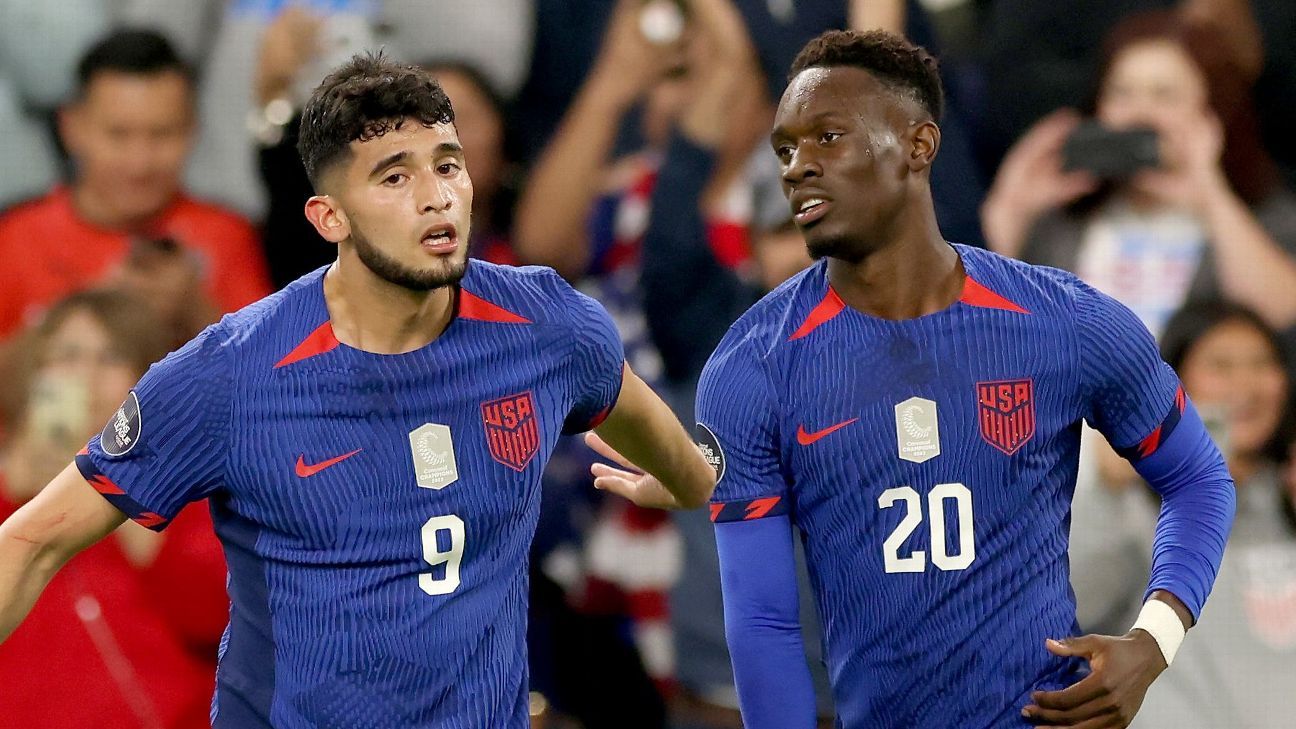
With just under three months remaining until the FIFA World Cup kicks off this summer, co-hosted by the United States, Mexico, and Canada, U.S. men’s national team coach Mauricio Pochettino faces critical decisions ahead.
Pochettino will need to trim his pool of players down to 26 for the prestigious tournament, an undoubtedly challenging task. While the U.S. may not yet boast the depth of elite teams such as Spain, France, and England, the talent within the American squad has significantly improved, with more players showcasing their skills internationally.
In the forward position, several American players are making names for themselves by scoring in competitive European leagues. Notable strikers include Folarin Balogun of AS Monaco, Ricardo Pepi from PSV Eindhoven, Haji Wright of Coventry City, and Patrick Agyemang of Derby County, who have all established themselves as reliable options for the national team ahead of the tournament. Joining them is Josh Sargent, who recently joined Toronto FC in MLS after his stint in Europe, providing a wealth of invaluable experience.
The historical struggle for the U.S. to find dependable scoring from a No. 9 since Brian McBride’s retirement in 2006 makes these developments particularly encouraging for fans and Pochettino alike. The pressing question remains: how do these strikers compare to past generations?
– Pochettino’s USMNT roster reflects a relaxed stance on club form
– Ranking: Every USMNT World Cup kit from 1990 to 2026
– USMNT 2026 World Cup Big Board 5.0: Predicting the squad for March camp
With insights from TruMedia/StatsPerform and comments from McBride, let’s assess the current state of America’s top strikers.
To set the parameters, we will evaluate season-long performances from club play leading up to the World Cup. Players like Clint Dempsey, while not traditional strikers, are included for their relevant experience in that role.
Current Landscape of U.S. Strikers
When it comes to scoring efficiency among the four recent World Cups (2014, 2018, 2022, 2026), Pepi has been impressive in the Netherlands, tallying 10 goals in the 2025-26 season, tying with Agyemang and trailing only Wright’s 16. However, Pepi leads in two key metrics: goals per 90 minutes and non-penalty expected goals per 90 minutes.
“Pepi’s movement in the box is exceptional,” McBride, who is the general manager of USL Championship side Brooklyn FC, told ESPN. “He’s a really strong finisher.”
It’s important to consider that some of Pepi’s statistics might reflect a lack of starting opportunities, as he often comes off the bench against fatigued defenses in a league not known for its solid defensive play. Nonetheless, the numbers speak volumes, as evidenced by Fulham‘s interest in a potential summer transfer.
Jozy Altidore is second on the lists for goals per 90 minutes and non-penalty expected goals per 90, having had a successful stint in MLS from 2017 to 2018. Behind them, Wright stands out with his impressive scoring record and versatility, making him a formidable candidate for the upcoming roster.
“Wright has the ability to play on the wing as well,” McBride added. “He might not be the traditional hold-up player, but he offers versatility.”
Ultimately, the most complete striker and likely frontrunner for the USMNT’s starting position this summer is Balogun. The Monaco forward is joint leader in big chances created per 90 minutes alongside Dempsey and has netted eight goals in Ligue 1.
In total, his tally rises to 14 across all competitions this season, including matches in the prestigious UEFA Champions League. In terms of assists per 90 minutes, he is just shy of Dempsey’s record and that of former Eredivisie standout Aron Jóhannsson.
Although the sample size is limited, of those in contention for the 2026 World Cup, no player has a better assists-per-90 ratio than Balogun. His scoring abilities alongside his playmaking skills position him as the most well-rounded forward in the USMNT pool.
“He’s probably the most complete striker,” McBride stated. “He excels with the ball at his feet, makes great runs in the box, and can connect well with his teammates.”
Then there’s Agyemang, who stands tall at 6-foot-4 and matches Pepi’s goal tally while holding the record for most consistent club appearances in the 2025-26 season with 34 games to his name.
While his underlying numbers like expected goals per shot and goals per 90 may not impress many, Agyemang offers a unique skill set with his size. He features the best aerial duels win percentage among the current crop of strikers, making him a valuable backup choice for Pochettino.
“Agyemang excels in hold-up play,” McBride said. “He brings quality both offensively and defensively in the air.”
A broader look at the statistics indicates that the 2026 generation of U.S. strikers presents solid potential, with room for growth. Balogun, Pepi, Wright, and Sargent rank highly in expected goals per shot and shot-conversion rates, showcasing their capabilities. While this group ranks lower in attempted passes per 90 minutes, distribution is not typically a central focus for these players at the club level.
These strikers are still in development, with their ages showing that the youngest, including Agyemang, Balogun, and Pepi, are all 25 or younger, while Wright, the oldest, is 27. Sargent, also competing for a World Cup spot, recently turned 26. The stats also highlight the exceptional performances of Altidore and Jóhannsson in previous World Cup cycles.
Jóhannsson, leading in expected goals per shot, ranks second in shot-conversion rate and assists per 90 minutes. Before his 2014 World Cup debut, he boasted 17 goals and seven assists over 34 matches in the Eredivisie season, but he fell short of expectations, earning just 19 caps for the USMNT.
Altidore faced struggles in the Premier League with Sunderland but revitalized his career in Toronto. His peak form from summer 2017 to spring 2018 shows him leading in shot-conversion rate and ranking high in multiple offensive metrics.
The USMNT missed the chance to qualify for the 2018 World Cup, a year when Altidore struggled with injuries, but it’s conceivable that he might have been the go-to striker in 2026 had he remained fit and at his peak.
For the past two decades, the USMNT has not fully relied on a consistent No. 9. McBride recognizes the numerous factors affecting performance from that position, including injuries, availability, and the variability in the lineup.
“These are real challenges,” McBride commented, “but there’s definitely talent and goal-scoring capabilities within the squad.”
The World Cup approaches, and so does the prospect for one of these players to emerge as the next reliable No. 9 for the U.S. Who will seize the opportunity? Will it be the versatile Balogun, a finisher like Pepi, strategic Wright, the determined Sargent, or the powerful Agyemang?
“Anyone can claim that position and make it their own,” McBride concluded.