



-
Jeff Carlisle
Close
Jeff Carlisle
U.S. soccer correspondent
- Jeff Carlisle reports on MLS and the U.S. national team for ESPN FC.
Multiple Authors
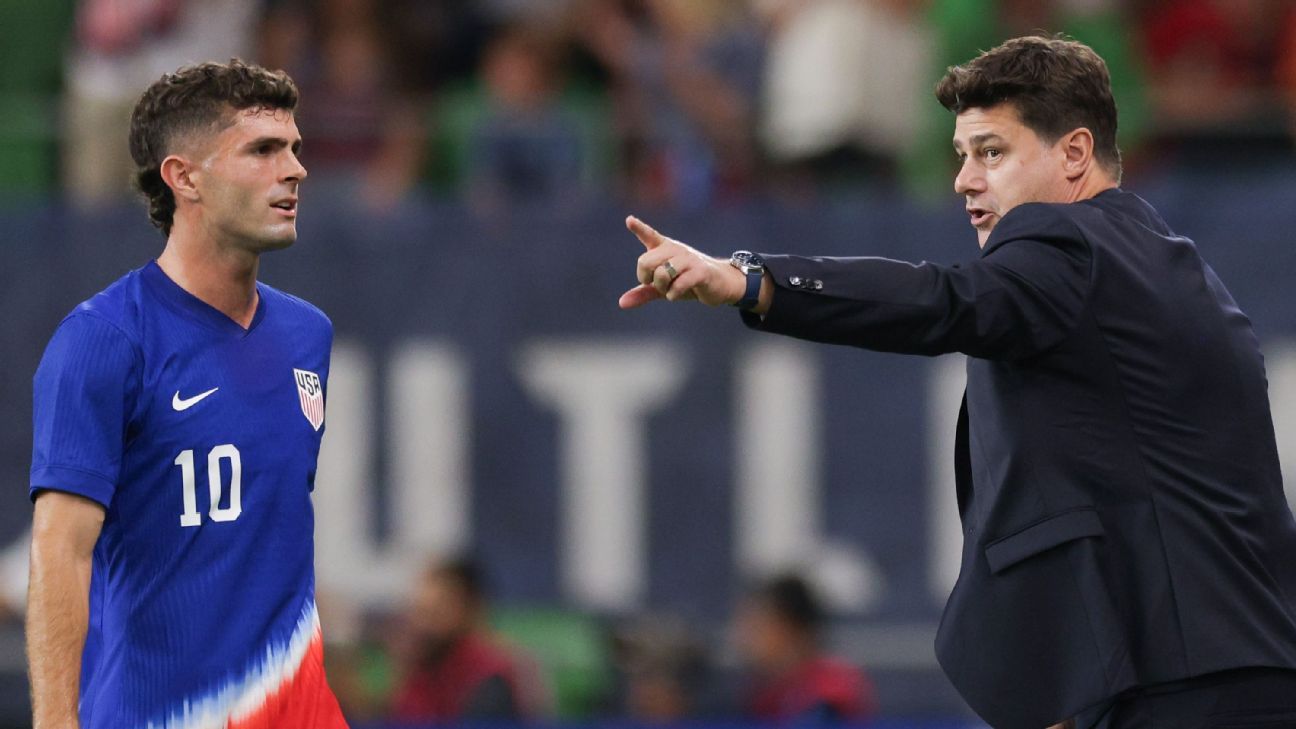
Describing the experience of playing for U.S. men’s national team manager Mauricio Pochettino reveals a mixture of feelings. Players often describe him as “intense,” “passionate,” and “demanding,” but they balance that description with terms like “family-oriented,” “likable,” and even “loving.”
This duality often characterizes coaching; pulling the best from a group means navigating a wide range of emotions and approaches, which can shift not just from player to player but throughout a single session. The right moment may call for tough love, while another might require a comforting hand. Coaches strive for this balance, even when it’s impossible to connect with every player.
Recent performances indicate that Pochettino’s method is yielding positive results. The U.S. men’s national team (USMNT) is on a five-game unbeaten streak leading up to friendlies against Belgium on March 28 and Portugal three days later.
While these results have come in friendly matches, as the U.S. prepares to co-host this summer’s World Cup, their focus remains on the opponents they face. Thus far, the trajectory looks promising, largely thanks to Pochettino’s strategies and the players’ willingness to embrace them.
“He demands intensity and mentality — energy is what he expects from us,” said midfielder Cristian Roldan in an interview with ESPN. “His approach is contagious. He’s approachable, often hugs players, engages in conversations, and does not shy away from yelling when necessary. You know he comes from a good place, and as long as you deliver what he asks, you’ll be in a good position.”
– The latest USMNT Big Board: Who’s in and who’s out?
– Ranked: Every USMNT World Cup kit from 1990 to 2026
– USWNT transfer grades: Every American move assessed
A USMNT culture that’s “more strict”
Pochettino’s arrival in September 2024 marked a pivotal shift for the USMNT, signaling the need for transformation after negative habits seeped into the team culture.
This transformation was partly a response to the instability of having two interim managers in quick succession at the start of 2023 and the eventual return of Gregg Berhalter, whose second tenure failed to replicate the progress made during the previous cycle. A growing sense of complacency led to stagnation.
When Pochettino took over, he established clear expectations: every player must earn their spot without guaranteed roles based on reputation or public perception. Accountability became paramount.
“No one is above anyone else; as you enter camp, you are a U.S. men’s national team player, and you have the right to be there,” midfielder Tyler Adams said. “[Pochettino] ensures you improve with each camp and feel worthy. Yet it is essential to contribute to this environment, and every camp has required players to adapt.”
Adams believes Pochettino hasn’t altered the culture but rather revealed the inherent strength within the team. “It’s always been there; it just needed someone to bring it out,” he noted.
How exactly did Pochettino inspire this shift? According to Adams, it was a matter of establishing stricter standards from day one, emphasizing trust and respect among players.
“If you’re going to disrupt that trust or disrespect anyone, you won’t last long here,” Adams added.
The transition wasn’t immediate. The USMNT’s lackluster performances at the 2025 Concacaf Nations League finals, where they suffered defeats against Panama and Canada, prompted criticism from former players about the current generation’s commitment.
Pochettino responded decisively by excluding certain players, like Weston McKennie, from future camps. He initiated a squad for the 2025 Gold Cup that leaned youthful, with 12 players having five or fewer international caps.
Even though the U.S. lost to Mexico in the Gold Cup final, the intention was clear: Pochettino was prioritizing a cohesive team dynamic over assembling merely the most talented individuals.
Pochettino’s patience was key, recognizing that adjustments take time, especially given the different background he brought to the team.
“We all knew there would be growing pains with a new coach, but grace is essential during this adjustment,” said U.S. defender Mark McKenzie. “Recognizing that perfection doesn’t come immediately is crucial.”
2:58
Is Mauricio Pochettino under pressure to deliver success for USMNT in the World Cup?
The ‘Futbol Americas’ crew debates whether Pochettino faces serious pressure to achieve results for the USMNT as they prepare to host the 2026 FIFA World Cup.
These growing pains have eased, but with less than 100 days to go before the World Cup and only one more international window available, pressure will likely mount as the roster announcement approaches in May. Will fear become a dominant emotion for players in the lead-up to the tournament?
“Honestly, I think some guys will feel scared,” veteran defender Tim Ream shared. “That’s a realistic feeling to have.”
“The reality is, your position isn’t guaranteed, no matter your standing. There’s always someone younger, faster, more skilled trying to take your role. To hold them off, you just have to keep working. That’s the sport,” he added.
The USMNT’s intense “die for the shirt” mentality
Pochettino instills a culture of accountability that extends into training, often requiring a level of commitment that is physically demanding. When they train, nothing outside the pitch matters. While perfection is not the objective, maximum effort, intensity, and focus are non-negotiable.
“Every small detail counts — every pass, every bit of communication,” Ream emphasizes. “Pochettino demands that level of attention in training. The focus must solely be on our tasks during every session, which can be exhausting.”
The expectation is that training sessions should simulate game conditions. This sometimes results in competitive, physical settings where players are not shy about tackling each other.
“In practice, I’m going to engage and challenge for every tackle – not recklessly, but with competitiveness,” McKenzie stated. “Winning tackles and duels is essential, reflecting how we aim to play.”
The underlying philosophy is to elevate the entire squad’s performance through shared competitive energy.
“You see guys who typically shy away from tackles getting involved. That’s the contagious aspect of our culture,” Roldan noted.
1:38
Is Pulisic right to respond to criticism directed towards him by USMNT legends, including Landon Donovan?
The Futbol Americas panel discusses Christian Pulisic’s response to criticism from various USMNT former players.
The structure of training sessions aims to reflect the actual competitive environment players will face in matches. Every drill or tactical exercise is purposefully designed to maximize effort and minimize wasted energy.
“Every drill leads us toward a unified vision of how we want to perform on the field,” McKenzie explained. This diligent approach fosters a training environment that ends with both physical fatigue and a desire to return to the field the next day. Pochettino’s cultural reset has had the intended impact.
“Overall, the culture is that players are willing to ‘die for the shirt’ now,” goalkeeper Matt Turner mentioned.
From “inmates running the asylum” to unity
In the previous cycle, a leadership council of select players was implemented under Berhalter to gauge morale, but Pochettino has opted for a structure that fosters more open communication, where every player’s voice matters.
“Previously, it felt like the inmates were running the asylum,” Ream remarked about the former leadership council. “Certain players had a disproportionate say, making others hesitant to contribute. Now, it’s a collective effort. Everyone feels empowered to voice their opinions.”
While Pochettino typically allows players their autonomy at their clubs, Ream notes that the amount of communication among players—both during and outside of camps—has reached new heights, to the point where he struggles to keep up with all the group chats.
Nonetheless, Pochettino remains the leader, and he has not hesitated to address players publicly when they step out of line.
The team’s most prominent figure, Christian Pulisic, expressed confusion regarding Pochettino’s decision to exclude him from two pre-Gold Cup friendlies, despite his plans to skip the tournament. Pochettino emphasized that he was “not a mannequin” and would prioritize decisions in the team’s best interest, regardless of Pulisic’s views.
Pochettino has also communicated his displeasure with midfielder Timothy Weah for trivial comments concerning World Cup ticket costs, asserting that players should focus solely on their performance.
Whether this method signifies Pochettino’s attempts to maintain focus or alludes to underlying tensions remains unclear. The results of the upcoming World Cup will ultimately evaluate his approach, yet players appear committed based on their public statements.
Pochettino’s personal touch with players
Effective communication is vital in coaching, directly influencing knowledge transfer, trust, motivation, and performance. A single misstep in communication can disconnect an entire locker room.
Pochettino’s communication style comprises two aspects: his interactions on the field versus those off the field.
During training, knowing when to step in versus when to allow players to experiment is key. Over-intervening can disrupt a session’s rhythm.
“Pochettino excels at recognizing when to intervene and when to allow the players to work through challenges,” Ream highlighted. “Frequent interruptions can diminish the weight of his input.”
This understanding mirrors match dynamics; once the game kicks off, players carry most of the influence. McKenzie compares this to assembling an assembly line — meticulous training builds the framework, while players must steer it effectively during matches.
Away from the pitch is where Pochettino often delivers his most crucial work. Here, he can connect with players on a personal level, gathering insights about their backgrounds and feelings. This approach enables him to understand how to motivate and connect with players best.
“He’s genuinely interested in personal conversations, getting to know about your family, and understanding you beyond just a player,” Ream shared. “Initially, some were unsure about this approach, but now they have grown to appreciate his style.”
Turner added, “When a coach is intense, demanding, yet caring, you naturally develop ways to communicate effectively. Understanding one another becomes crucial.”
This emphasis on connection fosters unity among the players and staff. While past discussions revolved around a brotherhood, the prevailing term now is “family,” encompassing everyone involved in the team.
“That familial aspect is significant,” McKenzie noted. “It cultivates an environment where conversations are invited, making every member feel included, whether it’s their first or fifty-first camp.”
This strengthened bond will be essential as the squad gears up for the World Cup, which begins for the USMNT on June 12 against Paraguay. If they perform as intended, they could find themselves together for two months in the high-pressure context of the tournament, spanning from their May camp to the final on July 19.
“This closeness is vital; accomplishing something extraordinary requires it,” Ream affirmed. “You’re facing the biggest tournament in the sport’s history; that connection is crucial for success.”