



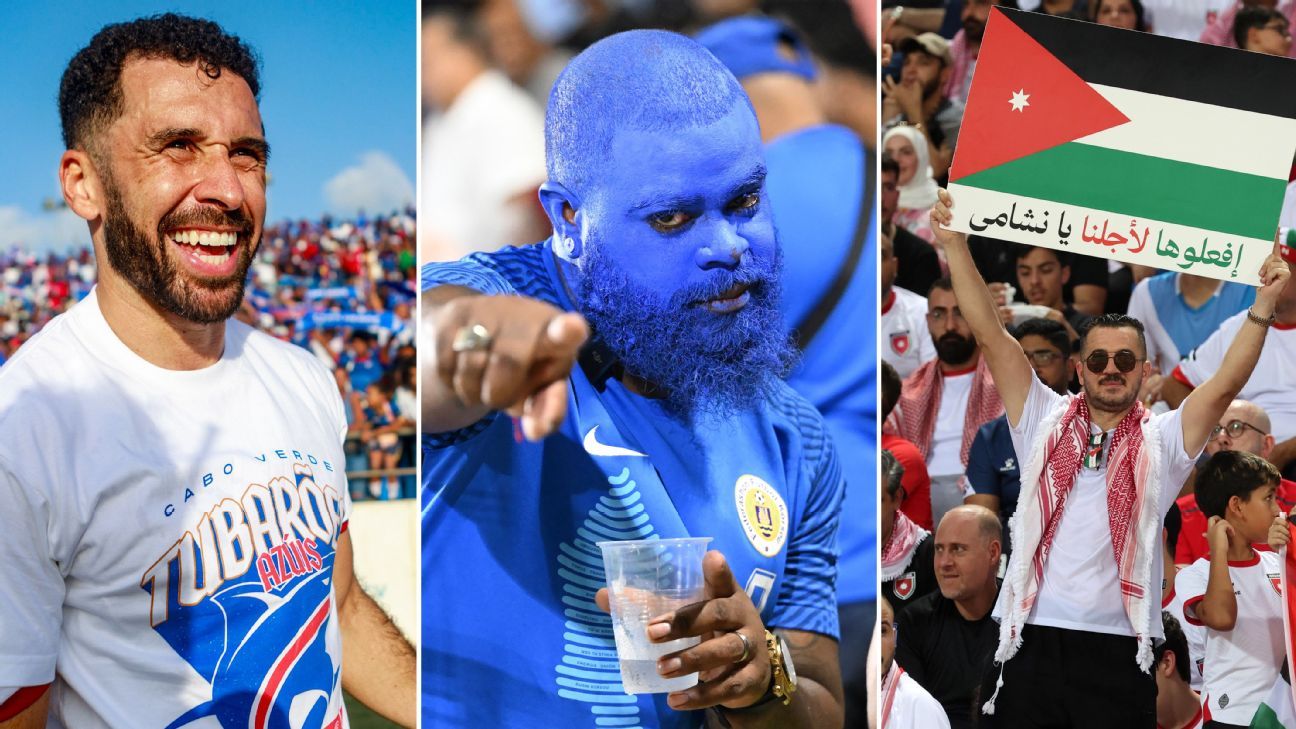
For every soccer enthusiast, witnessing their country’s participation in a World Cup is a cherished dream. Yet, for numerous member associations of FIFA, comprising 211 nations, this aspiration remains elusive.
The 2026 World Cup, co-hosted by Canada, Mexico, and the United States, marks an exciting development as the tournament expands to 48 teams. This change opens opportunities for nations that previously struggled to qualify, while others benefit from a surge of talent in their squads, elevating their chances to compete at the finals for the first time.
The highest number of debuting nations in a World Cup, excluding the inaugural tournament in 1930, is six. At the 2006 event, teams such as Angola, Ivory Coast, Ghana, Togo, Trinidad and Tobago, and Ukraine made their debut.
– Will USMNT’s depth impact their success at the 2026 World Cup?
– Essential info about the 16 World Cup host cities
– Check out the official poster and stunning art from host cities for the 2026 World Cup
As the playoffs unfolded in March, there were up to nine potential newcomers vying for spots in the 2026 tournament. Ultimately, only four of these teams will be on display when the competition begins on June 11.
Cape Verde, Curaçao, Jordan, and Uzbekistan have secured their places. Yet, how much do we really know about these nations, both on and off the field? For many global fans tuning in this summer, the answer is likely not much.
We consulted with experts from each debutant nation to help us get to know the 2026 World Cup’s lesser-known participants.
Cape Verde, a volcanic archipelago with ten islands off the West Coast of Africa, qualified by winning Group D in Africa, triumphing over Cameroon to claim the top spot.
With a population of just 525,000, Cape Verde is among the smallest nations ever to qualify for a World Cup, following Iceland (2018) and fellow debutants Curaçao. Their historic win occurred on October 13 when they defeated Eswatini 3-0 at home, igniting exuberant celebrations in the capital, Praia.
“I was trying to stay calm on the day of the Eswatini match, but my stomach was filled with nerves,” said Cape Verde defender Roberto ‘Pico’ Lopes in an interview with ESPN.
“I was meant to take a pre-game nap, but one of the players plugged in some speakers and started playing music. We all began dancing, and you could just feel that it was going to be our day.”
The camaraderie within the Cape Verde team thrives on music and food, as they connect from various corners of the globe for international matches.
“Music is an essential part of our dressing room vibes,” Lopes shared. “We enjoy traditional songs and funaná music, blending old and new. Our national dish, Cachupa (a bean and corn stew), is a must-have at dinner and breakfast, and we share it together.”
The Blue Sharks have previously reached the quarterfinals of the Africa Cup of Nations in both 2013 and 2023, showcasing their competitive spirit, but the magnitude of qualifying for a World Cup is unmistakable.
“We’ve been preparing for years, and once the draw was made, our resolve intensified. We thought, ‘If not now, when?'” Lopes said.
“The government even granted a day off work for everyone to watch the Eswatini match. Qualifying means everything to us. As small islands competing with footballing giants, it’s a matter of immense pride.”
Cape Verde will compete in Group H alongside Spain, Uruguay, and Saudi Arabia.
“The little boy in me dreams of playing against Brazil—they embody the essence of the World Cup. But we recognize the work that lies ahead to reach that level! We’re pleased with our group,” Lopes expressed.
Jordan, situated on the east bank of the Jordan River, shares borders with five nations: Syria, Iraq, Saudi Arabia, Israel, and the West Bank of Palestine. It has emerged as a prominent tourist destination, attracting visitors to its UNESCO heritage sites and the Dead Sea, the lowest point on Earth.
“Petra, the ancient city and archaeological site, is among the most famous tourist attractions in Jordan,” shared fan Zaid Al Atiyat with ESPN. “It’s often called the ‘Rose City’ owing to its reddish sandstone, and is recognized as one of the New 7 Wonders of the World after a campaign in 2000.”
“If you seek an otherworldly experience, Wadi Rum offers a dramatic landscape reminiscent of Mars. It has been featured in acclaimed films like Dune, Star Wars, The Martian, and Lawrence of Arabia.”
Jordan’s culinary pride, ‘mansaf’—lamb cooked in a sauce made from fermented dried yogurt and served with rice or bulgur—also recently sparked some on-field controversy.
“In a 2023 AFC Asian Cup knockout match against Iraq, Jordan forward Yazan Al-Naimat celebrated by forming a Bedouin-style circle with teammates and gesturing as if eating mansaf,” Al Atiyat recounted. “When Iraq took the lead, their scorer, Aymen Hussein, mirrored this in his own celebration, eventually leading to a controversial second yellow card from referee Alireza Faghani.”
Aymen Hussein has been shown a second yellow for over celebrating! 🍛#AsianCup2023 #HayyaAsia pic.twitter.com/9i90ART2zh
— beIN SPORTS (@beINSPORTS_EN) January 29, 2024
Jordan emerged victorious against Iraq, winning 3-2, and eventually reached the final, where they faced Qatar.
They secured their World Cup spot in June 2025 with a 3-0 away victory over Oman, finishing as the runners-up in Group B behind South Korea.
“I never thought I’d witness Jordan on such a prominent stage,” Al Atiyat remarked. “The 2023 Asian Cup truly allowed us to dream without limits.”
In the World Cup, Jordan is placed in Group J against Austria, Algeria, and Argentina. Although they face a formidable challenge ahead, they have talented players ready to shine.
“Mousa Al-Tamari, known for his speed and dribbling, should be a player to watch from Jordan,” Al Atiyat said. “He is the first Jordanian to score in a top five league and is now an integral part of Stade Rennais.
“Yazan Al-Arab stands as our anchor in defense; he’s the first Jordanian to play in K League 1 [for FC Seoul], and was recognized in the K League’s 2025 Team of the Year.”
Curaçao, a picturesque Caribbean island within the Kingdom of the Netherlands, has made its way into soccer lore. With a population of only 156,000, Curaçao has now achieved the remarkable feat of being the smallest nation to qualify for a World Cup, taking advantage of the absence of three traditional giants in CONCACAF during the qualification process.
Soccer and baseball are the two major sports in Curaçao. While legendary baseball player Andrew Jones hails from Curaçao, the island had yet to achieve significant success in soccer until now.
“Once we learned that the tournament would be held in the USA, Mexico, and Canada, we were confident we could succeed,” shared Brenton Balentien, known as Captain Blue Face, a former youth international and leader of the supporters’ group for Curaçao, in discussion with ESPN.
But the road to qualification came with its share of anxiety as Curaçao had to travel to Jamaica on the final matchday, needing at least a draw to secure their spot.
“After defeating Jamaica at home, I felt we were destined, but during the away game, I thought my heart might stop when they were awarded a penalty at the last moment, only for VAR to disallow it. That feeling is unforgettable!” Balentien recounted.
Most of Curaçao’s players hail from the Netherlands, and they qualified under the experienced guidance of legendary Dutch coach Dick Advocaat. Although Advocaat, who is 78, was set to become the oldest World Cup manager, he stepped down due to family obligations. Nevertheless, Curaçao’s culture showcases diverse influences.
“Curaçao is a melting pot of many cultures,” Balentien explained. “We speak multiple languages, including Dutch, English, Spanish, Papiamento, Portuguese, and French.”
While many naturally support the Netherlands during the World Cup, locals born and raised in Curaçao feel an obligation to back Brazil, a team cherished since the days of Pelé.
Curaçao faces tough competition in Group E, where they will play against Germany, Ecuador, and Ivory Coast. Regardless of the outcome, it is expected to be a memorable time on the island.
“There’s always a vibe of celebration, especially around sports. We know how to enjoy good food and drink,” Balentien emphasized.
“Our specialty is Kuminda di Tera, or earth food, which includes goat and iguana, along with okra soup—those are community favorites. And don’t forget the blue Curaçao, our vibrant orange-flavored liqueur produced at the local distillery, Landhuis Chobolobo.
“No matter the result, we’re celebrating the chance to compete on such a grand stage.”
Uzbekistan has made history as the first Central Asian nation to qualify for a World Cup, finally overcoming a history of near-misses to take part in the world’s premier soccer event.
The former Soviet republic, home to around 38 million people, possesses an interesting geographic distinction, sharing it with the small European nation of Liechtenstein: being one of the two doubly landlocked countries worldwide—a situation where two other countries lie between any land border and the coastline.
“Uzbekistan was once the heart of the Great Silk Road, which linked many great civilizations,” noted supporter Jaloliddin Makhmudov during his conversation with ESPN.
Uzbek cuisine also boasts remarkable achievements.
“Our traditional dish, plov, is enjoyed during every significant event, from weddings to funerals,” Makhmudov explained. “We’ve even set a Guinness World Record for preparing 7,360 kg [16,226 lbs] of Plov in Tashkent, our capital.”
Uzbekistan remained unbeaten in the second qualifying round and sealed their World Cup spot with a game to spare, ensuring their successful bid, especially in light of their past near misses.
The White Wolves were bitterly disappointed in their previous campaigns, losing a World Cup playoff to Jordan on penalties in 2014 and being controversially eliminated in 2006 by Bahrain due to a refereeing error that resulted in a first-leg replay.
“The entire nation has held out hope for the World Cup for 34 years,” Makhmudov declared. “We often fell short in the final rounds, which deeply affected our population.
“Football is undoubtedly the most beloved sport in Uzbekistan, despite our status as one of the best boxing countries. Participating in the World Cup is immensely important and we’ve always had faith in our capabilities, especially as our players begin to shine in top leagues while our domestic football continues to evolve.”
Uzbekistan will be led by Fabio Cannavaro, Italy’s 2006 World Cup-winning captain and Ballon d’Or recipient. Star player Abdukodir Khusanov from Manchester City adds star power to the squad, with other exciting players ready to shine.
“Oston Urunov’s exceptional dribbling and shooting make him a player to watch,” Makhmudov stated. “And Abbos Fayzullaev recently earned the title of 2023 AFC Youth Player of the Year, so prepare for surprises!”