



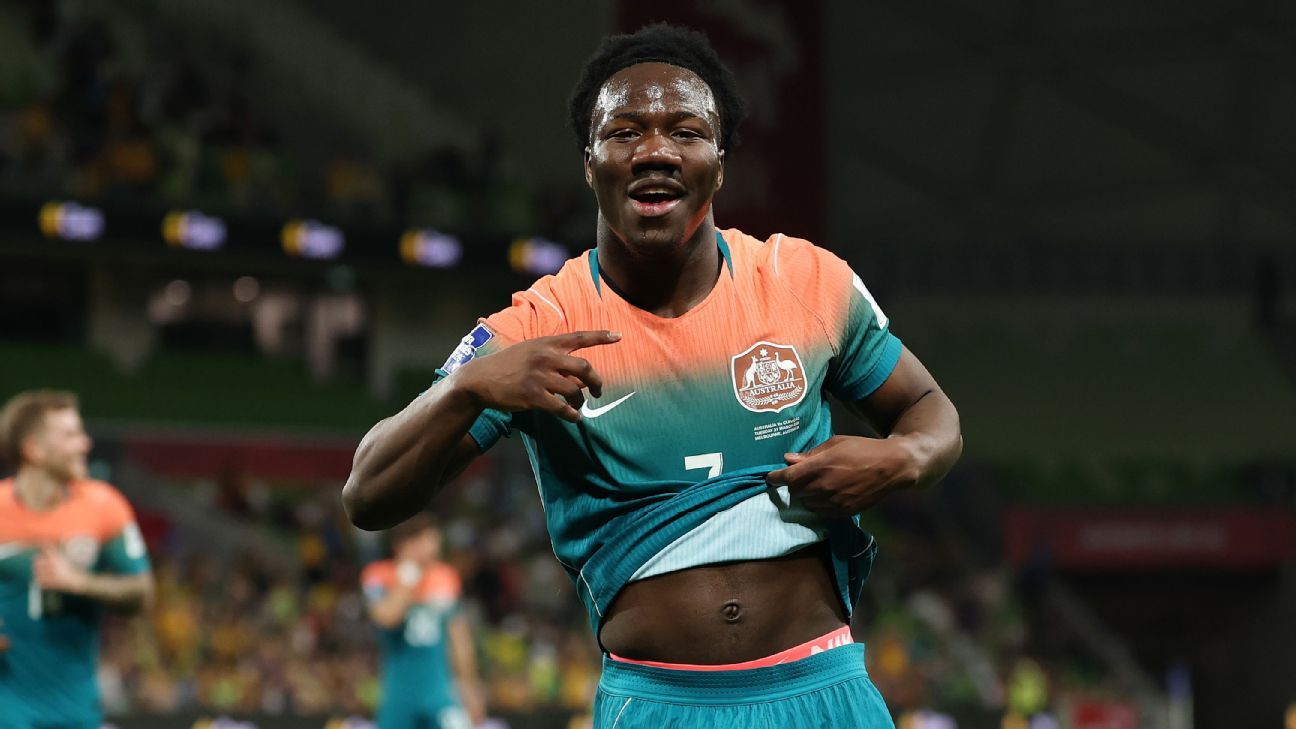
MELBOURNE — Nestory Irankunda has a special fondness for Michael Jackson, particularly for his hit “Smooth Criminal” — a classic tune recounting the tale of Annie, who falls victim to a stealthy assailant. In contrast, the Socceroos forward made his impact clear at AAMI Park on Tuesday, scoring two goals in a remarkable 17-minute surge that propelled his team to a 5-1 triumph over Curacao. He commemorated his first goal with a celebration inspired by Jackson, donning a silver glove tossed to him from the crowd and executing the pop star’s iconic crotch-grabbing dance.
“He’s my mate,” Irankunda shared about his mysterious glove supplier, who is a photographer he connected with on Instagram. “He reached out to see if I’d like to do something Michael Jackson-related, and I jumped at the chance since I’m a massive fan.”
– Ogden: Türkiye emerge as favorites for World Cup Group D following late qualification
– Introducing the 2026 World Cup debutants: Cape Verde, Curacao, Jordan, Uzbekistan
– Live updates: Italy is eliminated from a third consecutive World Cup after a loss to Bosnia
Partnering with Jordan Bos and Riley McGree, who both joined the game in the 66th minute, Irankunda played a vital role in boosting the Socceroos in the final 20 minutes, dramatically converting a sluggish narrative following their farewell match in Melbourne. This match marked the last on home turf before the FIFA World Cup and served as a critical rehearsal before Tony Popovic announces the expanded squad for the tournament.
Leading up to this game, anticipation and confidence had been dwindling. After Awer Mabil’s first-half goal nudged Australia ahead, they had struggled to convert chances against their Caribbean rivals, who quickly found an equalizer when Ar’jany Martha breached the defense five minutes into the second half. The atmosphere in the stadium dimmed, and captain Mathew Ryan acknowledged post-match that the team had to rally together to overcome some testing times.
Popovic responded by making strategic substitutions, a hallmark of his coaching philosophy, which focuses on breaking through the opposition with a combination of speed, intent, precision, and innovation from standout players. McGree previously made a significant impact off the bench, assisting Aziz Behich for a crucial goal against Japan, and all of Irankunda’s goals under Popovic have occurred in the second half. These substitutions symbolically indicated the coach’s aggressive intent.
With the score hanging in the balance and the coach likely not wanting to add stress with a negative narrative as they approach the World Cup, experimentation was set aside. Cameron Burgess was brought in to solidify the defense, and the team pressed forward with renewed intensity.
The reward came quickly, with Irankunda and McGree combining, leading to McGree assisting Alessandro Circati for his first goal for the Socceroos just two minutes post-substitution. Bos then received a pass from McGree, skillfully cut inside, and curled the ball in off the far post. Irankunda then danced through defenders before unleashing a shot that despite a touch from Eloy Room couldn’t be kept out. He capped off the scoring by slotting the ball past Trevor Doornbusch, who had come on as a substitute for Room.
This sequence was thrilling for Socceroos fans, vividly illustrating their potential to be devastatingly effective when unleashing their youth talent. As the season nears its conclusion, Irankunda, Bos, and McGree have been carefully managed, but they are expected to play pivotal roles come June. Meanwhile, Circati stands out as a quality defender, Kai Trewin has been evaluated as a potential right wing-back, and Paul Okon-Engstler displayed promising potential in midfield after joining at half-time.
The hope is that by the time the World Cup arrives, they will draw even more game-changing talent from a fit Mohamed Toure. With Toure absent due to injury, Deni Jurić took his place in the starting XI for the second consecutive game, aiding in Mabil’s opener with his astute positioning and flick-on. However, the Wisła Płock striker has not yet claimed the starting position. Ante Suto was not utilized in his debut matches, with Irankunda instead taking on a second-half substitute role in both games.
This need for automatic qualification underscored its significance, granting Popovic the chance to introduce players like Toure and Irankunda into the mix slowly through low-stakes friendlies after limited use during qualification. This strategic approach allows valuable gameplay experience while emphasizing the necessary standards and expectations, both on the field and off. Irankunda’s three goals this window highlight his capacity to penetrate the penalty area and shoot — a key focus of improvement emphasized by Popovic over the past year.
“It’s been a major focus,” Irankunda remarked. “To be part of the national team, getting into the box is what he expects from me — and he wants me doing the same at my club too.”
However, zooming out for a broader perspective, Tuesday’s match served as a reminder of how the Socceroos, despite personnel changes, will likely approach the World Cup. They will establish a solid defensive foundation—known for their robust defending—then rely on individual talents to seize a game-winning moment. This was evident on Tuesday, in the past against Cameroon, and in numerous other occasions.
This approach doesn’t eliminate risk but rather reshapes it — reducing defensive vulnerabilities while raising the stakes for their attacking players. The team has historically excelled at capitalizing on limited chances under coaches Graham Arnold and Popovic, outperforming their expected goals (xG) during qualifiers, but faltering following qualification when their clinical edge waned.
Whether this playing style will be effective against the Group D contenders — Türkiye, the United States, and Paraguay — in just two months will determine not only Popovic’s future but also the trajectory of Australian football for years to come. Can they handle the pressure against seasoned teams, adapt after setbacks, and learn from the challenges posed by teams like Venezuela and Colombia? Effectiveness, despite its complexity, will be key.
The answers will become clear soon enough, as this is the playing style that has brought Popovic to this point, and now he must make it work on the world stage. Yet, while he may not be moonwalking through it, he will certainly be dancing with the pressures of expectations.