



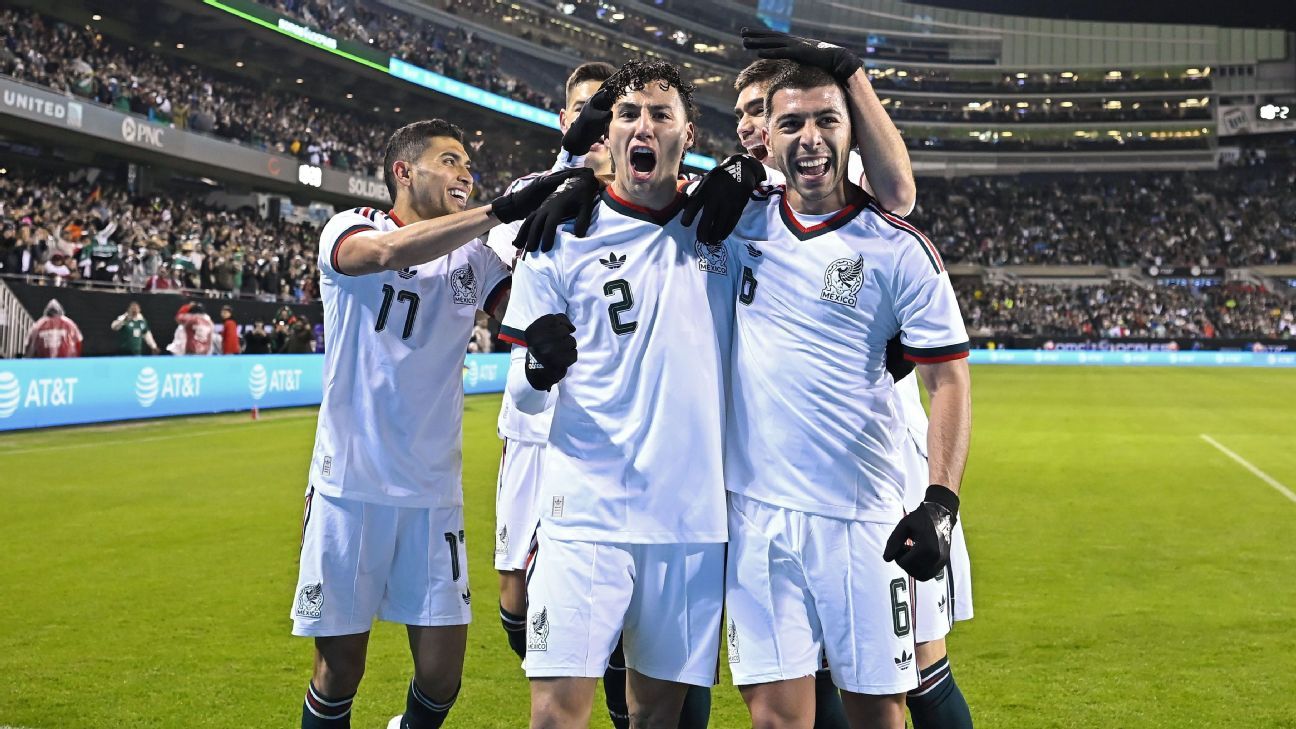
It’s easy to overlook how bleak things appeared for Mexico just a few months back.
El Tri concluded 2025 on a low note, enduring a troubling six-game winless streak that represented their worst performance in a decade. With the FIFA World Cup approaching, serious concerns arose.
“Mexico’s loss to Paraguay has cost it all credibility,” one report claimed, questioning whether this was the worst national team in the last 50 years.
Normally outspoken, even the usually charismatic manager Javier Aguirre wore a somber expression when addressing the media following his final match of the year.
“You can never be truly at peace when you’re not winning,” Aguirre remarked during a winter press conference. “Sometimes, old issues resurface, and a negative outcome reveals that we haven’t overcome them. We still haven’t reached our desired destination.”
However, fortunes can shift swiftly. Opening January with a 1-0 victory over World Cup-bound Panama, Mexico has navigated away from turbulent waters, embarking on an unbeaten five-game streak in 2026. With a record of 3 wins, 2 draws, and no losses, along with a solid plus-6 goal differential, El Tri is gaining momentum as the summer approaches.
It’s worth noting that the two draws in March came against top-10 teams, Portugal (0-0) and Belgium (1-1). These results still signify progress for the national team, particularly when evaluating Tuesday’s draw against Belgium.
Mexico outperformed their opponents with 10 shots to 5 (0.9 xG for Mexico, 0.3 xG for Belgium), won a greater percentage of duels (54.4% to 44.9%), and created more key passes (seven to two), leaving the European side visibly upset by El Tri‘s aggression throughout the match. Had it not been for a stunning long-range strike by Dodi Lukebakio, Belgium’s only goal, we might have been discussing a historic win for Aguirre and his team.
National media, once frustrated with Aguirre and El Tri, have since changed their perspective. Ricardo “Tuca” Ferretti, a former Mexico coach and current analyst on Futbol Picante, heaped praise after the draw with Belgium.
“In Javier [Aguirre]’s era, this was the best performance I’ve witnessed,” he stated.
Although it’s a flawed comparison, this is the same Belgium team that recently crushed the U.S. men’s national team 5-2 last week. The U.S. then lost 2-0 to Portugal on Tuesday. For Aguirre, managing to avoid such losses and keeping pace with Portugal and Belgium signals progress in molding his roster.
“The team’s attitude was very good … the atmosphere was positive,” he reflected on the recent matches. “I’m leaving [the March window] feeling satisfied.”
But what changes have occurred for Mexico in 2026? It’s one thing to beat teams like Panama, Bolivia, and Iceland earlier this year, but how did they manage to almost conquer a top-tier team like Belgium and hold their own against a World Cup contender like Portugal?
Several factors come into play here—one notable trend is Mexico’s escalating scrappiness, winning more duels—but perhaps the clearest difference in this window and throughout the year has been the opportunity afforded to alternate players. With injuries affecting multiple positions, the competition for World Cup roster spots has become more open.
Prominent players like Edson Álvarez, Rodrigo Huescas, Mateo Chávez, Gilberto Mora, and César Huerta are recovering from short-term injuries, while players like Luis Ángel Malagón and Marcel Ruiz are sidelined due to more serious injuries. While a fully fit team would be the ideal scenario, this situation has prompted others to rise to the occasion.
In the March fixtures, substitutes and newcomers such as Brian Gutiérrez, Erik Lira, Obed Vargas, and Álvaro Fidalgo impressed in their starting roles. Julián Quiñones, who has often found himself in and out of Aguirre’s rotation, delivered a standout performance against Belgium. Jorge Sánchez, potentially a No. 3, 4, or even 5 option at right back if the roster were fully fit, exceeded expectations with a goal in the 19th minute.
The examples are plentiful, and these players are not only motivated by their opportunity but also by the understanding that the recent international window served as a crucial audition ahead of Aguirre’s World Cup roster selection. When asked if he felt assured of a spot on the major tournament team post-Belgium match, the Spanish-born Fidalgo chuckled.
“No, no, no, certainly not,” he replied. “There are some truly incredible players here. I need to keep performing well. I just have to focus on my club duties and continue to improve.”
With 71 days remaining until their World Cup opener against South Africa, the pressing question is whether El Tri will sustain their growth.
This is the critical inquiry for Aguirre and his team as they refine their strategy for what could be a bright and promising summer. Given that they will co-host the tournament with the U.S. and Canada, the outlook is generally favorable for the home nations in any World Cup.
The dark clouds of Mexico’s winter have dissipated. With additional support from their reinforcements, they have not yet returned—at least for the moment.