



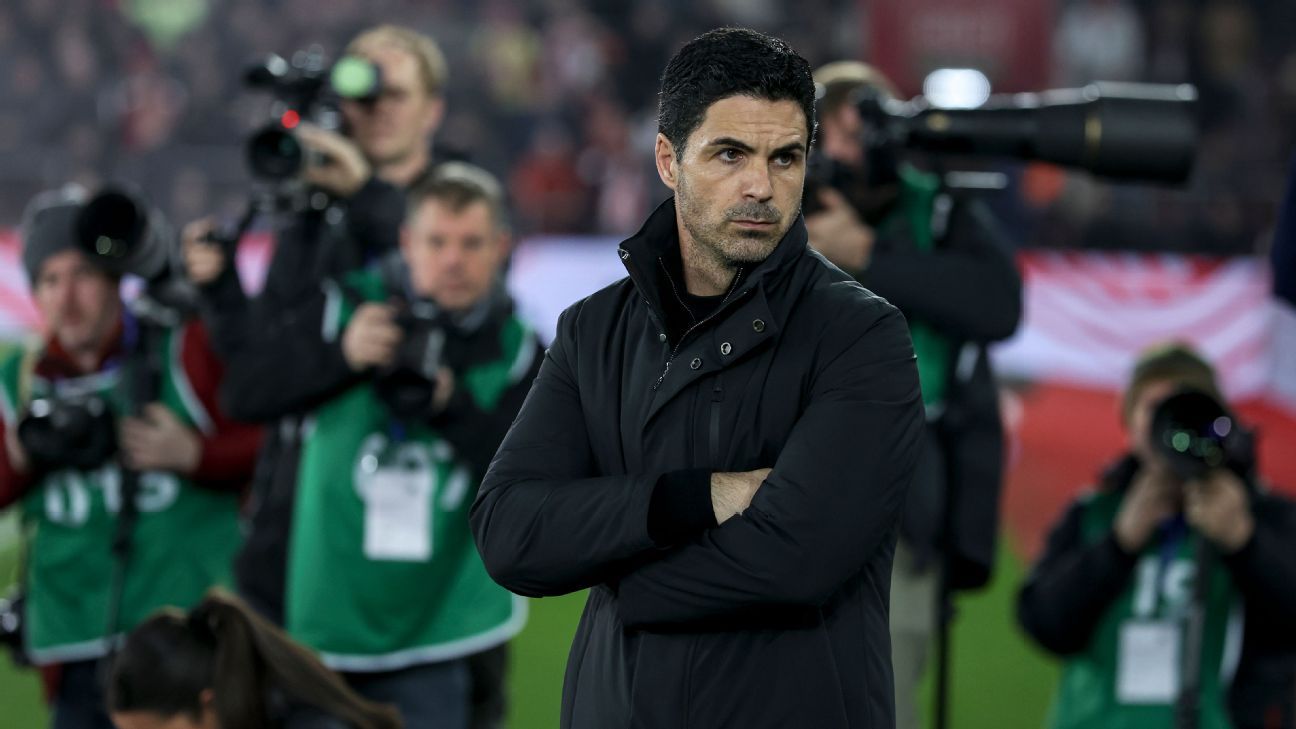
Once viewed as strong contenders for a historic Quadruple, Arsenal now teeter on the edge of a dramatic collapse. Yet, under Mikel Arteta’s leadership, they remain just five wins away from achieving success in the two competitions they so desperately want to claim: the Premier League and the Champions League. The question is: Will they find glory, or will this end in infamy?
More than ever, Arsenal’s destiny hinges on their manager’s decisions and mindset.
After the unexpected 2-1 defeat to EFL Championship side Southampton in the FA Cup quarterfinals, Arteta surely found himself wrestling with the weight of his team’s future. As he awoke on Sunday, with Tuesday’s UEFA Champions League quarterfinal first-leg against Sporting CP looming, the weight of potential success or failure continued to swirl in his mind.
With Arsenal’s season hanging by a thread, the pressure mounts on Arteta, his players, and their supporters, all haunted by the terrifying possibility of chasing a quadruple yet finishing with nothing—again.
While Arsenal seems to be faltering, title rivals Manchester City appear to be cruising toward a domestic treble. Pep Guardiola’s squad enjoys a seemingly effortless run after claiming the Carabao Cup against Arsenal and advancing to the FA Cup semifinals against Southampton, despite their exit from the UCL at the hands of Real Madrid.
For Arteta, the elimination from both domestic cups has turned into a nightmarish scenario. The prospect of failure looms larger, particularly after his team finished as runners-up in the Premier League for the last three seasons.
The issue escalates with Guardiola’s impressive record only intensifying Arteta’s doubts and fears. Having worked alongside Guardiola for three years, Arteta knows the gravity of the situation they both face.
Though Arsenal currently sits atop the Premier League standings, City trails them by nine points in second, with a game in hand and home advantage when the teams clash on April 19. It’s likely that Arsenal must win all eight of their remaining league matches to secure the title.
Since losing to Manchester United on January 17, City has remained unbeaten in the league. Arsenal’s last league defeat came just a week later against United, and their recent back-to-back losses in cup competitions don’t provide a true measure of their league form. The perception of a decline stems from Arsenal’s struggles coinciding with City’s surge.
This is the critical moment when Arteta must demonstrate his managerial capabilities. His every statement and action over the coming weeks will be pivotal, as impactful as the saves from goalkeeper David Raya, the defensive work of Gabriel and William Saliba, or the attacking brilliance of Bukayo Saka, Kai Havertz, and Viktor Gyökeres.
Arteta’s comments leading up to the Southampton match, urging his players to channel their disappointment from the Carabao Cup final into fuel for their remaining games, mirrored a moment of self-doubt. Reminding them of their previous defeat may not have been the motivational boost he intended; it sounded more like a manager struggling to instill confidence—a sentiment unlikely heard from seasoned managers like Guardiola, Jurgen Klopp, Jose Mourinho, or Sir Alex Ferguson at this critical juncture.
1:07
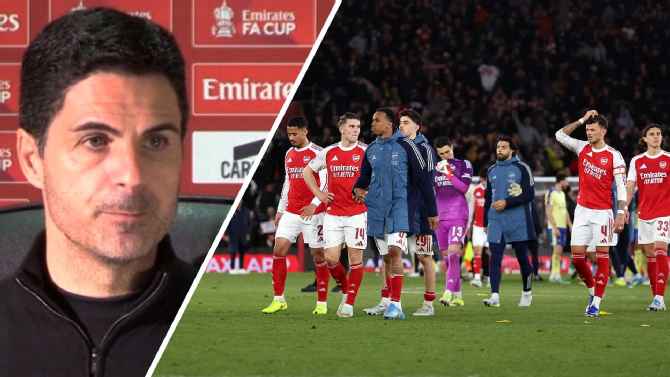
Mikel Arteta: I take the blame for Arsenal’s defeat vs. Southampton
Arsenal manager Mikel Arteta believes he is to blame for Arsenal’s FA Cup exit to Southampton.
As a relatively inexperienced manager, Arteta is still striving to solidify his legacy alongside the legends of the Premier League.
Only Mourinho was younger at 42 when he secured his first Premier League title (with Chelsea in 2004-05), having previously won a Champions League with FC Porto; Dalglish won the title at 44, but he already had three titles under his belt when he guided Blackburn Rovers to victory in 1995.
Unlike a young Mourinho or Dalglish, Arteta lacks extensive experience, and the next youngest champions—Guardiola, Roberto Mancini, and Antonio Conte—were all 47 when they clinched their first Premier League titles but had already achieved league success elsewhere. Thus, for Arteta, the quest for that first title presents a dual challenge, with his players now looking to him for guidance, inspiration, and composure as the pressure mounts.
If Arteta can keep his composure, Arsenal possesses numerous advantages. They lead the Premier League with more goals scored (61) and fewer conceded (22) than any other team, and they’ve clinched the most league wins (21) while suffering the fewest losses (3). Winning five more matches would render it impossible for City to overtake them, even if Guardiola’s squad wins all their remaining games.
In the Champions League, Arsenal has sidestepped a challenging route to the final, avoiding teams like Real Madrid, Bayern Munich, Paris Saint-Germain, and Liverpool. They’ve drawn a favorable quarterfinal matchup against Sporting CP, with Barcelona or Atletico Madrid potentially waiting in the semis.
Five more wins in the Champions League could secure Arsenal’s first-ever title in the competition, so Arteta should remain optimistic as he steers his team through this crucial period.
He simply needs to make the right decisions on the pitch and communicate effectively, even amidst the noise of mounting expectations. Sounds easy, right?