



-

Ryan O’Hanlon
Multiple Authors
Here’s a look at players with more assists in a Premier League season than Bruno Fernandes currently has:
– Achieved it twice: Kevin De Bruyne and Cesc Fàbregas
– Achieved it once: Thierry Henry, Mesut Özil, Frank Lampard, and Mohamed Salah
If tasked to compile a list of the best creative players in Premier League history, these six names would undoubtedly feature. Eric Cantona never surpassed Bruno’s current tally, and players like David Beckham, David Silva, Eden Hazard, Steven Gerrard, Trent Alexander-Arnold, and any other contender don’t come close to matching the number of assists that Manchester United‘s captain has achieved this season.
The notable difference with Fernandes is that he still has seven games remaining. If he continues at his current rate of approximately 0.6 assists per 90 minutes, he could equal Thierry Henry’s record of 20 assists from the 2002-03 season, matched by De Bruyne in 2019-20. He could also surpass it.
This indicates that Bruno is assembling what may be regarded as the most remarkable creative season in Premier League history. It’s also propelling Manchester United towards a likely third-place finish, a significant improvement from their 15th place last year. They boast a goal differential of +17 when he is on the pitch and have been outscored by one goal when he is absent.
More from Ryan O’Hanlon:
– What would the Premier League table look like without set pieces?
– Ranking all 48 teams at the 2026 World Cup
– From Dowman to Messi, the best men’s players at every age
As the season concludes, Bruno will have just one year remaining on his contract. The choice is clear: do whatever it takes to retain an all-time Premier League great at the club… right? However, the answer isn’t as straightforward as it seems. For guidance, United need only look roughly 35 miles west to the club that now shares the title for most first-division championships in English football history.
The Indispensable Bruno for Manchester United
It’s not an exaggeration to state that Manchester United could very well be playing in the Championship without Bruno Fernandes. While it’s true that they wouldn’t be left with the same squad without him—other players may have been signed to replace some of his contributions—it’s doubtful anyone could replicate his specific skillset.
Since January 2020 in the Premier League, Bruno has:
– Scored 70 goals, while no other United player has more than 48
– Provided 67 assists, while no other United player has more than 22
– Attempted 610 shots, while no other United player has taken more than 314
– Created 638 chances, while no other United player has made more than 190
– Played 171 through balls, while no other United player has delivered more than 38
– Completed 1,887 passes into the final third, while no other United player has achieved more than 909
– Won possession 1,182 times, while no other United player has managed more than 781
In nearly every facet of soccer, aside from perhaps winning headers or making saves, Bruno has been Manchester United’s most crucial player of the current decade.
At times, I have questioned whether Manchester United’s reliance on Bruno has stunted their overall potential. Yet, such concerns vanish when you’re finishing in the lower half of the table. During his time at the club, United has averaged a goal differential of +0.38 per 90 minutes with him on the field, while they have been outscored by 0.11 goals per 90 minutes in his absence.
Thus, it’s easy to deduce that without Bruno, their performance would drastically decline. Who else would fill his critical role? However, whether or not they retain him, Manchester United is unlikely to keep this version of Bruno for much longer—and they may never see him again.
The Reality of the Age Curve
This chart illustrates the concept of the “age curve,” showing every minute played by players labeled as attacking midfielders since the 2008-09 Premier League season, categorized by age:
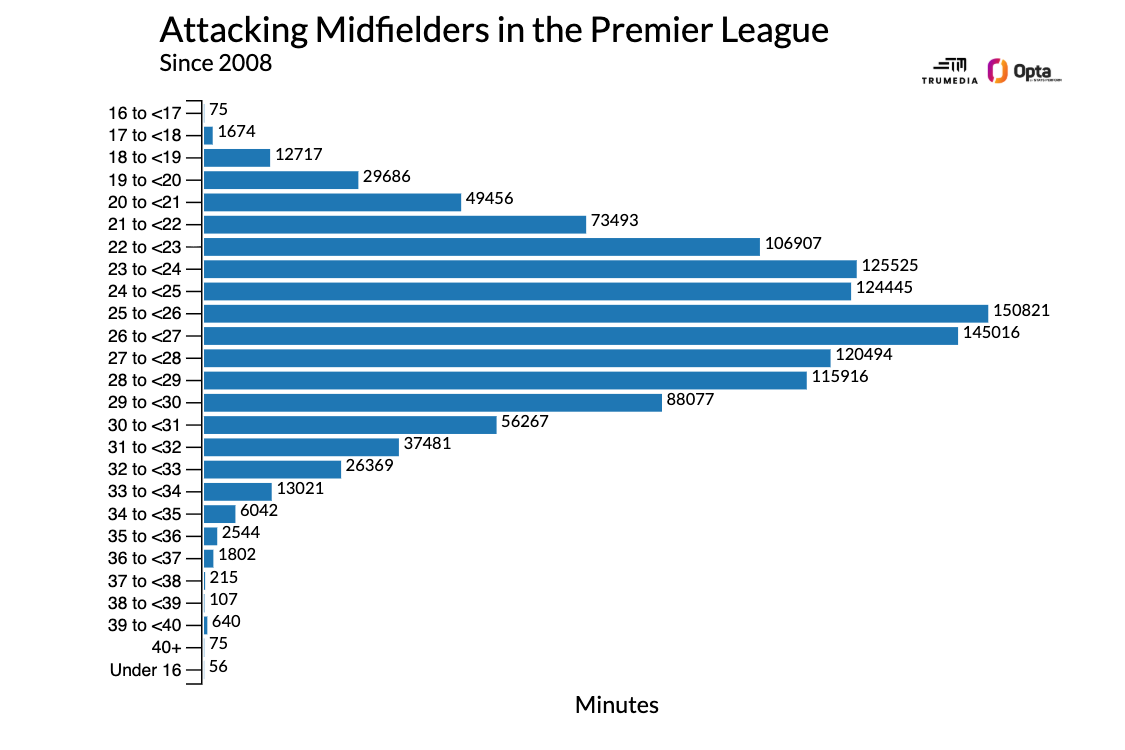
Most careers at this position thrive between the ages of 22 and 29. After that, there is typically a sharp decline at each subsequent age. It’s a common trend for athletes to experience a downturn in performance as they age, especially with Bruno set to turn 32 in September.
While he might be at the peak of his performance now, I previously noted concerns about how clubs like Liverpool, in handling high-performing players nearing their 30s:
To re-sign Salah, Liverpool had to account for the risk of paying a player like one of the best in the world right at the moment when he might cease to be one.
Substituting “Bruno Fernandes” and “Manchester United” into this analogy presents a similar scenario.
When I examined Salah alongside other players still excelling at the same age, the age curve appeared more favorable: Lionel Messi, Cristiano Ronaldo, Zlatan Ibrahimovic, and Robert Lewandowski have maintained their goal-scoring prowess into their 30s. Given Salah’s exceptional fitness and low injury rate, he seemed more likely to continue performing at an elite level, despite the age curve’s implications.
Despite my fiancée not harboring the same admiration for Bruno as she does for Salah, the Portuguese star has demonstrated impressive consistency and durability, perhaps even a greater level across the entire Stats Perform database. Bruno has accumulated more competitive minutes, at both international and club levels since 2020, than all but one player: Brazilian goalkeeper Weverton.
Excluding goalkeepers and defenders, who typically participate the entire match, here are the top 15:
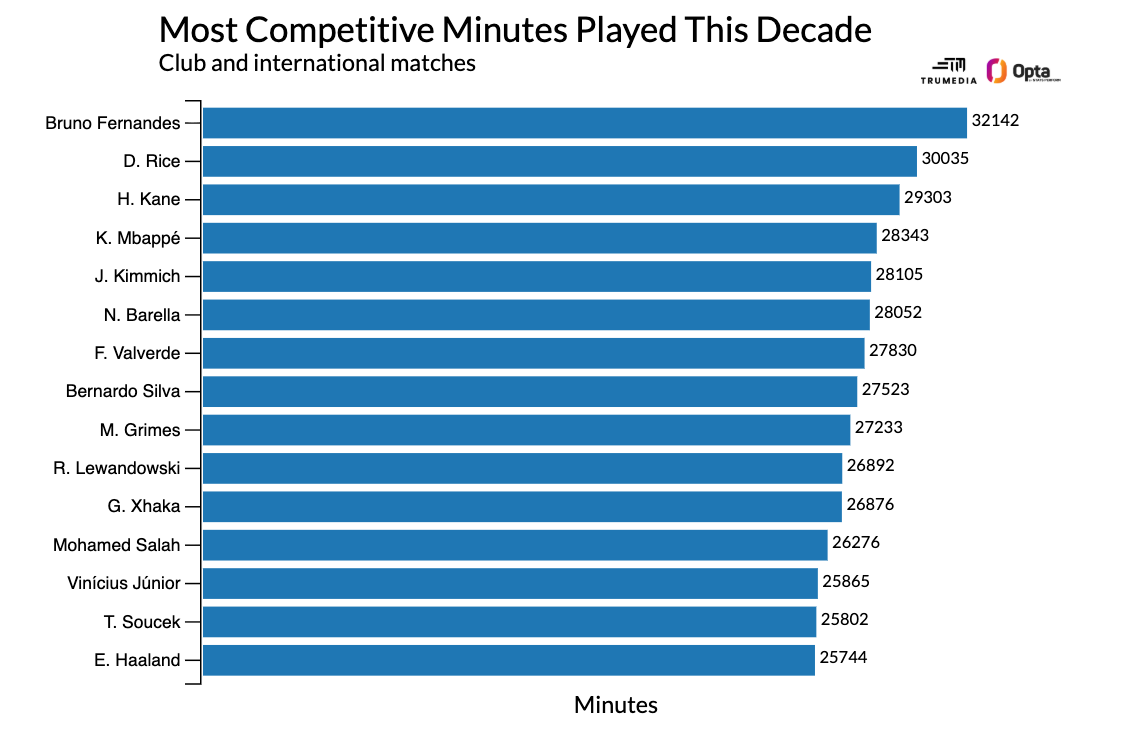
In summary, Bruno has played over 2,000 more competitive minutes than any other midfielder or attacker since 2020 – equating to nearly an additional full season compared to the runner-up, Declan Rice.
This can be viewed from two perspectives: either past injuries are the best indicator of future health, suggesting that Fernandes is less at risk of injury than others, or these minutes could soon take their toll on him.
Lessons from Salah’s Experience
At the conclusion of last season, the same two scenarios could have been hypothesized for Salah – showcasing that age can catch up even when players maintain peak physicality. While Salah’s numbers dipped in the latter half of the previous season, it’s worth considering Liverpool’s lack of motivation after mid-March, as they had little left to play for and their squad celebrated their title win. His performance has sharply dropped this season.
Salah achieved 47 goals+assists in the Premier League last season, yet this is down to 11 this year, having never scored fewer than 26 in his Liverpool tenure. Liverpool gambled by paying Salah as an elite player right at the moment he potentially ceased to be one, which appears to have manifested.
A contributing factor could relate to the remarkable competitiveness of the Premier League. While players like Lewandowski, Harry Kane, and Luka Modric continue performing exceptionally in their mid-30s, they do so in leagues that handle less physical demands than the rigid competition present in the Premier League. This may account for why Salah is performing better in the Champions League this season compared to his domestic results.
This season, Bruno has yet to participate in the Champions League, which is a vital factor in Manchester United’s achievements. Previous research indicates that Premier League teams typically lose, on average, a point for every two additional matches they play in Europe compared to their preceding season. With United eliminated from European competitions this year and early exits from both domestic cups, Bruno is set to conclude the season with a maximum of 36 appearances; last season, he made 55 starts, with 43 being his lowest over his tenure at United.
Could it be coincidence that he’s achieved his peak efficiency, in terms of goals and assists per 90 minutes, in a season with the fewest matches? With the World Cup approaching this summer and barring a downfall, United is anticipated to return to the Champions League next season.
Currently, Bruno possesses another year on his contract with a £57 million release clause, and he won’t turn 33 until September 2027. While his situation doesn’t mirror Salah’s precisely, the broader narrative remains: a consistently high-performing superstar still excelling in his 30s—if you could assure he remains at this level for a few more years, you’d provide whatever he requests. However, the reality of human physiology often suggests otherwise.
Salah and Fernandes showcase the potential for world-class athletes to maintain their prowess into their 30s. However, the situation underscores a cautionary tale; as Liverpool learned this season, one can be exceptional until suddenly one is not. This is the dilemma United must address.
Will their captain be among the rare athletes who defy aging year after year? Or will time catch up with him, as it tends to do for most professional footballers in their 30s, sooner rather than later?