



-

Graham Hunter
Multiple Authors
Throughout UEFA’s 70-year history of the European Cup, Champions League, UEFA Cup, Europa League, Cup Winners Cup, and Conference League, a total of approximately 350 semifinals have taken place.
The competition has seen giants like Real Madrid, AC Milan, Liverpool, Barcelona, and Bayern Munich, alongside underdog teams like Aberdeen, Malmö, Reims, Saint-Étienne, Club Brugge, Standard Liege, and Dukla Prague.
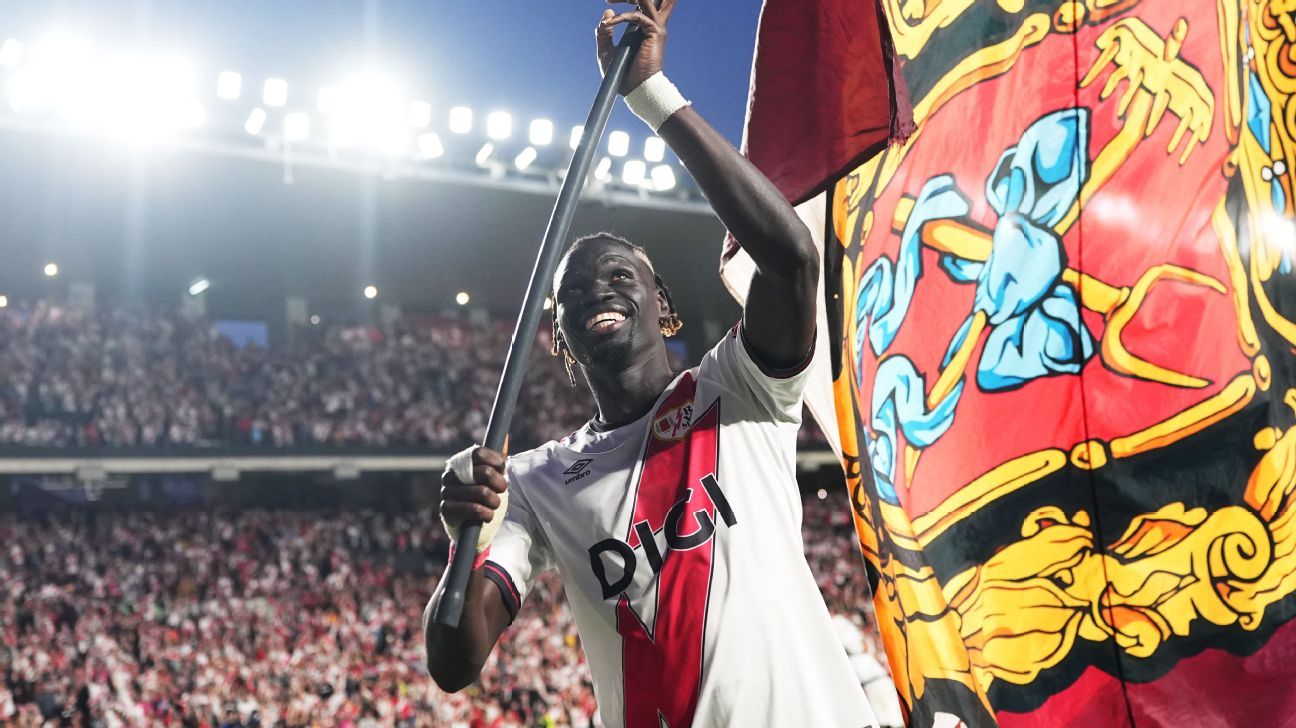
However, this Thursday marks a unique moment as Rayo Vallecano, the underdog club based in a tough yet spirited neighborhood of Vallecas, enters the semifinal fray.
It’s a club where fans publicly express their discontent with the president, the training facilities are lacking, and players are known to share post-match drinks with die-hard supporters. Showers are often cold, away team towels appear to be bargain-bin finds, and the pitch is reminiscent of a lunar landscape.
– Can Griezmann leave Atlético on a high with a UCL win before heading to MLS?
– Comparing Mbappé’s first 100 matches with Real Madrid’s legends
– Matarazzo elevating the profile of U.S. coaches in Europe with Real Sociedad
The club’s best player struggled early in his career, even resorting to fruit picking, while their star striker is the only player in UEFA competitions to come from a village of just 92 residents.
Perhaps you recognize Rayo, known for their iconic red “lightning flash” across their white kit. If you’re into underdog stories, you may be hoping they can upset the financially superior Strasbourg, the Ligue 1 club backed by Chelsea’s owners, BlueCo.
This piece is not meant to be critical or sensationalistic; Rayo’s situation is genuinely extraordinary. The term “miracle” barely captures the fact that they could reach the Conference League final in Leipzig with just two more strong performances.
For further context, consider these snapshots from Rayo’s recent matches.
Last Sunday, during an exhilarating 3-3 draw with Copa del Rey champions Real Sociedad, the notorious president Martín Presa engaged in a heated argument with a director from La Real. Furthermore, a friend captured an image of a rat scurrying along the sideline.
In the previous Thursday’s victory against Espanyol, a glaring hole in the goal net delayed the second half after assistant referee Judit Romano brought it to attention. The goalkeeper Daniel Cardeñas took the initiative to repair it using tape, with a photographer assisting him as he stood on a match ball to reach the net.
This is Rayo—where nothing is routine.
Yet, amidst all the chaos, the footballing side, along with their fiercely loyal supporters, deserves high accolades.
In their last five home encounters against Barcelona? One loss, two draws, and two wins, including one that cost Ronald Koeman his job. In their last six matches against Real Madrid at Vallecas, the record shows one loss, three draws, and two victories. Impressive.
It’s essential to recognize Rayo as a true “neighborhood” club. Vallecas embodies a strong identity: working-class values, a commitment to family, and a proud history of standing against Franco’s regime.
I spoke with Spanish soccer broadcaster Phil Kitromilides, a devoted Rayo fan, about the club’s deep connection with its community. He emphasized, “Rayo is an extension of the barrio, representing a community that constantly engages in events, marches, and parties. The club embodies more than just winning matches; it carries the identity of Vallecas to a global platform.”
This connection explains why President Presa, who has led the club through its most successful period in 102 years, is so controversial among fans. His plan to relocate the club to a new stadium outside the neighborhood is firmly opposed by Rayo supporters.
Moreover, Presa’s reluctance to offer online ticket sales forces fans to queue—regardless of the weather—at small windows for their tickets, reminiscent of bygone eras, igniting both anger and disbelief.
In April 2021, Presa invited representatives of the right-wing Vox party to a match, declaring, “Rayo is a club for everyone.” Soon after, a group of hardcore fans arrived at the stadium in biohazard suits to disinfect areas they deemed “desecrated.”
Returning to the team, they recently formally denounced their president with support from the Professional Footballers’ Association in Spain, criticizing the poor state of their training amenities and pitch. The report highlighted: “There are deficiencies in our daily facilities, including inadequate hot water in showers and outdated amenities unfit for a top-flight club.”
Presa has allowed the training ground to deteriorate, leading the first team to use a nearby amateur pitch for practice, and relying on the Spanish FA’s Las Rozas facility over 25 miles away for better training conditions.
For example, after a earlier Copa de la Reina match, the referee noted, “This pitch was in unfavorable condition, posing potential injury risks—areas without grass and many potholes.” The president of CF Pozuelo remarked, “This was like playing on a potato field, with torn-up turf and inadequate lighting. These facilities are dangerous—closure is necessary.”
A quick tour of our locker room 👀 pic.twitter.com/AbS0tQqRCG
— Lech Poznań (@LechPoznan) November 5, 2025
The peculiar circumstances surrounding Thursday’s match reflect Rayo’s chaotic reality. During an earlier Conference League match in November, Lech Poznan’s kit manager filmed a humorous “Welcome to Vallecas Stadium” video that went viral, inciting anger from Presa, who commented, “Mocking someone for being poorer is deplorable!” The commentary expressed disbelief at the outdated facilities, calling them a “relic of the past.”
Despite such ridicule, Rayo managed to turn the tables, coming back from a 2-0 deficit to win 3-2, showcasing their tenacity and disdain for mockery.
This Thursday marks Rayo’s thirteenth match in UEFA competitions this season—more than they have played in their entire history—having already eliminated teams from Turkey and Greece in previous rounds. Coach Pérez, who once was an assistant at Bournemouth, would have continued there had it not been for visa issues.
Under his management, the team features remarkable players like Andrei Ratiu, Isi Palazón (the former fruit-picker who found success at Vallecas), Jorge De Frutos (the Spain international from a tiny village), and the powerful Florian Lejeune.
Director of football and former Rayo goalkeeper David Cobeño has crafted this historic squad under truly challenging conditions, deserving recognition for his accomplishments.
As this European journey began, he expressed concern about the pressures of competing on such a high stage: “As the match approaches, there’s the fear we might not perform at our best and disappoint the fans due to the nerves and unforeseen challenges. I hope these factors won’t impact us!”
It seems they haven’t been hindered at all. Thursday promises to be the first leg of an exhilarating semifinal clash: the affluent French team facing off against the rebellious yet lovable Rayo.
“Lights, camera, action!” as they say. All we need is for the electricity meter to be topped up, the goal nets secured, and a way to manage any unexpected visitors, like that rat.