



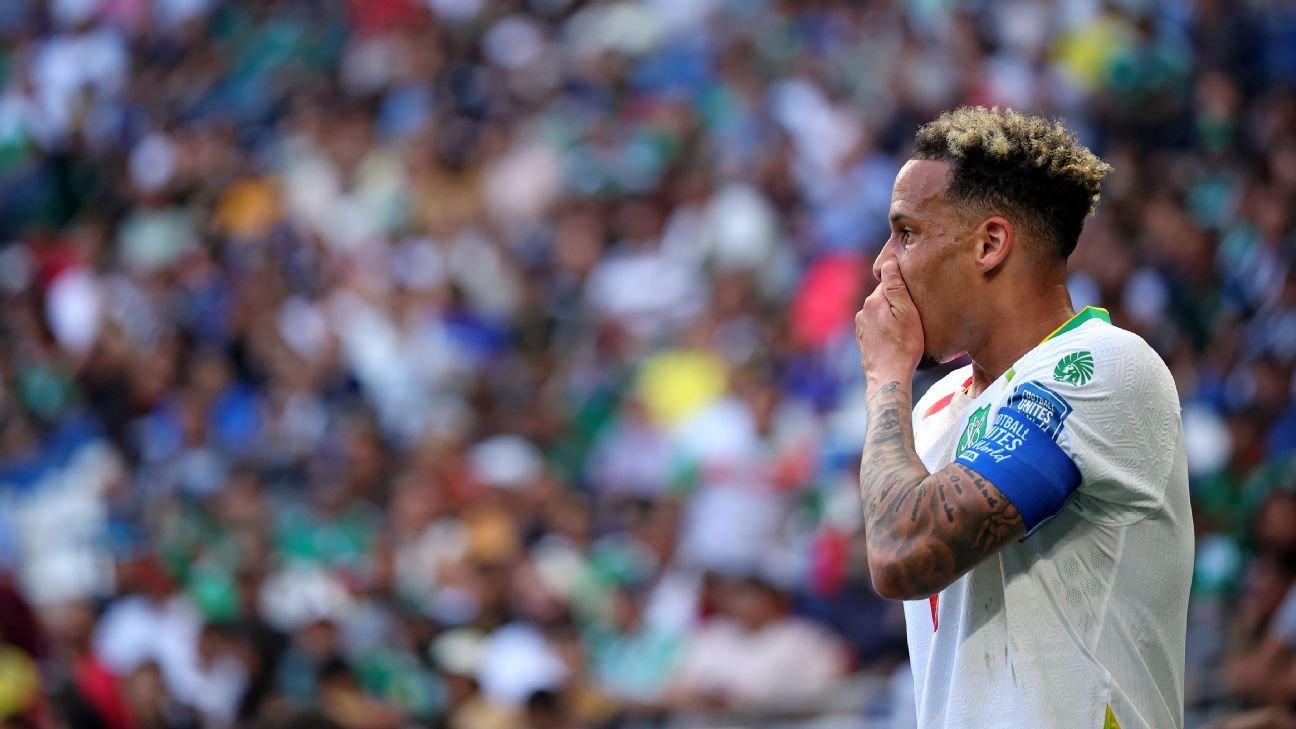
WHEN TJARONN CHERY returns to his home in the Netherlands after playing for Suriname, he typically enjoys a brief moment with family before diving back into his responsibilities at NEC Nijmegen. However, upon returning in late March after Suriname’s unsuccessful World Cup qualifying bid, his children were puzzled by his extended presence at home. He hadn’t sustained an injury; rather, he was in a holding pattern.
“I had to stay home for five days because I wasn’t allowed back to the club. I guess my family got to have dad around for a while,” Chery shared with ESPN Netherlands. “But my wife and kids were wondering, ‘What’s going on?'”
In recent weeks, Dutch football has been engulfed in turmoil. This crisis, dubbed “Passportgate”, has led to confusion surrounding player eligibility, sparked by a popular podcast, causing players to be sidelined, and prompting clubs to seek legal counsel. Approximately 25 players, including Chery, are caught in this eligibility crisis related to issues surrounding dual nationality, unprecedented in the Netherlands.
– O’Hanlon: What if Liverpool never signed Mo Salah?
– Hamilton: Does fan happiness, panic influence how their teams play?
– Gundogan Awards 2025-26: Celebrating soccer’s over-30 stars
A court ruling expected Monday in Utrecht regarding the case initiated by NAC Breda could significantly impact Dutch football. Should the court side with NAC, the KNVB (Dutch Football Association) might face a logistical nightmare, potentially needing to replay at least 133 matches.
At the heart of this unfolding drama are a bewildered group of players from Indonesia, Suriname, and Cape Verde, who had agreed to represent these nations without realizing the far-reaching implications of their decisions. “My family kept asking, ‘Which passport do you have now? Are you Dutch or Surinamese?'” Chery recounted.
‘It could become a very big deal’
The origins of this crisis can be traced back to a March 15 podcast episode by the hosts of “De Derde Helft” (“The Third Half”), where they dissected NAC Breda’s heavy 6-0 defeat by Go Ahead Eagles. The podcast, known for its influence among players and administrators, sparked debate after one analyst, Rogier Jacobs, mentioned that Go Ahead might have fielded an ineligible player, Dean James, who had accepted Indonesia’s offer to play for their national team.
“If you’re a Dutch player with Indonesian heritage, you can opt to represent Indonesia,” Jacobs explained. “Afterward, you might lose your Dutch nationality, which many players and clubs might not realize.”
“Renouncing Dutch citizenship places you in a different jurisdiction, meaning you are then classified as a foreigner,” noted Marjan Olfers, professor of sports law. “As such, you need a work permit to play in the Netherlands.”
James, having played without a work permit, was ineligible by law. “If NAC becomes aware and files a lawsuit, they could secure a win from this match,” Jacobs warned. “A legal expert I spoke to said this could escalate quite significantly,” he added.
Just four days after that podcast aired, NAC Breda raised concerns with the KNVB about James’ eligibility. NAC’s managing director Remco Oversier disclosed on April 28 that he had become aware of James’ situation upon listening to the podcast episode and subsequently conducted his own investigation.
James described the shock he felt, stating, “I was pulled from the gym by Go Ahead’s director, who informed me that NAC intended to file a complaint. I was completely in the dark.”
Following suit, Eerste Divisie team Top OSS questioned the eligibility of Willem II‘s Indonesian international Nathan Tjoe-A-On from their March 13 match, setting off a chain reaction of confusion among clubs and agents as they rushed to verify their players’ eligibility and understand the extent of the situation.
‘I only blame myself’
Historically, Indonesia, Suriname, and Cape Verde have sought to enhance their football squads with Dutch-based players eligible through their ancestry. By the time Patrick Kluivert was appointed as Indonesia’s coach in early 2025, the national team already featured an array of Dutch-influenced players, with nine of the eleven starters in their October World Cup qualifier against Iraq born in the Netherlands.
However, this brought up significant complications. Dutch nationality is automatically relinquished if a person voluntarily adopts another nationality. Seeking a new passport to play for Indonesia seems to fit this criterion.
While there are exceptions, generally speaking, players who accepted offers from Indonesia, Suriname, or Cape Verde and obtained dual citizenship effectively forfeited their Dutch nationality. Indonesia, in particular, does not recognize dual citizenship, meaning that players like James are considered non-EU, thus requiring work permits to compete in the Netherlands.
To secure a work permit, specific criteria need to be met: for players over 21, a salary of €608,000 annually is typically required, and for those under 21, approximately half that amount. This regulation left many players in the league trapped in blissful ignorance, continuing to play without proper work permits.
Concerns over this issue surfaced in 2025 when Dutch publication Voetbal International highlighted it on March 25. “We raised the alarm after noticing an interview with Tom Knipping,” reported Evgeniy Levchenko, chairman of the Dutch players’ union VVCS. “After consultations with lawyers, we recognized that players might be surrendering their Dutch nationality by representing other nations, especially since some countries explicitly prohibit dual citizenship. While we issued a warning stressing diligence for those considering playing for Indonesia, it went largely unheeded.”
Some clubs had previous awareness of the situation; for instance, Ajax goalkeeper Maarten Paes, who made his Indonesia debut in 2024, was treated as a non-EU player by Ajax when he transferred from FC Dallas on February 2, 2026. However, clubs outside the Eredivisie’s top teams lack comprehensive legal acumen.
“Many clubs are still behind the learning curve in legal matters, especially in these areas,” Olfers stated. “Although an increasing number of clubs are hiring legal advisors, expertise dwindles as you move past the top tier of the Eredivisie. Most resources are funneled into on-field talent rather than legal counsel.”
Who deserves responsibility for this oversights? According to some, including Olfers and TOP Oss striker Luciano Slagveer, athletes also bear some of the blame. “In my case, had I understood the implications, I would have thought it through much more thoroughly,” Slagveer remarked. “Should I lose my Dutch nationality, accountability rests on me for not conducting enough research.”
Others don’t share that viewpoint. “We just want to represent our country without understanding the legal side,” said Fortuna’s Indonesia defender Justin Hubner. One agent noted that national teams approached players directly, avoiding club or agent involvement, leading players to act on the assumption they were eligible as long as one parent was Indonesian or Surinamese. “The players wanted to be part of the national teams and didn’t think about their passports,” the agent noted.
“We’ve received no communication from any government body in the last two years,” expressed Wilco van Schaik, NEC general manager, during “De Bestuurskamer” (The Boardroom) podcast. “Neither the KNVB nor the Eredivisie provided us with information. I am outraged about this—every party acted in good faith.”
What comes next?
As players returned from the late March international break, clubs temporarily benched individuals with eligibility concerns, including Chery and Go Ahead’s James. “I just shut my phone off; constant reading about it drives you mad,” James remarked. “In the first five days, there was no clarity on what was going to happen.”
Several players from Suriname were allowed back for Matchday 29 and played during the weekend of April 5, including Chery, who returned under an IND stamp in their passports permitting them to play. Such stamps are issued to players with partners or families in the Netherlands while awaiting their work permits. This allows them to work normally in the meantime.
Chery captained NEC in their 2-0 victory over Excelsior Rotterdam on April 4. Although he doesn’t fully grasp the situation’s complexity, he appreciates that his club and attorneys managed it well. “[My teammates] were eager to know when I’d be back,” he elaborated. “We’ve spent so much time together; we become a family. It was disorganized, and there was a bit of panic, but ultimately, I’m relieved everything is back on track.”
Conversely, players like Telstar‘s Dion Malone remain sidelined as he considers his next steps. “Dion is a thoughtful player who has been with Suriname for a long time,” remarked Telstar’s technical manager Peter Hofstede. “It’s wise for him to make informed decisions. He’s handling the situation calmly—he’s not an everyday starter—and is primarily focused on preventing harm to the club.”
Many players returned for the weekend of April 11-12, including Geypens, who received a residence permit valid until 2031 after a two-week suspension from his club. However, resentment lingered. “I find it disgraceful that NAC Breda took action,” said Fortuna’s Hubner, an Indonesian international. “What does it matter to them what nationality a player holds? Let players play! If you lose 6-0 to Go Ahead Eagles, you shouldn’t have a right to raise passport issues.”
James also returned on April 11, featuring in Go Ahead’s 0-0 draw with FC Groningen. “I wasn’t pleased about NAC’s appeal, to say the least,” he admitted. Though back on the field, his international future remains uncertain. “I can’t say much about my situation right now, but I definitely want to continue playing for Indonesia. We’ll have to see how we resolve that,” he added, as Indonesia’s strict stance on dual nationality persists.
Olfers anticipates that the football association and the IND will evaluate ways to streamline work permit acquisition for non-EU players in the future, and various measures aimed at expediting passport and permit processing are under consideration.
The KNVB and the Eredivisie supervisory board (ECV) rejected NAC Breda’s request for a match to be replayed. The KNVB cited their decision as being based on the lack of awareness on the parts of James and Go Ahead regarding his permit status, as was the case for numerous other players involved. Several legal experts confident that NAC has an opportunity to overturn the KNVB’s ruling on appeal.
This appeal was presented at a court in Utrecht, with the KNVB indicating that an overturning of the decision could lead to further challenges from clubs concerning the outcomes of all 133 matches involving affected players. The association expressed concerns that such legal action could lead to an insurmountable backlog in the Eredivisie schedule, jeopardizing the season’s completion. “If NAC prevails, other clubs will likely pursue similar legal actions, potentially halting competition altogether,” stated Marianne van Leeuwen on behalf of the KNVB.
NAC contended that their appeal pertains solely to the 6-0 match against Go Ahead Eagles, arguing that the fear of a cascading effect leading to multiple appeals is unfounded. “These are not amateurs; they are professional entities,” asserted NAC’s attorney in court.
“Standing here today makes my stomach churn,” NAC general manager Oversier expressed at the hearing. “We’re going to great lengths to ensure justice is achieved. This isn’t a comfortable situation; I wish this wasn’t necessary, but I owe it to NAC to pursue it.”
The judge has postponed the case to deliberate the presented arguments, with a verdict forthcoming on Monday. As this unfolds, the ECV is working closely with governmental institutions, including the IND, to ensure the Passportgate situation is conclusively resolved.
“We had no prior knowledge of this,” remarked FC Groningen and Surinamese goalkeeper Etienne Vaessen. “Ultimately, I would like to reclaim my Dutch citizenship, but I also wish to represent beautiful Suriname. A resolution that accommodates both needs to be established.”