



THE DINNER BEGAN on a simple note, featuring steaks, wine, and light conversation.
However, two key figures in bringing the World Cup to Kansas City, Missouri, may find themselves considering tattoos.
Last summer, Jake Reid, the president and CEO of Sporting Kansas City, along with Alan Dietrich, a former executive at Sporting KC, hosted a delegation from England. This was part of their efforts to convince the England national team to use Kansas City as their summer training base during the World Cup.
After an exhilarating city tour, they enjoyed dinner at Eddie V’s, a fine restaurant on the Plaza. The atmosphere was so positive that England’s CEO, Mark Bullingham, jokingly proposed that if England secured a World Cup victory, they would all get tattoos.
“Are you in?” Bullingham asked.
Without missing a beat, they agreed.
“I thought, ‘This would be the coolest thing ever,’” Dietrich recalled.
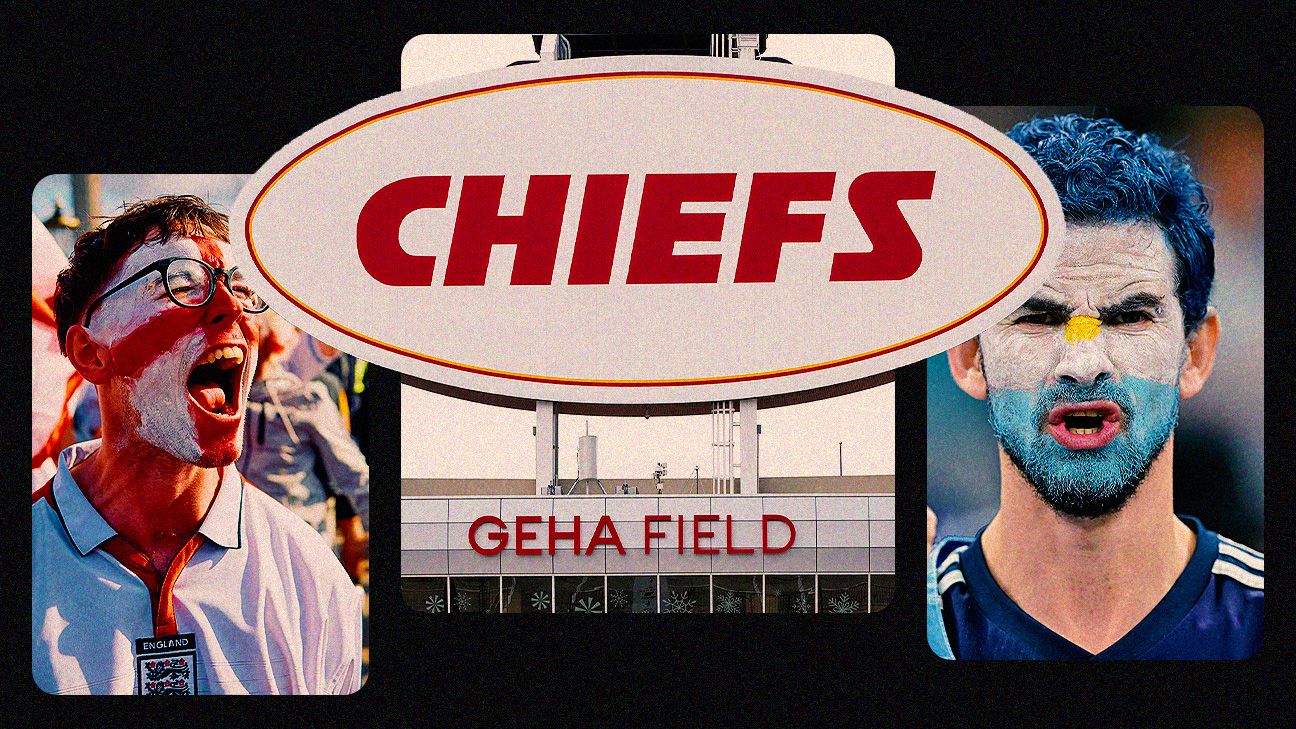
A year later, Kansas City will host four teams during the tournament, including three top-10 squads with passionate fanbases: England, Argentina, and the Netherlands. Algeria will be situated in nearby Lawrence, Kansas, a college town with under 100,000 residents.
Kansas City is, in many respects, an unexpected choice. It ranks as the least populated of the 11 U.S. cities hosting the World Cup and has never been the site of the Olympics or a Super Bowl. Moreover, the training site chosen by England wasn’t even listed in FIFA’s options during their visit. Yet, the city capitalized on its rich soccer heritage, central location, and generous Midwestern hospitality to emerge as the World Cup’s base camp capital.
Organizing base camps while hosting six matches and a FIFA Fan Festival in the city center presents a thrilling yet formidable challenge for Kansas City. Dietrich acknowledges that the city has never coordinated anything of this magnitude, nor has it hosted teams with such fervent fanbases for an extended period.
Nevertheless, both he and other local organizers are confident in their capability to make it happen.
“I tell people constantly that when this is over, we will all have been part of the biggest event to ever occur here,” said Pam Kramer, CEO of KC2026.
In the months leading up to FIFA’s 2021 tour of 23 cities to select 16 World Cup hosts, representatives from Sporting KC and the Kansas City Sports Commission met weekly to brainstorm strategies to make their brief but vital visit memorable.
The city lacked mountains, oceans, or prior experience in hosting such events. Its airport, an outdated facility nearly fifty years old, was on the brink of a major redevelopment. Kansas City would also host the 2023 NFL Draft, which attracted over 300,000 attendees, showcasing its ability to handle large events.
They decided to think outside the box.
They meticulously planned routes for the FIFA delegation to avoid blight and gridlock and placed friendly volunteers around the airport to create a bustling atmosphere. Additionally, they arranged for nearly two dozen children from Kansas City’s Guadalupe Centers to take a day off school to stage a soccer scrimmage outside the downtown Loews Kansas City Hotel, ensuring FIFA delegates saw how serious the Heartland takes soccer.
“We discussed every detail,” Dietrich said. “Every sight, smell, and sensation—we wanted to show them that we are the Soccer Capital of America. We can handle this, and we truly want it.”
Kansas City proudly claims the title of Soccer Capital of America due to its long-standing commitment to the sport. This title is prominently displayed on the city’s World Cup website and is even registered as a trademark. City officials report that since 2009, almost $700 million has been allocated to soccer infrastructure in the Kansas City area, which played a crucial role in attracting the three top-10 teams to train here.
The city’s soccer roots trace back to the 1960s, when the late Lamar Hunt, owner of the NFL’s Chiefs, was instrumental in founding the United Soccer Association. Decades later, with the launch of MLS, he established the Kansas City Wiz, which was later renamed the Wizards and eventually evolved into Sporting KC. The franchise secured an MLS Cup in 2000.
In 2011, Sporting KC realized Hunt’s long-held ambition by opening a soccer-specific stadium, Sporting Park, just across the state line in Kansas. Six years later, they inaugurated the Compass Minerals National Performance Center, featuring 52 acres of various fields. Dietrich noted that David Beckham has praised this state-of-the-art facility, which includes hyperbaric chambers, a cryotherapy lab, a zero-gravity room, and even two ponds for those interested in fishing during their downtime. This is likely why England sought to secure access to the center during their summer visit.
However, a few months later, FIFA updated its base-camp criteria to favor teams with group stage matches nearby, thus putting England, which won’t be playing in Kansas City, at a disadvantage.
When Argentina discovered it would play its opener in Kansas City, they swiftly sent a team to the city. Initially, they were rumored to prefer Miami, partly due to the MLS affiliation of their star, Lionel Messi, according to Dietrich. However, upon inspecting Sporting KC’s enormous gym, they immediately showed interest, and Argentina quickly claimed the facility.
Luis Martin, the fitness coach for Argentina, recently mentioned to journalist Juan Pablo Varsky that they appreciated the accommodation Kansas City provided after their search in Dallas yielded no satisfactory results. “They’re treating us incredibly well,” Martin remarked.
The Netherlands subsequently chose the new training facility for the Kansas City Current. Although initially it seemed England might head elsewhere after bonding with local residents, they returned to explore Swope Soccer Village, located in the city’s largest municipal park, which impressed them greatly. Algeria opted for Lawrence, about 40 miles west of the city, citing its tranquil environment as a key factor.
Kramer noted that Kansas City’s central location within the U.S. also factored into the decision of so many teams to set up camp here. Given the tournament involves 48 teams across three vast countries, teams will face longer travel times and waits between matches. For instance, England will log nearly 9,000 miles as they play in Dallas, Boston, and New York, and they won’t have their first game until nearly a week after the tournament kicks off.
In March, England manager Thomas Tuchel indicated that the team would return to its base camp whenever possible. “Maybe the headline should be: ‘We’re trying to spend as much time in Kansas as possible,’” he said.
However, it wasn’t just logistics and facilities that drew the teams to Kansas City.
“What we offer is the Midwestern way of life,” Kramer said, “where people generally respect your space. You can dine without interruption. Kansas City holds an appeal that we frequently heard echoed by the teams as they went through the process.”
THE WORLD CUP is set to be the largest event in the history of a city with a population of 511,000 (and 2.3 million in the Kansas City metro area). City officials predict that 650,000 visitors will arrive during the tournament, although hotel and flight bookings are slower than anticipated, just a month before the opening match.
Jenny Wilson, vice president of tourism development at Visit KC, remains optimistic those projected visitor numbers will materialize, particularly buoyed by the later knockout rounds.
“What we’re observing,” she remarked, “is that international bookings are coming in later than predicted. Domestically, people tend to plan closer to the date anyway.”
“But for those later games we’ve scheduled, we’re seeing strong trends.”
To tackle the massive security demands of six matches and 18 days of the FIFA Fan Festival, Kansas City Police Capt. Jake Becchina has coordinated resources with law enforcement agencies across Missouri and Kansas. These collaborations were established after the Kansas City Royals won the World Series in 2015, revealing the necessity for increased manpower and strategic planning for large-scale sporting events.
Since then, the various law enforcement agencies have collaborated during three Super Bowl parades in the 2020s, including the 2024 event that culminated in a shooting. Becchina emphasized a positive collaborative environment.
“What you see on cop shows,” Becchina noted, “where the FBI and county sheriffs clash, doesn’t happen here. I believe that if you asked any federal entity, they would confirm that Kansas City’s operating environment is uniquely cooperative.”
In addition to local law enforcement, assistance will come from jurisdictions as far away as Nebraska and Wisconsin, along with private security firms.
Becchina, who is also a devoted NFL fan, has immersed himself in soccer knowledge over recent years, especially concerning fan behavior. He assigned a homework project for the KCPD’s command staff to watch “Attack on Wembley,” a Netflix documentary detailing a July 2021 match between England and Italy that witnessed violence when approximately 2,000 fans gained unauthorized access to the stadium.
“The fervor surrounding some of these fanbases is evident,” Becchina explained. “For some, their entire lives revolve around it. You see similar levels of passion in the NFL, but the intensity usually dies down by Monday afternoon.”
A group from Visit KC journeyed to the Netherlands and Argentina to promote Kansas City and excite potential tourists. Recently, Visit KC also facilitated cultural training for local restaurants and hotels.
Jason Booker, deputy athletic director at Kansas University, will be closely collaborating with the Algerian team, having delved into various cultural nuances, including appropriate greetings. He noted that although people in the region tend to prefer hugging, they are cautious not to presume.
Booker further discovered that many Algerians observe halal dietary restrictions, necessitating blessed meat. To accommodate these needs, Algeria’s chef has connected with a butcher specializing in halal meat in Lenexa, Kansas, located about 30 minutes from Lawrence. Halal-friendly restaurants in the area are displaying window stickers to welcome the team.
This level of detail is part of an effort that has spanned over five years, impacting various sectors across a two-state region. “For us at KU, it’s not about profit from hosting the World Cup,” Booker stated. “What matters is that the team leaves with a memorable experience of Lawrence.”
“That’s the Midwest ethos.”
If everything goes according to plan this summer, especially for England, at least two locals will see a permanent change. Neither Reid nor Dietrich has ever gotten a tattoo, but England has considered a significant, and likely elaborate, design.
“I’m not sure my wife would approve,” Reid joked. “But it certainly makes for a great story.”
ESPN researcher Gueorgui Milkov contributed to this report.