




BARCELONA — In 2012, when Alexia Putellas met with then-Barcelona coach Xavi Llorens prior to returning to the club from Levante, he remarked that her comeback would signify a turning point in the team’s history. Even Llorens could not have envisioned the extraordinary evolution Barça would experience over the next 14 years.
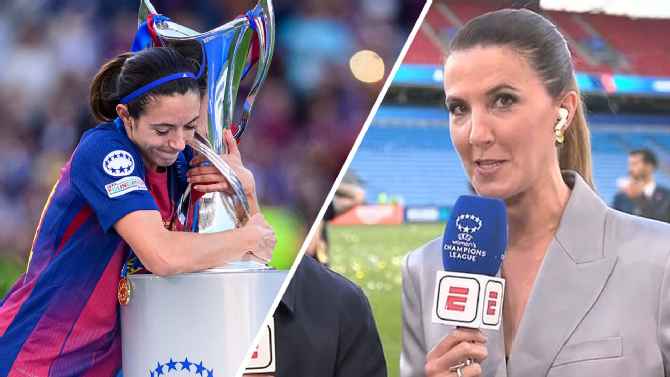
Earlier this week, Putellas announced her departure from the club as her contract comes to an end this summer. The 32-year-old bids farewell in style, having recently led the team to their fourth Champions League title with a commanding 4-0 victory against OL Lyonnes in Oslo, where she was later named Player of the Season in the tournament.
Barça capped their season with a complete trophy haul, winning the Champions League, Liga F, Copa de la Reina, and Spanish Supercopa—achieving this remarkable quadruple for the second time in three years.
Putellas’ tenure at Barça brings her total trophy count to 38, including 10 league titles and four Champions League trophies. Throughout her time at the club, she has made over 500 appearances, scoring 232 goals from the midfield and securing the Ballon d’Or twice—only Lionel Messi, with 672 goals, has netted more for either the men’s or women’s teams.
However, Putellas’ impact at Barça transcends statistics. The team’s remarkable ascent in the women’s game, from relative obscurity in 2012 to a European powerhouse today, cannot be told without her. Her teammate Irene Paredes referred to her as the “motor” behind the team’s achievements, and the president-elect, Joan Laporta, remarked that she is “more than a player.”
Strolling through Barcelona, it’s common to spot someone wearing a No. 11 Putellas jersey. Attending matches at the city’s leading club—be it men’s or women’s—guarantees that encounter.
Her contributions, presence, and community work (both for Barça and the Spain national team) have played a pivotal role in turning the squad professional, facilitating improvements in their working conditions. Much of the record attendance at women’s football matches—surpassing 90,000—can be attributed to her influence.
During her farewell event at Camp Nou on Wednesday, the tangible proof of Putellas’ legacy was on display: 38 trophies displayed on the pitch, extensive media coverage, supportive messages from legends like Xavi Hernández and Andres Iniesta, and notably, the tearful reactions of her young teammates.
Putellas, often called La Reina (The Queen), is not only a role model but a friend to her teammates; someone who has consistently raised the standards to usher in repeated success. “Sustaining that level of demand over 14 years is uncommon,” she acknowledged this week.
She expressed her decision to leave was made now, feeling the team is well-equipped to continue winning. Yet, she’s not the only significant departure this summer, further straining Barça’s already limited squad.
Football is unyielding. Less than a week after clinching the Champions League title, Barça is grappling with the departure of one of its most celebrated players. Just as Llorens foretold, she has indeed marked a significant turning point. Now, the European champions must ponder: what lies ahead without Putellas?
Other Departures on the Horizon
As Rosalia’s “Magnolias” echoed through the Camp Nou speakers, the emotional atmosphere masked the reality that Putellas won’t be the only pivotal player departing the Champions League winners this summer. Barça announced on Thursday that full-back Ona Batlle will also be leaving as her contract concludes after three years since joining from Manchester United. Reports suggest she is set to join Arsenal after clinching 11 of a possible 12 trophies during her time with the club.
Another player heading to London is defender Mapi León. Barça confirmed she will exit when her contract expires in June, with reports suggesting she has an agreement to join London City Lionesses. Putellas has also been linked with the same club, but she intends to take her time before deciding her next destination, with interest also coming from teams in the NWSL and Mexico.
Putellas, Batlle, and León were all starters in last weekend’s Champions League final, and they all leave with much more to contribute on the pitch. Additionally, defender Marta Torrejón was also anticipated to depart. While her exit may not impact the team’s playing performance—due to her reduced minutes in recent years—it would still be a loss in the dressing room. Recent reports, however, indicate she might extend her contract for another year.
Forwards Caroline Graham Hansen and Salma Paralluelo are also set to become free agents this summer. Prior to the Champions League final, where Paralluelo scored twice, the club was optimistic about renewing both players. However, neither has committed to next season yet, and rumors suggest Paralluelo may have other offers, including from OL Lyonnes.
Even coach Pere Romeu is approaching the end of his contract next month, but he stated this week that an extension is expected to be finalized soon.
Recent Departures
Significant player exits at Barça have become a trend over the past two years.
The right back Lucy Bronze moved to Chelsea, and forward Mariona Caldentey joined Arsenal, both in the summer of 2024, while midfielder Keira Walsh (Chelsea) returned to her home country in January 2025. All three had been key contributors when fit.
Ingrid Engen (OL Lyonnes), Fridolina Rolfö (Manchester United), Jana Fernández, and Lucía Corrales (both London City Lionesses) added to the exodus last summer. While Engen started regularly due to injuries to others, Rolfö’s role diminished with the rise of Esmee Brugts; Fernández and Corrales moved to LCL despite not having significant first-team experience but were considered promising academy talents on the verge of breaking into the squad.
1:37
Can Barcelona’s UWCL dominance stretch even further?
Reasons Behind Player Departures
The reasons for players leaving such a successful team vary and are case-specific.
While individual motivations abound, Barça has shown a relatively open stance on player departures. Sources suggest that most exits are not driven by cost-cutting measures, although spending has been constrained. Nevertheless, efforts have been made to secure key players, such as three-time Ballon d’Or winner Aitana Bonmatí, who signed a new deal.
This comes after a phase of increased expenditure. The club’s wage bill surged from €6 million in 2021-22 to €14.3 million by 2024-25, according to official accounts. Figures for 2025-26 have yet to be disclosed.
In Putellas’ situation, she felt it was the opportune moment to leave after accomplishing all she had set out to achieve. Although she had the option to extend her contract by another year, her decision to depart was firm. Financial considerations were not the primary factor in her choice.
Caldentey also achieved everything at Barça and was enticed by the opportunity to shine at Arsenal. Meanwhile, Fernández and Corrales saw a more promising avenue for regular playing time in London.
Financial incentives can certainly play a role, and personal circumstances have influenced some players’ decisions—Bronze and Walsh were drawn back home—while the wish to compete in a more challenging league is also a factor. Barça has dominated the Liga F, winning seven consecutive titles and winning 28 of 29 matches this season, which some players believe is detrimental to competition levels.
“We have issues,” Bonmatí mentioned last year. “We suggested changes, including a reduction in the number of teams [from 16], as we think it would make the league more competitive and enhance the overall quality. With the WSL next to us, a more competitive and appealing league, we feel the need to measure ourselves against it.”
Future Signings for Barcelona
As seen with the men’s team, Barça has increasingly relied on its La Masia academy in recent years. In 2024, they made significant investments to acquire striker Ewa Pajor and forward Kika Nazareth, but last summer, despite losing many players, the sole signing was defender Laia Aleixandri on a free transfer.
The club opted to promote from within, elevating defender Aïcha Cámara and midfielder Clara Serrajordi to the first team. This decision was met with skepticism at the time due to the squad’s perceived lack of depth, yet their triumph in the Champions League last weekend quieted those doubts.
“At the onset of the season, we heard critiques about the team’s stability and depth,” Graham Hansen noted. “That motivated us to prove our quality. Yes, the past couple of years have been challenging due to financial constraints, but both the men’s and women’s teams have maintained a top-level status thanks to years of hard work in La Masia.”
As more players depart, indications suggest that the most effective replacements might emerge from within the ranks. Despite Putellas’ absence, Barça boasts a strong midfield; Bonmatí and Patri Guijarro are among the world’s elite, while Serrajordi, who started the Champions League final at 18, along with Nazareth, Vicky López, and Sydney Schertenleib are all viable options for starting positions.
While the departures of Batlle and León may necessitate reinforcements in defense, Camara is poised to fill in, and Aleixandri will soon return from injury. Eventually, some level of investment will be required. Sources indicate that signings are anticipated this summer, but confidence in La Masia remains high. One insider highlighted the unique standing of the club in the women’s game: “They will be alright because no other club has an academy so synergistic with the first team.”
Putellas spent just one year as a youth player at Barça. La Masia predated her—but not to the extent it has evolved today for the women’s team—and will carry on beyond her departure. Yet, witnessing Serrajordi and other academy graduates in tears as Putellas bid farewell underscores the significant imprint she has left on the future of the club. This legacy will undoubtedly play a crucial role in what lies ahead for Barça.