



The largest FIFA World Cup in history kicks off in under two weeks. Spanning 39 days, a total of 103 critical matches — along with one inconsequential third-place match — will determine the world champion.
The pressure is immense. So, what better way to gear up for the excitement than with … a series of friendlies that carry no weight?
As nations prepare for the tournament, the United States men’s national team will engage in two friendlies before the World Cup kicks off: they will meet Senegal on May 31 and then Germany on June 6.
Results from these matches won’t matter for the USMNT, as their official competition only begins against Paraguay in Los Angeles on June 12.
So, what’s the purpose of these friendlies right before the World Cup? Are they mere distractions posing risks of injuries, or valuable opportunities to gear up for the tournament ahead?
Why do teams participate in friendlies before the World Cup?
For starters, national teams engage in World Cup tune-ups because FIFA has set up the schedule that allows them to.
As clubs are responsible for player salaries, FIFA only requires them to release players for national team duty during specific international windows. These windows are limited, with only five available for every nation in 2025, and just two prior to the 2026 tournament.
This limited availability of national team matches is why various stakeholders — from sponsors to coaching staff — are keen to see two games scheduled before the World Cup begins.
With national teams bound by sponsorship agreements and broadcast contracts, it’s vital for federations around the globe to maximize game opportunities. The upcoming friendly between the USMNT and Senegal? That’s not just any exhibition; it’s the “Allstate Continental Clasico.” This match will be broadcast on platforms tied to lucrative U.S. Soccer Federation rights agreements, which reportedly bring in around $25 million for their English TV rights, according to the Sports Business Journal.
In essence, pre-World Cup friendlies not only assist in funding the federation, which oversees multiple senior and youth teams, but they also have significant financial implications.
Moreover, these matches hold critical significance for the players, too.
It’s essential to remember that players in top European leagues are experiencing an offseason during the World Cup. For instance, Folarin Balogun, expected to be the starting striker for the USMNT, wrapped up his season with AS Monaco on May 17, leaving a gap of nearly four weeks until the World Cup opener.
Without national team practices and games to maintain the careful balance of player workloads established at their clubs, complications could arise. Pre-tournament friendlies serve to reacquaint athletes with game intensity that they may have been lacking.
A paper published in April by the Aspetar Sports Medicine Journal highlighted that national team “squads are formed from players arriving with differing training backgrounds, competitive experiences, injury histories, and recovery states. Hence, international performance staff must quickly assess readiness and prepare players for high-stakes competition under uncertain conditions.”
Having two weeks to fine-tune training to suit individual player needs prior to the World Cup is invaluable.
These friendlies also allow players the chance to make an impression on coaches who seek rare firsthand evaluations. With limited training sessions and games each year, these last-minute friendlies provide an opportunity for coaches to assess players, build on-field partnerships, and explore various tactical approaches.
For Pochettino and his staff, the final friendly against Germany will serve as a testing ground for strategies that may arise again deep in the tournament — should the USMNT progress to that level.
5 key objectives for the USMNT in their final friendlies
As Pochettino’s team prepares for matches against Senegal and Germany, what should be on his agenda?
1. Determine the starting midfield duo
Following Pochettino’s unexpected decision to exclude Lyon midfielder Tanner Tessmann from his World Cup roster, a starting position beside Tyler Adams remains open.
Out of several roster surprises, excluding Tessmann and bringing few natural central midfielders was the most significant. Adams, Sebastian Berhalter, Cristian Roldan, and Weston McKennie are now the only true defensive or central midfielders in the squad — and even McKennie has predominantly played as an attacking player under Pochettino.
1:33
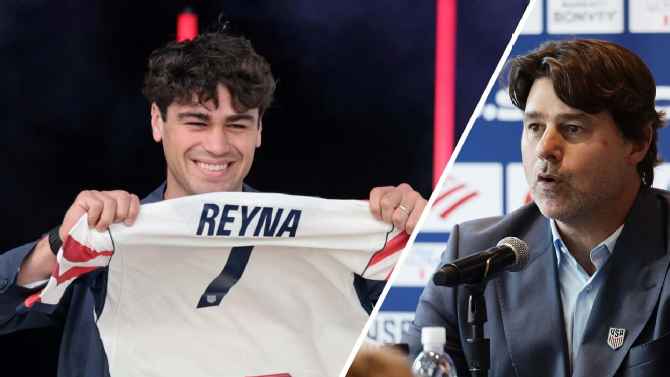
Pochettino expresses confidence in ‘amazing’ Reyna’s prospects for the World Cup
During his ready conference, the U.S. coach hinted at the possibility of playing Malik Tillman or Gio Reyna in deeper positions. He also mentioned that fullbacks Sergiño Dest, Alex Freeman, and Antonee Robinson could also be utilized in midfield.
These friendlies before the World Cup are the final opportunity for the U.S. to solidify their starting midfield duo that many expected to be Tessmann and Adams. Finding a way to balance getting reps for Adams and his midfield partner while conserving his energy for the crucial matches will be a challenge.
2. Evaluate candidates for Christian Pulisic‘s attacking partner
Prior to the coach’s roster announcement, McKennie was seen as the likely choice alongside Pulisic in attack. However, now that McKennie may need to step back into a midfield role, there’s an opportunity for someone else to step up.
While relying on Reyna for consistent minutes may be risky, players like Tillman, Brenden Aaronson, and Alejandro Zendejas fit well into that role.
Tillman has been a favorite of Pochettino, but he struggled for playing time at Bayer Leverkusen towards the end of the Bundesliga season. Meanwhile, Aaronson is more of a presser than a precise passer, and Zendejas was a wildcard pick after a lengthy absence from selections.
With fresh competition for attacking roles, all players will have the chance to prove themselves during these friendlies.
3. Find a replacement for Tim Ream
Pochettino has called up five pure center-backs to the World Cup, along with Freeman and Joe Scally, both capable of playing as right-sided center-backs.
One reason for this focus on center-backs could be concerns about Tim Ream. Though the 38-year-old is still the top defender for effective line-breaking passes in the squad, his speed is a liability. Having multiple games to test potential replacements against strong opponents could be extremely beneficial.
Auston Trusty may be in the lead for the position following great performances in recent national team games. Others like Mark McKenzie or Miles Robinson could also vie for the chance to partner with Chris Richards, if Richards is fit following a recent ankle injury.
4. Reintegrate Sergiño Dest
After recovering from a hamstring injury that sidelined him in March, Dest returned for PSV in early May. He is likely to rejoin the USMNT for these World Cup warm-ups, which could open up new tactical options for Pochettino.
Dest has been utilized as both a right back and right winger under Pochettino, with hints from the coach suggesting he may also explore an inverted midfield role.
Given Dest’s knack for creating chances against tight defenses, he could become pivotal for the USMNT in what may be a challenging group stage filled with defensive teams. Reintegrating Dest in a position where he can aggressively attack will help bring him back up to speed in the lead-up to matches that count.
5. Enhance the pressing strategy
During their March friendly matches, the USMNT didn’t press Portugal and Belgium for the full 180 minutes but nonetheless engaged significantly in pressing.
Pochettino’s strategy involves pushing forward during opposition goal kicks in hopes of generating turnovers high up the field. With a scarcity of high-quality attackers ready to break down a defense or lead a counter, the pressing strategy makes sense.
However, the US team’s pressing has been inconsistent since Pochettino took over, suffering breakdowns against teams like South Korea last fall and Belgium earlier this year.
If the USMNT were to progress through the World Cup, fine-tuning the high press in matches against Germany and Senegal can be crucial.