



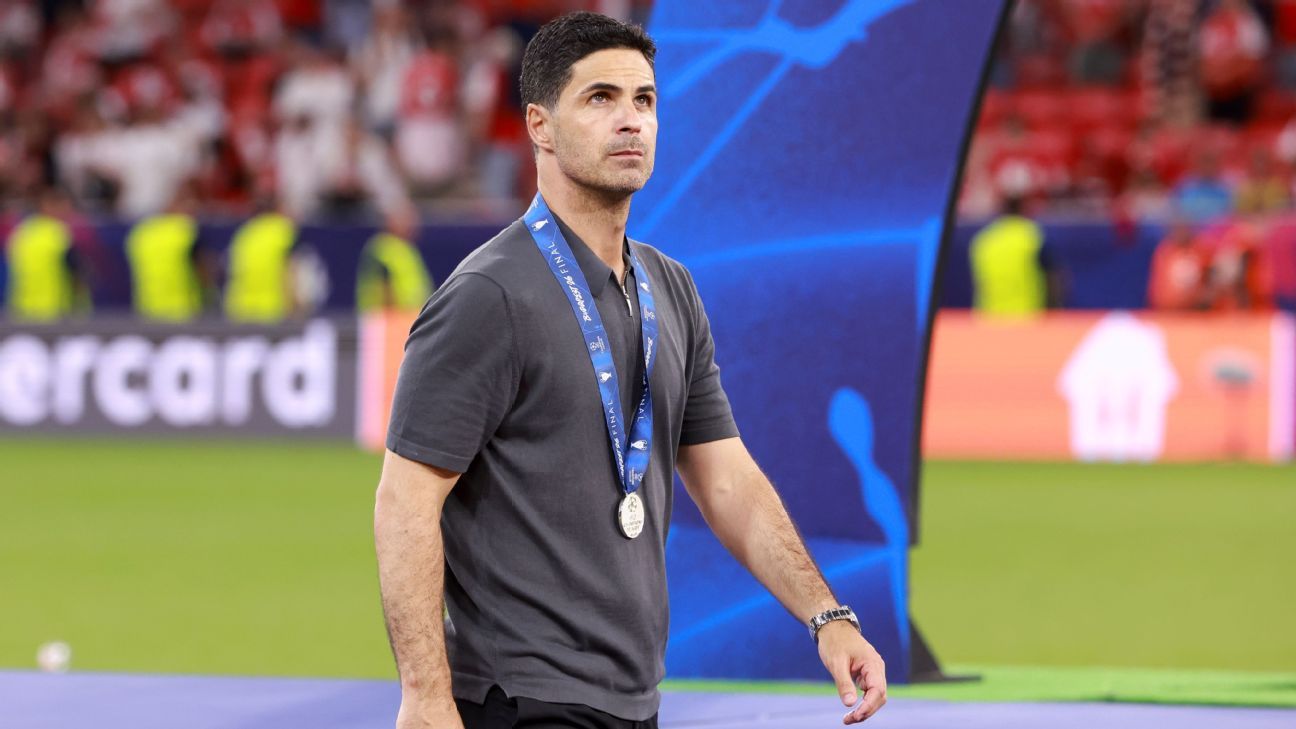
BUDAPEST, Hungary — Arsenal learned a hard lesson during their UEFA Champions League final defeat to Paris Saint-Germain on Saturday, a match that was decided by penalties. The question remains: will Mikel Arteta take the risks necessary to learn from this experience?
To win a Premier League title, a team can succeed by mastering defensive skills, excelling at set-pieces, and pushing the limits of time-wasting while influencing officials. But when it comes to clinching a Champions League final, a defensive and cautious approach simply won’t suffice.
Arsenal finished the match with only 26% possession, marking the lowest for a Champions League finalist since records began in 2004. This statistic reflects not only their timid tactics but also PSG’s effectiveness in maintaining and circulating the ball.
– How PSG triumphed over Arsenal to secure the UEFA Champions League
– VAR review: Ref got the Mendes-Madueke decision correct, albeit narrowly
– ‘Trophies reside in London’: Chelsea mocks Arsenal after Champions League defeat
The Gunners ultimately lost to PSG, the reigning champions, in a penalty shootout. Despite going through the tournament unbeaten, which statistically represents a draw, they still couldn’t secure the Champions League trophy.
This reflects the essence of the Arsenal team: solid yet insufficient. Being difficult to defeat was vital for their domestic success, bringing the Premier League trophy back after 22 years.
After taking the early lead in Budapest thanks to Kai Havertz‘s sixth-minute goal, Arsenal opted for a defensive stance, attempting to cling to their advantage rather than pursuing further goals to secure victory.
Their approach was characterized by attrition, even to the point of being unattractive. The focus shifted from quality to merely securing the win. This even extended to questionable tactics such as simulation, as both Havertz and Leandro Trossard went down without earning free kicks, while their time-wasting prompted PSG coach Luis Enrique to visibly express frustration by checking his watch.
Throughout the 120 minutes, 31 minutes and 42 seconds were consumed by Arsenal’s time-wasting efforts, which included delays in free kicks, goal kicks, and throw-ins, while PSG’s time-wasting was significantly less at 22 minutes and 12 seconds.
Defender Cristhian Mosquera received a yellow card just a minute into the second half for taking too long on a throw-in, likely because the referee was already annoyed by Arsenal’s overall time-wasting tactics, evident when they strolled onto the pitch two minutes after PSG’s players at the start of the second half.
This behavior seemed petulant and entitled, portraying the Arsenal players as the villains of the match. While it might have agitated PSG, they should reconsider if such tactics are worth it.
All this did was encourage PSG to intensify their offense and apply pressure. On a more favorable night, PSG could have capitalized on their chances; nevertheless, they pursued opportunities relentlessly.
As for Arsenal, the narrative remained unchanged — operating with two compact lines on defense and midfield, effectively squeezing space and running down the clock.
These strategies are valid, but some actions tarnish the club’s image and fall short of Arsenal’s prestigious status. Premier League champions should be ready to confront any adversary head-on, as seen with Liverpool and Manchester City, both of whom have lifted the Champions League trophy in recent years by playing adventurous football. Currently, Arsenal lacks that mindset.
When pitted against equally strong teams, their results have not met expectations. They failed to defeat Manchester City in the Premier League this season and fell short in the Carabao Cup final. They also could not best last season’s champions, Liverpool. It’s clear they need to discover that extra spark or recruit a pivotal player this summer to enhance their boldness against elite rivals.
Arteta indicated after the loss to PSG that he aims to implement necessary changes, yet his comments felt directed more at management than the players.
“We [will] start making significant decisions if we want to reach another level,” Arteta stated. “We must demonstrate ambition because we are entirely capable of achieving it. However, this will require us to be exceedingly bold, quick, and strategic.”
Yet the responsibility also rests on Arteta’s shoulders. He received significant financial support last summer to acquire forwards Viktor Gyökeres, Eberechi Eze, and Noni Madueke, none of whom started the match in Budapest. Although they were eventually introduced, they replaced other attacking players.
There was no indication of Arteta loosening the reins on his players or tactics. He must allow room for a maverick—an impactful player capable of changing a game and instilling confidence in his teammates to take bold risks, but that ultimately falls on the manager’s decisions.
When Sir Alex Ferguson addressed his Manchester United team at halftime during the 1999 Champions League final, trailing to Bayern Munich, he implored them that losing would leave them six feet away from the trophy, yet unable to grasp it. His message was one of courage and boldness in the pursuit of their dreams, resulting in a comeback to claim victory.
Arteta should consider a similar pep talk for himself. Without a willingness to be proactive and eliminate time-wasting tactics, Arsenal may never lay hands on the Champions League trophy.