



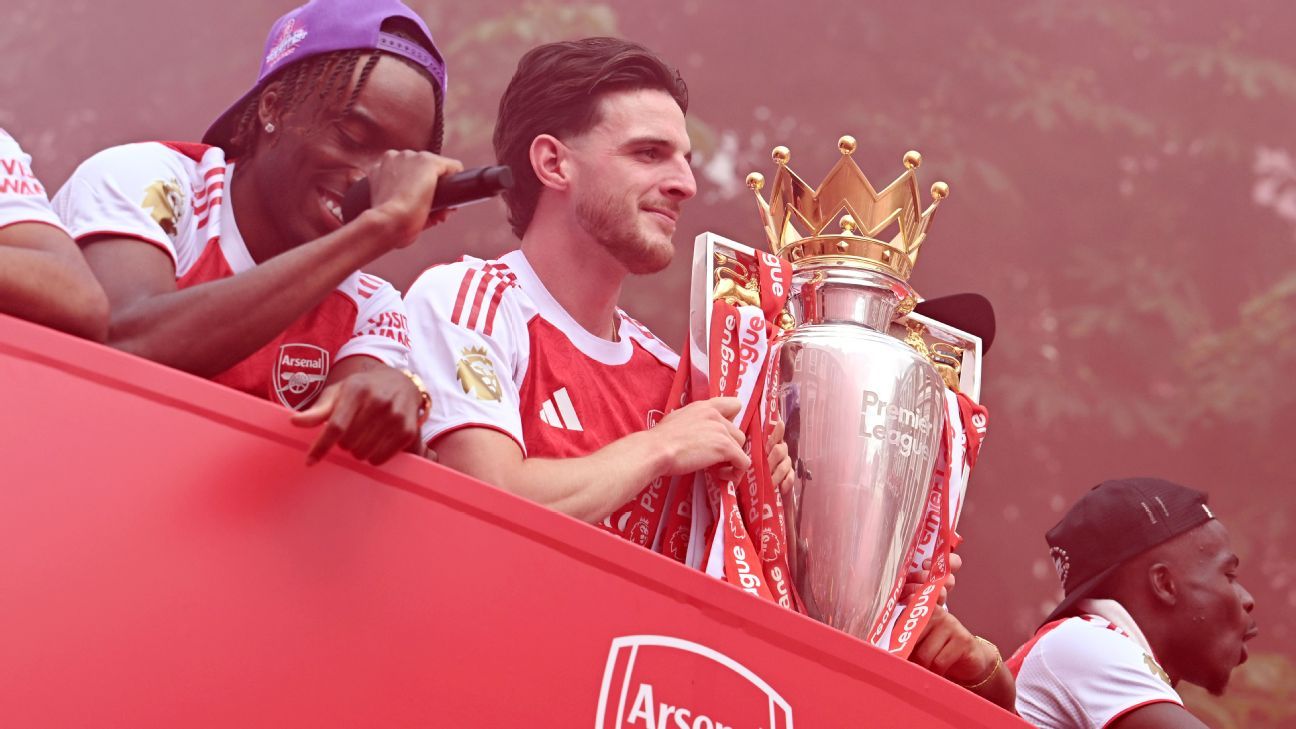
LONDON — Arsenal’s extensive 63-game season has come to an end, providing a true test for the club. It culminated in historic achievement with a first Premier League title in 22 years, while simultaneously confronting painful disappointment after a penalty shootout loss to Paris Saint-Germain in the UEFA Champions League final.
Despite the bittersweet aftermath of Saturday’s 4-3 defeat in Budapest, a wave of pride surged hours later as hundreds of thousands of fans filled a five-mile stretch in north London to celebrate a team that had fought its way back to the pinnacle of English football.
The Gunners’ season has been an emotional journey for everyone involved, battling against lofty expectations and historical significance while ultimately overcoming adversity to outpace Manchester City for the title by a seven-point margin.
In the wake of the defeat to PSG, there was an immediate sense that Arsenal would bounce back. During the parade, midfielder Declan Rice spoke into a camera, confidently stating: “We will be back for more.”
At the same time, director Ben Winston took to Instagram, reflecting on past disappointments and recognizing a shift: “I remember this feeling coming home from Paris in 2006 [when Arsenal lost to Barcelona]. But that was the end of an era; this is the beginning of one.”
This renewed sense of hope stems from the realization that Arsenal is evolving. While the transformation is ongoing, the growth is evident. Here’s the narrative of the club’s journey through the season.
Mikel Arteta’s Quest for Joy
Arsenal manager Mikel Arteta is a passionate footballer, driven intensely to ascend among the elite in the sport. It is said he begins his day around 5:30 a.m. with an Americano coffee and scrambled eggs.
The 44-year-old former player is frequently one of the first to arrive at Arsenal’s Sobha Realty training center, though he prioritizes moments for meditation. Sources indicate that last summer, Arteta consciously aimed to embrace the enjoyable aspects of his profession, recognizing the need for balance amidst relentless ambition.
For instance, when winger Noni Madueke expressed eagerness to join the squad immediately after his £48.5 million transfer from Chelsea, Arteta praised his enthusiasm but reconsidered, deciding the player should adapt gradually to his new environment rather than face immediate pressure.
His communication throughout the season reflected this continuing struggle for equilibrium. Players often noted Arteta’s unwavering intensity, ensuring high standards yet inadvertently creating a sense of pressure that made the season feel arduous.
This was particularly evident after a frustrating home defeat to Manchester United on January 25. The following day, the squad convened for a meeting to reset mentally, encouraging players to enjoy the current moment rather than be overwhelmed by it.
On January 27, Arteta urged fans to “jump in this boat because it’s going to be fun,” acknowledging a need to relieve pressure. Yet, this sentiment didn’t always resonate; many home matches were fraught with tension as the team focused on defensive solidity, emphasizing risk reduction and set pieces, resulting in narrowly fought games.
Following a pivotal 2-1 defeat to Manchester City on April 19, Arsenal found renewed optimism. The close nature of the loss, marked by a last-minute goal from Erling Haaland, steered the players’ mindset as they headed into their final five fixtures of the season.
In the days after that match, Arteta dined with his coaching staff, including Gabriel Heinze, where they refined their tactics over a meal at La Patagonia Restaurant. Arteta later announced that they were starting a “new five-game season,” a focus that sharpened their mentality, resulting in a clean sweep of league wins for the remainder of the season. Ultimately, there is no joy quite like winning.
1:01
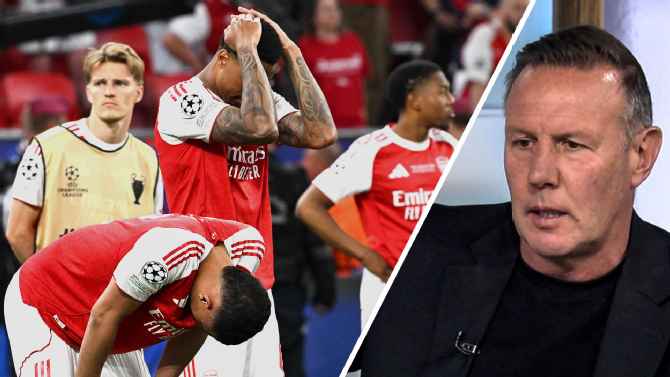
Burley: Arsenal’s approach in Champions League final was ’embarrassing’
Style Versus Substance
Intertwined with the quest for joy was the team’s playing style. Arsenal’s summer transfer strategy focused on adding depth across various positions to allow Arteta to rotate players without sacrificing quality.
Winning the Premier League and falling short in the Champions League final only validated this approach. Yet at times, the team struggled.
Club insiders acknowledge a needed shift in style to get the best out of Viktor Gyökeres, who was acquired from Sporting CP for around €63 million last summer.
Signs of this evolution appeared during pre-season tours in Singapore and Hong Kong, where there was a concerted effort to quicken the pace of play and move away from the overly cautious “horseshoe” tactics that previously dominated many matches.
However, Gyökeres struggles initially—scoring just five goals in his first 15 league appearances—coupled with Kai Havertz‘s injury setbacks, led Arteta to utilize central midfielder Mikel Merino in an emergency striker role, with success; Arsenal then found themselves leading the Premier League and progressing well in the Champions League.
Arsenal found themselves conflicted between their established identity—which was proving effective once again—and the desired evolution of their style. This, alongside external expectations, contributed to numerous cautious, conservative performances.
The squad also faced injury challenges, particularly with their attacking options. The right-sided axis of Jurriën Timber, Martin Ødegaard, and Bukayo Saka—the team’s most effective attacking trio—were frequently sidelined throughout the campaign.
Arteta’s historic lessons from past failures—often blamed on naivety or individual errors—also informed an increasingly cautious approach. However, the extreme nature of their tactics in the Champions League final, where they managed only 25% possession and a single shot on target, starkly contrasted with the more proactive style they had discussed earlier in the season.
While PSG could intimidate any team, Arteta acknowledged a need for a more ambitious approach in the transfer market this summer, recognizing the elite qualities of PSG’s players. This suggests a desire to enhance the squad with top-tier forward talent, reducing reliance on set pieces and evolving Arsenal into a more dynamic side as Arteta envisions.
Gyökeres concluded the season with 21 goals—all in all, a solid achievement—but doubts linger about his fit at the highest level and whether he is the ideal player to help redefine the team’s style. Arsenal’s strategies in the upcoming transfer market will clarify this discussion.

1:35
Leboeuf: PSG-Arsenal UCL final ‘one of the worst ever’
Team Unity and Incremental Gains
Efforts to cultivate greater team unity were evident throughout. Heinze, hired last summer to replace Carlos Cuesta, often held huddles with the defensive group during warm-ups.
Behind the scenes, players bonded through various activities. A popular board game, “Parchis,” became a favorite within the squad, with Leandro Trossard, Ben White, Havertz, and Ødegaard displaying competitive spirits as they partnered up for matches and tracked ongoing scores. The card game Uno also became a hit.
In October, a small contingent of senior players approached Arteta, expressing their wishes to host a team dinner. Meanwhile, Ødegaard and Madueke grew closer during November as they rehabilitated from similar knee issues together.
Support from senior executives also played a crucial role. Co-chair Josh Kroenke served as a calming influence in the training environment, offering encouragement and guidance to Arteta when necessary.
Winning enhances team morale, but the collective commitment from fringe players—who rarely started matches—was equally essential. Arteta praised backup goalkeeper Kepa Arrizabalaga as a model of “dressing room behavior and culture,” despite playing only 12 matches behind first-choice David Raya this season, with just one appearance in the Premier League on the final day against Crystal Palace.
Similarly, sources have highlighted the positive contributions of 32-year-old midfielder Christian Nørgaard, who made just 12 starts following his £10 million transfer from Brentford, and only started once in the Premier League after Arsenal’s title was secured at Selhurst Park.
Sources indicate that some players recommitted to the club after facing uncertain futures last summer. White and Gabriel Martinelli were uncertain about their positions but played integral roles when summoned.
Ødegaard, as captain, played an essential role in fostering team cohesion, organizing dinners, and stepping in for media duties when other players were unavailable.
Rice was brought into Arteta’s office after two games and shown clips highlighting his areas for improvement, focusing on maintaining closer positioning with Martín Zubimendi to ensure compact passing distances. He stepped up significantly towards the season’s conclusion, taking the captain’s armband when Ødegaard and Saka were sidelined. Rice also chose to address the media in an uncommon mixed zone appearance before facing City in April, displaying vocal leadership during critical dressing-room confrontations after they dropped points against bottom-placed Wolves in February.
The mindset translated into performances, as Arsenal made history as the first team in Premier League history to complete a season without conceding a penalty or receiving a red card. The club recognized that their previous tally of six dismissals—the highest in the league—had cost them crucial points.
Additionally, despite enduring various injury setbacks, Arsenal successfully mobilized most of their squad for the season’s peak. For example, Havertz’s knee injury was carefully managed to ensure his availability for the most significant matches in late-season clashes.
Arteta enlisted Spanish physiotherapist and long-time friend Joaquin Acedo to investigate the squad’s injury challenges, complemented by ongoing reviews of their training loads and injury management procedures.
The physically demanding nature of Arteta’s training sessions contributed to injury occurrences during warm-ups, with defender Riccardo Calafiori sustaining injuries twice and winger Saka suffering a setback prior to January’s match against Leeds. However, most issues were resolved by the time the season was in its final stretch.
Strengthening Connections with Fans
The connection with fans has steadily improved under Arteta, with “North London Forever” now emerging as a cherished pre-match anthem.
Efforts to create a more intimidating atmosphere at the Emirates Stadium for opponents and instill urgency in each match were crucial this season. Pre-game tifos became the standard, with fan group Red Action significantly contributing to displays before November’s victory over Tottenham. Before facing Liverpool on January 8, there were requests for fans to arrive in their seats 10 minutes early, emphasizing that “every supporter has a part to play” and reinforcing that “home is where the heat is” in accompanying promotional content.
New director Winston has played an essential role in bridging the gap between the club and supporters. Kroenke discussed having lunch with Winston post-European Super League turmoil to gain insight into fans’ sentiments, and Winston has become a central figure in ensuring clearer communication with supporters.
Nonetheless, there remains a risk that the intense expectations for continual high energy every few days could compound existing nerves. Many home fixtures became unnecessarily tense.
This is where youthful exuberance proved vital. Academy forward Max Dowman set several records this season, with a defining highlight in March as he scored to become the youngest goal scorer in Premier League history at just 16 years and 73 days.
In a surprising move, Arteta, acting on instinct, deployed left-back Myles Lewis-Skelly in midfield during the season’s closing games, a role notably shifted due to Zubimendi’s fatigue. The 19-year-old made a significant impact, leading the club past Atletico Madrid in the Champions League semifinals and making an impression in the final against PSG.
The future looks promising for him and for Arsenal.
Plans are in motion for stadium improvements, with revenues soaring to record heights. Arteta hinted at major market moves, calling for the club to adopt a “very ambitious” stance. The transitional phase for rivals— including Manchester City, Liverpool, and Chelsea—presents a unique opportunity for Arsenal to establish themselves as the preeminent force in English football.
Thus, when Arsenal supporters took to the streets to express their support, it was not only in recognition of what they achieved, but also with excitement for what lies ahead.