



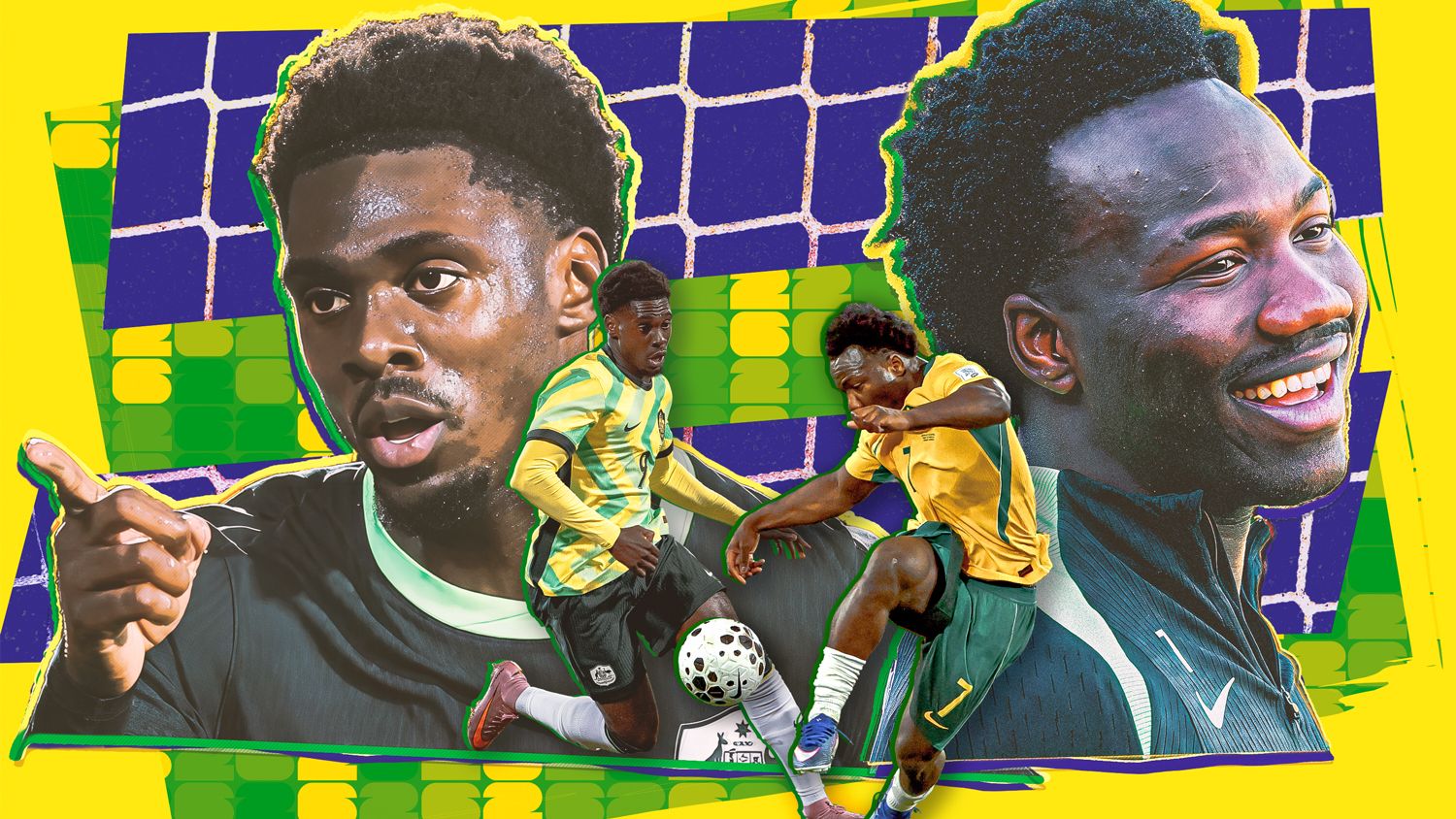
BERKELEY, California — On a bright afternoon by the Bay, with the FIFA World Cup just a week away, the media session for the Socceroos is coming to a close. For the last hour, Tony Popovic’s squad has taken turns answering questions in a spacious hotel hall, engaging in 15-minute sessions with reporters, some on camera while others are conducted over the phone. It’s that special time every four years when the Australian public starts to pay serious attention to their national team, bringing forth a flurry of interviews.
Mohamed Touré, 22, is a standout figure in the squad, attending media obligations long after his teammates have moved on. As he prepares for one last interview, clearly eager for a sauna session but aware of his responsibilities, two of his fellow players simulate groans nearby.
“I’ll be quick, I’ll be quick,” Touré chuckles as he settles in. His teammates, fellow World Cup newcomers Tete Yengi and Nestory Irankunda, pretend to roll their eyes at him before effortlessly transitioning between glancing at their phones and playing with leftover props from a photoshoot, all while playfully attempting to distract Touré from his focus. At one point, Yengi humorously interjects, urging his friend to “stop lying.”
The trio shares a long-standing friendship, having grown up together in Adelaide. Touré and Irankunda, who came to South Australia as refugees from Guinea and Tanzania respectively, first connected through school sports, leading to a strong bond that has endured through grassroots football and their shared experience at professional club Adelaide United. While Yengi did not play for the Reds, his diverse path to the World Cup marks a unique journey. He’s known Touré since he was 12, while Touré was just 8; the pair have literally grown up together.
– World Cup predictions: Champions, Golden Ball, breakout stars and more
– Jackson Irvine has endured a rollercoaster season leading up to the FIFA World Cup
– ‘We’re really hard to beat’: Socceroos undaunted by World Cup sceptics
“That’s the best part about being here alongside friends I’ve known since childhood,” Irankunda tells ESPN. “We’ve grown together, and our friendship runs really deep.”
“To be here with them, possibly sharing the pitch during a World Cup, is just incredible. I’m thrilled and excited,” he adds.
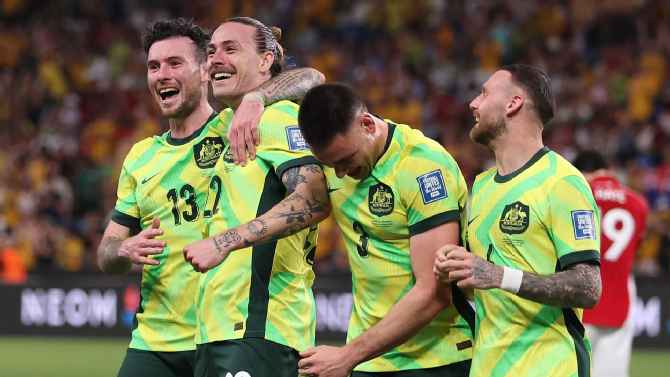
On and off the field, the Socceroos are undergoing a transformation. Australia is sending one of its youngest squads yet to the 2026 World Cup, with 17 players making their debut and eight members of the 26-player team aged 23 or younger. There’s genuine enthusiasm about what this talented youth can achieve, both now and in the future. Coach Popovic emphasizes their immediate contributions, as some are anticipated to start or make significant appearances when Australia kicks off its tournament against Türkiye in Vancouver on June 13.
Touré and Irankunda are at the forefront of this new wave and have attracted considerable attention from not only the small football community in Australia but also the broader public. Their rising stardom has led both former Socceroos coach Graham Arnold and Popovic to intervene, attempting to manage the overwhelming interest and associated pressures while shielding them from added expectations.
“Sometimes I try to avoid media engagements as much as possible; they aren’t really my favorite,” Irankunda candidly admits. “With the domestic season over and World Cup upon us, I want to remain fully focused and locked in to achieve something special here.”
Popovic has continually focused on mentoring the pair off the field since he took the helm of the Socceroos in 2024. He has provided support to Touré as he adjusts to the professional environment and encouraged him to embrace the competitive nature of European football, working to overcome the frequent soft-tissue injuries that have hindered his promising career. Following his breakout performance with Adelaide United that led to a transfer to Bayern Munich, Popovic has urged Watford striker Irankunda to navigate the challenges that come with evolving from being the standout star of Australian football to one of many aspiring talents in the competitive European landscape. He has also encouraged him to enhance lesser-known aspects of his game, such as his defensive work-rate and taking more shots in the box.
“They’re progressing well,” Popovic tells ESPN. “We want them to enjoy the journey, train at their peak, and strive for improvement daily. Off the field, it’s important to maintain the right balance, enjoying personal activities whether together or alone without feeling overwhelmed, but rather embracing the excitement.”
“Here we are at the World Cup, the largest platform of all, and I am confident these young talents will thrive under the spotlight.”
However, there are limits to how much the coach can shield and mentor his players. Alongside Jordan Bos and Ajdin Hrustić, they have become the face of the Socceroos’ World Cup kit launch, representing a campaign celebrating the underdog Australians on a mission to outperform their opponents. If they aren’t already, the duo is poised to become synonymous with the Socceroos, although Irankunda believes the title belongs to seasoned players like Mathew Ryan, Mathew Leckie, or “Star Boy” Bos.
1:47
What are the expectations for Australia at the World Cup?
“Jordy Bos, I mess with him a lot,” Irankunda jokes. “I call him the Star Boy because I believe he’s our best player.”
Unfortunately for Irankunda, who has often been more reserved during media engagements, it seems Bos’s rising profile will parallel his own. As long as Touré continues to shine through their careers, both literally and figuratively, the media spotlight will undoubtedly follow. However, Touré adopts a more optimistic view of the attention.
“For me personally, it doesn’t really bother me,” he reflects. “If people are talking about you positively, it signals that you’re making an impact. So to me, it’s more of a proud feeling, that I am doing something great.”
Engaging in conversation with Touré and Irankunda reveals that even if they’re not keen on media exposure, their personalities shine through effortlessly. Touré vividly recalls the emotional rollercoaster he experienced while scoring a hat trick against Oxford United shortly after joining Norwich City. Their vibrant personalities become even more apparent when they escape the constraints of an interview—like their friends’ playful attempts at distraction during Q&A sessions—and even more so when they’re on the field.
Irankunda has a fiery spirit, often getting entangled in confrontations; he received a yellow card during the Socceroos’ 1-1 tie with Switzerland for an incident involving a cheeky pass to Granit Xhaka after the veteran was fouled. He sometimes displays his discontent when substituted, making it clear he is passionate about the game—a trait his coaches, whether at Adelaide or in the national setup, have worked diligently to channel positively. The aim has been to retain his spirited nature while helping him control his emotions.
“We’ve watched them mature over time,” says Popovic. “We brought Mo in during the past year’s key matches… he debuted against Saudi Arabia, and he’s earned his place in the squad. His transition to Norwich is not just progress; it’s a crucial step forward.”
“And with Nestor, we’ve witnessed ups and downs, a journey that continues ahead for him. They’re young, gifted players learning the blend of professional football’s demands on and off the pitch.”
“To reach their dreams and ambitions, they must strive for excellence in every aspect of their lives while cherishing the qualities and experiences that have formed who they are. Those must be kept intact.”
Though Popovic often comes off as stern and has not hesitated to challenge them, his concern for both Touré and Irankunda is apparent. During a friendly against Canada, when Irankunda’s emotions threatened to boil over on the sidelines, Popovic quickly embraced him as he made his way off the pitch. Additionally, Irankunda famously celebrated a goal during send-off friendlies against Curaçao with a Michael Jackson-inspired act that took the internet by storm, donning a sparkling glove and performing a tribute to the King of Pop.
“It’s just who I am,” Irankunda chuckles. “You can ask anyone on the team—am I ever different? I’m always the same…unless someone really irritates me! I believe in keeping the mood light, joking around, and just enjoying myself.”
“That’s my essence, and I hope it never changes. Some may misinterpret my lighthearted nature as cockiness, but I’m just enjoying life.”
“Maybe when I hit 25 and have settled down with a family, I’ll need to mature a bit. But for now, I’m young, and I want to savor every moment.”
Adding to Irankunda’s enjoyment are his close friends from Adelaide. Touré, one of six siblings—one being Al Hassan, also an Australian international—considers Irankunda, who has seven siblings, his “little brother.” Yengi, whose older brother Kusini has played for Australia, also sees Touré as a brother. Earlier that day, the three shared a room with Awer Mabil, who has previously appeared in a World Cup and also hails from South Australia; Yengi labeled Awer as an “idol.”
Adelaide is renowned for its vibrant African football community, exemplified by initiatives like the African Nations Cup of South Australia (AFCON SA), where teams representing various African nations can be regularly seen competing alongside both current and former professional players. This tournament is among the most established and successful sporting events in the nation.
“It’s a fantastic community-driven event,” Yengi beams. “The city really unites, celebrating African culture through the tournament. It’s a bit like experiencing a mini-World Cup right here in Adelaide—with a plethora of talent showcased. The hope is to inspire more young athletes to take the field.”
Due to limited financial resources compared to top-tier clubs in New South Wales or Victoria, semiprofessional clubs in the South Australian NPL tend to invest more in fostering local talent. Touré played for the Croydon Kings, Irankunda for Adelaide Croatia, and Yengi transitioned to professional football via the Croydon Kings and Adelaide Comets. Meanwhile, Adelaide United has adopted a model focused on local youth development, allowing Touré and Irankunda to make their professional debuts at just 15, and log significant match time—42 and 60 appearances—before moving on at age 18.
“We aim to honor our community back home,” Irankunda expresses. “Without them, we wouldn’t be where we are today. Their support and respect mean a great deal, and we strive to give back through our performances.”
“As African players, we’re showcasing the talent that exists, proving it’s possible to succeed—especially to younger kids from African backgrounds who aspire to be like us. We want to be the symbol that anything is achievable.”
Collectively, the community that nurtured their talent has contributed to the doubling of the Australian Socceroos’ African-heritage players from the 2022 World Cup; this year includes Mabil, Irankunda, Touré, and Yengi, reminiscent of players like Thomas Deng. While there is immense pride in representing Australia, there is concurrently a strong sense of duty to represent a community that spans the African continent, fostering one another here in their new homeland. In a 2023 interview, Touré’s mother, Amara, fondly recalled weekends when children from diverse backgrounds would congregate near their home in Croydon, to play football and then share toast and butter—sometimes depleting their supply of bread in the process.
“It’s inspirational for them,” Touré states. “It instills belief that they see our journey, knowing that achievements are attainable through hard work.”
“We feel a responsibility to give back to those who supported me, coaches, mentors, and community members throughout my journey. It’s essential for them to derive pride when they see us on their screens, knowing they were part of our developmental journey, reinforcing a sense of connection.”
However, beneath this overarching narrative lie the personal tales of these emerging stars. While media often attempt to frame their narratives, Touré, Irankunda, and Yengi have shared histories that extend beyond their performances on the world stage. What stands out in their current journey, as they prepare for the biggest moment of their careers, is the solidarity among friends who unabashedly express support for one another, navigating the rigorous demands of football towards success on the international platform.
Their achievements are a community victory, underscoring the power of friendship and collaboration—a testament to the nurturing and positive influence from their group chats. This collective journey also includes Touré’s brothers, Al Hassan and Musa, along with fellow Australian talents abroad such as Garang Kuol, Raphael Borges Rodrigues, Rhys Youlley, Ariath Piol, and Hosine Bility.
“It’s mind-blowing,” Touré shares. “At the onset of this season, we aimed to have successful seasons and reach the World Cup. To think that I’d be here with two familiar faces is surreal. It’s incredible.”
“It’s a powerful lesson: You can manifest your dreams. Throughout our group chat, we’d express our aspirations—saying, ‘It’d be great if we could all reach the World Cup.’ No one ever doubted it; we all believed that with hard work and focus, it could become a reality.”
Yengi, a notable addition to the squad, along with Cristian Volpato, made the squad even before his senior international debut, leveraging a successful loan spell at J1 League side Machida Zelvia to make the final roster, scoring on his debut against Switzerland in a pre-World Cup friendly. The excitement among the group chat was palpable.
“Everyone back home was thrilled; they offered their support,” shares Yengi. “We consistently uplift each other.”
“It’s fantastic that both Nestor and I had our first match together [against Switzerland], and one day, it’d be even greater to have all three of us on the pitch simultaneously. We’ve grown up together, share a similar background, and now we get to compete on the largest stage. It’s simply incredible.”
Touré and Irankunda have become increasingly established players under Popovic’s guidance following the team’s automatic qualification secured last June, with the subsequent year allowing for player integration without the stress of qualifiers.
Touré, boasting ten international caps and a sensational finish to the season with Norwich, contributing 13 goals in 12 matches after his January transfer, is expected to spearhead the Socceroos’ attacking line in the coming weeks. Meanwhile, Irankunda, with 15 caps, is likely to secure a start on one of the wings or serve as a strategic substitute in games, further enhanced by him logging the most minutes of his career at Watford despite facing various challenges.
Though they are still early in their careers, both players are viewed as vital components of the Socceroos’ World Cup aspirations. When asked about their ambitions, Touré and Irankunda modestly downplay their individual talents. However, when discussing their teammates’ potential, their enthusiasm shines through.
“Mo is going to shine,” Irankunda grins. “Not many people know Tete yet, but he’s phenomenal—a serious threat. They’ll be scoring goals, no doubt! And if they don’t, heaven help them!”
“The sky is the limit for [Touré], for Lucas [Herrington], for Bossy [Bos]. Everyone among the young boys—truly, the possibilities are endless. Mo is all kinds of dangerous—quick, strong, occasionally reckless—but undoubtedly a phenomenal player. If he desires greatness, he’s got to step up and seize every opportunity.”
As for Touré, he’s prepared to do his utmost for the team, but he also beams when predicting what his peers will achieve.
“Tete is primed to score goals, probably with a viral celebration,” he chuckles. “[Irankunda] just runs off after scoring, might pull off another Michael Jackson tribute now that we’re in America.”