



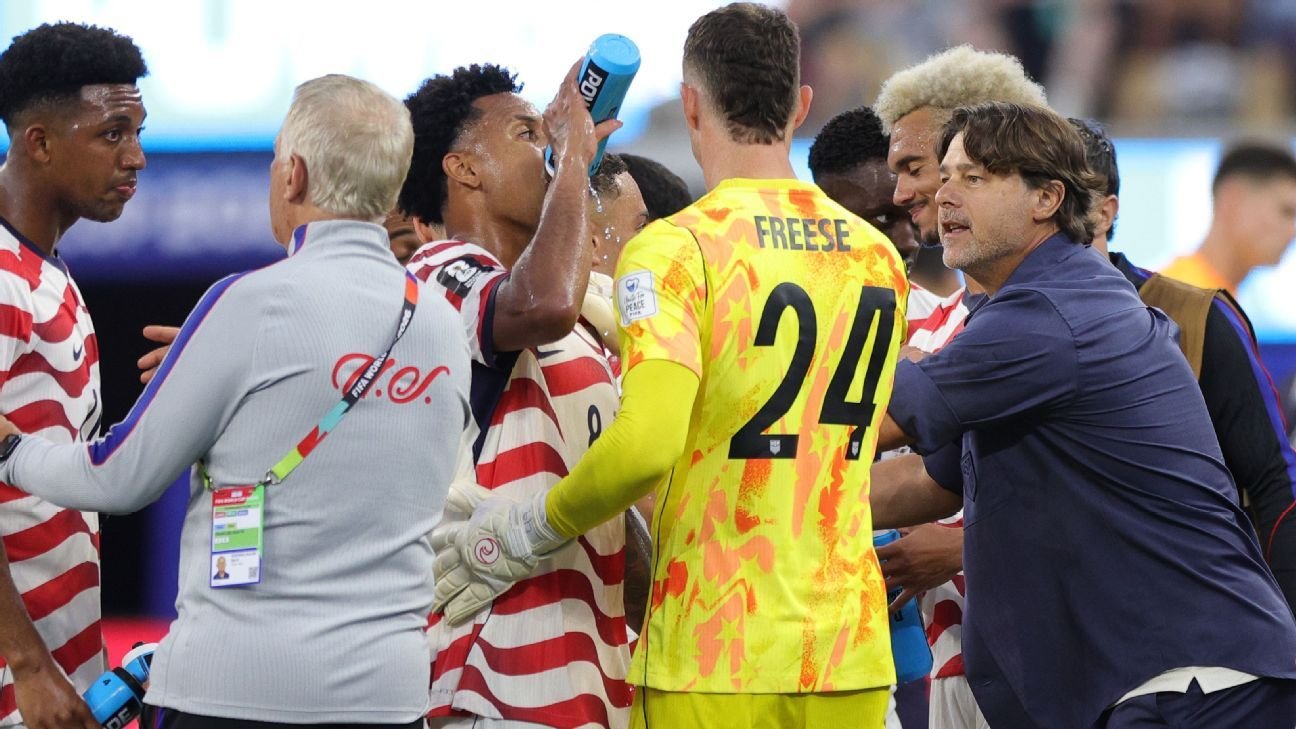
For this World Cup, FIFA has mandated hydration breaks at approximately the 22nd minute of the first half and the 67th minute of the second half in response to the summer heat across Mexico, Canada, and the United States.
While these breaks are crucial for player welfare in hot conditions, they are implemented regardless of the actual weather, leading to significant criticism about their effects on the game. The breaks effectively divide each match into four quarters, akin to the formats seen in the NBA or NFL. This structure may cater to the viewing preferences of sports fans from the host nations while also generating additional advertising revenue for FIFA during the three-minute pauses.
Our reporters have analyzed the various ways hydration breaks are impacting this World Cup.
Skip to: A financial windfall? | A disruptor of momentum?
Vital for player welfare?
The implementation of hydration breaks was announced by FIFA last December, motivated by the extreme heat faced by players during last summer’s FIFA Club World Cup in the U.S. The governing body aimed for a “streamlined and simplified” approach compared to previous tournaments, opting to enforce these breaks in every match, even in air-conditioned stadiums.
“Every game will have a three-minute hydration break, regardless of playing conditions,” stated Manolo Zubiria, the chief tournament officer for the World Cup, last December. “This will be enforced as three minutes from whistle to whistle in both halves, although referee discretion will apply if an injury stoppage occurs around that time.”
Critics have voiced their opinions on this approach.
“I’m not in favor of it unless weather conditions are extreme,” remarked USMNT coach Mauricio Pochettino. “In pleasant conditions, it feels unnecessary.”
Spain faced off against Cape Verde in a 0-0 draw, and coach Luis de la Fuente mentioned the temperature prior to the match. “In terms of player health, having breaks is right for extreme conditions. However, given the milder temperatures expected in the stadiums tomorrow, it might not be necessary. Yet, we’ve all experienced the heat and humidity in Chattanooga, and these breaks can help players regain their energy.”
Spain midfielder Mikel Merino noted, “Some matches will certainly require them, while others will not. When it’s hot, breaks help players perform their best. However, in some of the enclosed stadiums where it’s cooler, the game pauses can slow things down, which detracts from the experience for fans and impacts game dynamics. Coaches must adapt quickly to this change.”
Medical rationale supports the necessity of hydration breaks.
As per FIFPRO, the global players’ union, three matches during the last Club World Cup should have been postponed or suspended due to extreme heat, as they exceeded the safe threshold of 28 degrees Celsius (82.4 degrees Fahrenheit) on the Wet Bulb Globe Temperature gauge, which assesses heat stress considering various factors.
This summer, no World Cup games have been affected by extreme heat, with FIFA rescheduling matches to avoid challenging conditions.
Nonetheless, support for hydration breaks exists, as they are viewed as essential for player health.
“The hydration breaks should primarily be seen as a health safety measure,” stated Prof. Mehmet Karabulut, M.D., from Medicana Health Group. “Today, football demands high physical endurance, and players cover significant distances, leading to fluid loss and increased body temperature regulation challenges in warm, humid conditions. A structured break for hydration can help athletes return to optimal performance levels and mitigate health risks.” He added, “While hydration breaks are important, they aren’t a standalone solution for player safety; factors like kickoff times, recovery durations, cooling zones, emergency medical plans, and acclimatization are equally significant.”
A financial windfall?
It is notable that Zubiria announced the hydration breaks during the World Broadcaster Meeting in Washington D.C. at the time of the World Cup draw, amidst suspicions that broadcasters, rather than players, are the primary beneficiaries of these pauses.
While players take a three-minute break and coaches deliver tactical advice, broadcasters have the opportunity to monetize these stoppages, earning significant revenue during the 104-game tournament. According to Michael Johnson, a sports industry analyst with S&P Global, these breaks could yield substantial financial gains for broadcasters, potentially commanding up to $9 million during high-interest viewing times similar to the Super Bowl.
However, Netherlands captain Virgil van Dijk expressed concerns about the increased “commercialism” associated with the breaks. “Hydration breaks are a bit complicated. I’ve watched many games, and the commercial interruptions are less than pleasing for those watching at home,” he conveyed. “In extreme heat, they are beneficial, but it is imperative that we evaluate each game on its own merits.”
Colombia coach Néstor Lorenzo added, “If temperatures escalate from 30 to 35 degrees, as experienced in Copa América, a hydration break is appropriate. However, when breaks extend beyond three minutes, the initial purpose of hydration gets lost in commercial interests. Initially, these breaks allowed for manager-to-player communication, yet now they’ve shifted to commercial interruptions, suggesting an ulterior motive behind their introduction.”
Former players like Gary Neville have labeled the breaks a “stealth advertising break,” noting that U.S. broadcaster Fox capitalizes on these pauses for commercial purposes.
Interestingly, U.S.-based Spanish-language broadcaster Telemundo and UK-based ITV Sport have opted not to air commercials during these hydration breaks. — Mark Ogden
1:39
Where must the Netherlands improve after Japan draw?
A disruptor of momentum?
Re-starts are pivotal in any sport, often altering rhythm, momentum, and allowing teams to regroup.
The World Cup’s hydration breaks have fundamentally shifted game strategies. Teams can now adapt their tactics according to evolving circumstances, using the breaks to rethink their approach or recover from pressure.
“These breaks benefit teams that lose momentum,” remarked USWNT coach Emma Hayes during an ITV interview. “When you’re performing well, a break isn’t advantageous; when you’re struggling, it becomes a chance to regroup. Often, it’s not even about strategy—sometimes it’s just about players taking a moment to hydrate and recalibrate.”
Statistics from the tournament illustrate the significant repercussions these breaks have. Of the 22 first-half goals scored thus far, a dozen have occurred after the initial hydration break, and the same applies to the second half where 12 out of 24 goals followed the pause.
Not only does this indicate an increase in goals scored, but the timing is crucial as well. Of the 24 goals netted post-hydration breaks, 11 have significantly altered game outcomes, tying the score or giving the lead to a team.
For instance, Australia’s decisive 2-0 victory over Türkiye featured both of their goals following hydration breaks in each half, despite Türkiye dominating possession early on. Post-break, Australia shifted from a single shot to three, scoring immediately after the hydration break.
In the 1-1 encounter between Brazil and Morocco, Brazil equalized just six minutes after the hydration pause. Although their equalizer was a remarkable individual achievement, Morocco failed to capitalize on their lead right before the break. The Atlas Lions had seven shots and an expected goal value of 0.9 before the break, but managed only 0.3 xG from five shots after it.
In the second half of Japan’s thrilling 2-2 draw against the Netherlands, their equalizing goal came right after a hydration break, with their shot count jumping from two before to five after.
Germany’s resounding 7-1 victory over Curaçao allowed coach Julian Nagelsmann to clarify tactics during the hydration break when they encountered an unexpected formation. “Curaçao used a diamond formation, and we revised our attacking strategy right before the hydration break,” he explained. “That break proved valuable to reinforce what we had already discussed.”
Similarly, in Canada’s 1-1 match against Bosnia and Herzegovina, the hydration break was pivotal. Following Bosnia’s initial goal, a break allowed Canada to regroup, resulting in increased offensive activity—from one shot to five, and an upswing in touches in the opposition box from four to 17.
The pattern of momentum shifts was also observable in Scotland’s first game, where they scored a winning goal shortly after the first hydration break. Haiti experienced a similar scenario, conceding a goal after the first break but managing all their shots and touches in the opposition box after the second break.
Although game dynamics inherently influence momentum, hydration breaks present teams with new strategic opportunities, potentially leading to a shift in tactics as they adapt to this unique match format. As France’s Didier Deschamps put it: “These breaks are beneficial for managers, offering additional chances to communicate with players. However, the game has essentially transitioned from two halves to four quarters, requiring teams to adjust to this new framework for competitive play.” — Yash Thakur