



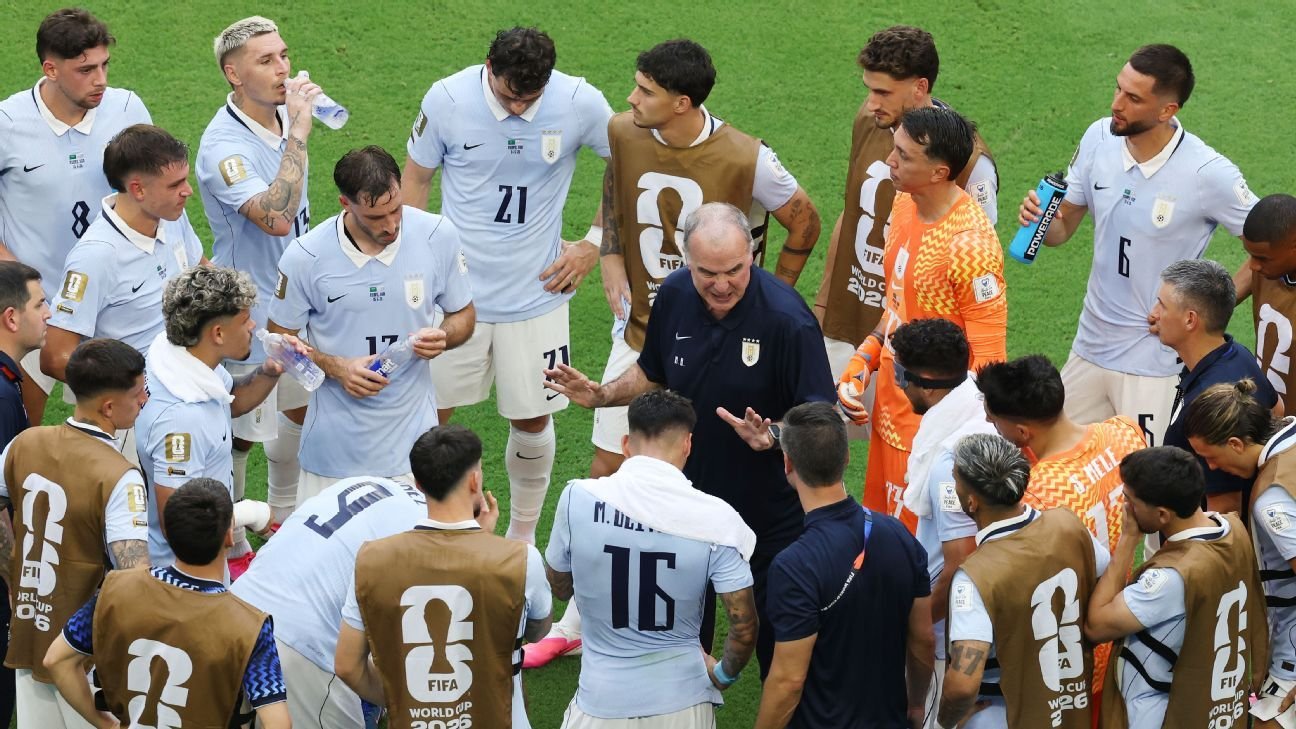
Did Marcelo Bielsa’s Uruguay manage to regain its momentum in the second half against Saudi Arabia?
After a lackluster start, they found themselves trailing just five minutes before halftime, facing what could have been a disastrous outcome for the next 40 minutes. With spirited teams like Cape Verde and Spain looming, an embarrassing early departure was a distinct possibility.
While that risk still lingers, Uruguay emerged from the 1-1 draw aware they should have secured a win, having created ample chances to seal the match in their favor.
It has been quite some time since they performed well against formidable opponents. Bielsa’s adjustments at halftime yielded positive results. If his team has found their rhythm again in the United States, it holds a certain irony considering they lost that rhythm here two years ago.
It feels like a distant memory now, but Bielsa initially had a strong start as the head coach of the Uruguay national team. His approach seemed intriguing, particularly as the squad required a generational shift following the group-stage exit at Qatar 2022, having featured players from as far back as the 2010 World Cup in South Africa (notably the 40-year-old Fernando Muslera, who has made a return).
The new coach had a dynamic core of young talent ready to implement Bielsa’s high-energy pressing style, which could overwhelm opponents in their own half, creating two-on-one opportunities on the flanks. For a time, Uruguay was the most in-form team in South America, achieving notable victories over Argentina in Buenos Aires and Brazil, dominating to an extent many could hardly remember. They kicked off the 2024 Copa América in the United States with great momentum.
However, during that tournament, things took a downward turn. Luis Suárez announced his retirement from the national team, publicly criticizing the poor atmosphere fostered by Bielsa, a sentiment echoed by many within the dressing room.
Bielsa himself added credence to these claims, labeling himself a “toxic” individual who is challenging to be around. It’s possible that his unique brand of aloofness doesn’t resonate with modern players who seek better communication.
The Copa América ended up being a pivotal moment, as Uruguay’s performance plummeted afterward. Going into the tournament, they were South America’s leading scorers in World Cup qualification. Yet, they failed to find the back of the net in eight of their last 12 matches. Even more alarming, they weren’t generating scoring opportunities, a stark contrast to the initiative-driven, dominant style expected from a Bielsa-coached team.
Friendlies that followed brought no solace, as they endured a humiliating 5-1 loss to the United States in November. In this game, Bielsa witnessed his strategies outperformed by Mauricio Pochettino, who was heavily influenced by Bielsa’s methods. Meanwhile, the USMNT’s comfortable 4-1 victory over Paraguay served as a testament to Bielsa’s principles while he struggled to make progress.
After enduring 18 World Cup qualifiers, a Copa América, and several friendlies in October, November, and March, Bielsa seemed to return to square one. His squad entered the World Cup without any pre-tournament friendlies. Instead, he focused on the training ground, unveiling a restructured team for the match against Saudi Arabia.
During his tenure with Argentina, Bielsa frequently faced criticism for not fielding both of his in-form strikers, Gabriel Batistuta and Hernán Crespo, insisting that his system only accommodated one forward who thrived on crosses from flank players.
This philosophy seemed to carry over to Uruguay. However, against Saudi Arabia, both Darwin Núñez and Federico Viñas took to the pitch. With midfielder Manuel Ugarte slotting in behind the central defenders, the wing backs, Guillermo Varela on the right and Matías Viña on the left, were set to provide much of the attacking width.
Viña could connect with Maxi Araújo, while Varela teamed up with Real Madrid‘s Federico Valverde, who was the standout performer, providing a pathway down the right side to push forward.
However, the new system, for reasons unclear, turned out to be a major letdown. The twin strikers needed quality crosses, but they received none. Especially considering Viñas’ recent injury issues and lack of form, selecting him for an attacking role on the left seemed ill-advised.
Valverde also struggled to make his presence felt on the field. The strikers were left to fend for themselves, with Núñez making little impact. Following the game, Bielsa was highly critical of the team’s performance in the first half.
Hence, after the break, instead of continuing with his revised system, Bielsa reverted to the tried-and-tested model. Off came Viñas and Núñez, and Uruguay shifted to Bielsa’s classic 4-3-3 formation, with Araujo returning to the left wing, Agustín Canobbio entering to cover the right flank, and Valverde allowed to roam freely in a central position.
Although they didn’t replicate the pre-Copa América Uruguay’s form, they began displaying the essentials of a typical Bielsa side—relentlessly pressing, controlling the game, and leaving the field justifiably frustrated not to have secured a win.
Next Sunday, they face Cape Verde in Miami once again. The African team faces a pivotal decision: will they aim to replicate the disciplined defense shown against Spain to secure a draw and position themselves for a last-32 appearance with a win over Saudi Arabia?
If so, stifling Uruguay will prove to be a different task entirely. Rather than the patient approach of Spain, they will encounter a Uruguay team ready to unleash intense pressure.
Bielsa is set to step down following this tournament, which may be a relief to some players. At 70, his opportunities for major coaching roles may be dwindling. For now, however, he leads a team steeped in tradition and high expectations. At times against Saudi Arabia, it seemed Bielsa could be just a couple of games from the end of his tenure.
That remains a potential outcome, but at least spirits are lifted as Uruguay seeks a victory over Cape Verde that could extend Bielsa’s illustrious coaching career by a game or two.