



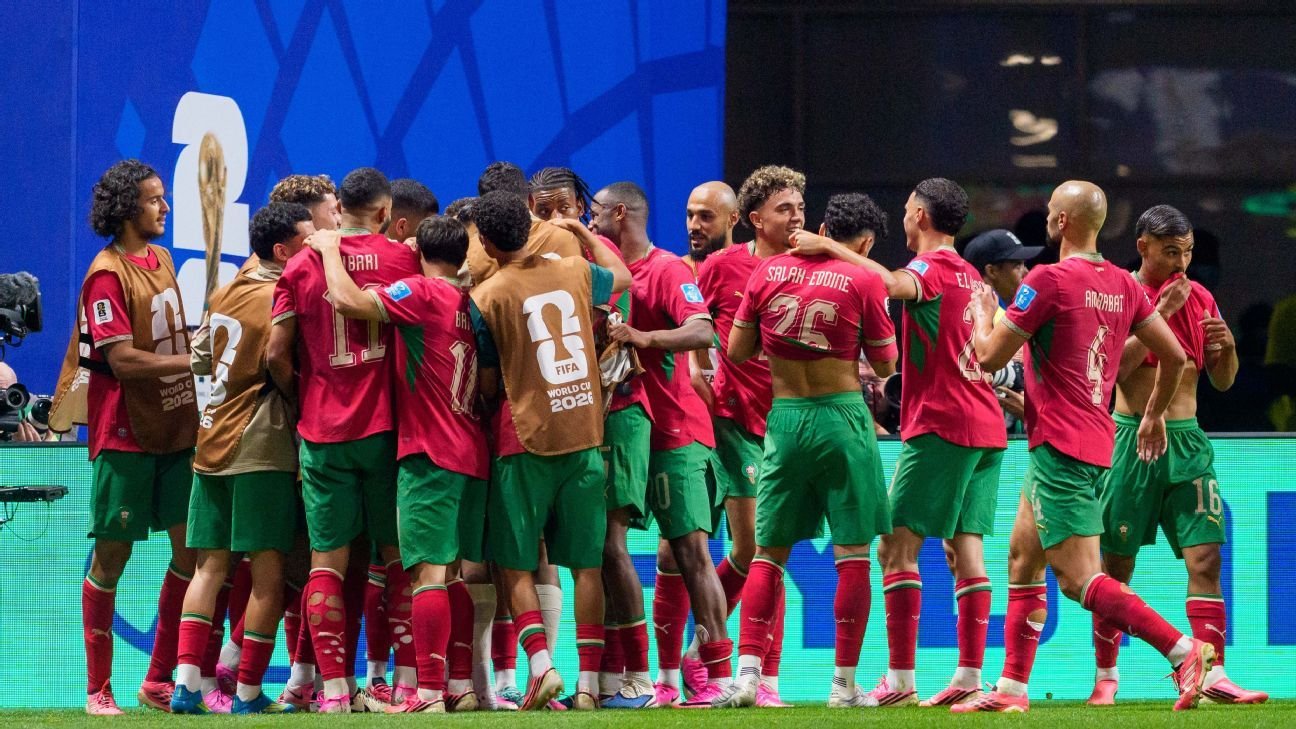
ATLANTA, Georgia — Credit to Morocco for staying true to their role as World Cup dark horses. They’ve been so committed that at times, it appears they’re holding back, striving to fly under the radar throughout the tournament.
While they showcased moments of brilliance during their 4-2 win against Haiti on Wednesday, there have also been stretches in each group match where Mohamed Ouahbi’s squad seemed disorganized and uneasy.
Ultimately, they’ve advanced from Group C and will face either the Netherlands, Japan, or Sweden in Monterrey, Mexico on June 29. Their performance in the group stage ensures that they won’t be taken lightly in the knockout phase, though some vulnerabilities might give opponents hope.
“I’m happy, we just won a World Cup game,” Ouahbi remarked. “We enjoyed a lot of possession and created several chances. They scored twice, and we need to manage parts of the game better. For the most part, we were in control.”
“It was not an easy match, but we had a lot of positives.”
– World Cup match schedule: All fixtures, results, features
– World Cup 2026: How teams can advance to the knockout rounds
– Curacao’s Gervane Kastaneer: What the World Cup is like for a player
Morocco’s strengths are evident. They dominated the early stages of their opening match against Brazil and had numerous opportunities against Scotland, where they should have secured a larger victory. In this game, they netted a goal that illustrated exactly why they are capable of reaching another semifinal.
After Haiti took the lead with an early goal, Brahim Díaz exploited a pocket of space in the center, quickly generating a precise pass to the left. The ensuing cross found Achraf Hakimi, who charged in from right back to deliver the decisive touch.
Since being appointed in March, Ouahbi has promised a more dynamic style compared to his predecessor, Walid Regragui, who took Morocco to the last four in Qatar. Hakimi’s goal mirrored Ouahbi’s vision in action.
While Regragui’s success was rooted in a robust defense, that characteristic has somewhat diminished in pursuit of a more offensive approach. Nevertheless, the team now possesses greater overall quality. In the knockout rounds, where the stakes are higher, they need to demonstrate this consistently.
Combining their traditional North African defensive solidity with the ability to create and finish chances, Morocco will be a formidable opponent. Ouahbi hinted that the only element missing is the confidence that this squad can go deep into the tournament.
“I mentioned before the World Cup that Morocco has entered a new phase [after Qatar],” he shared. “We’re part of an emerging momentum where we need to sincerely believe in our potential to become champions.”
“We have all the necessary ingredients to become the best nation. It’s time to have faith in that.”
While Morocco has serious aspirations for advancing far in the tournament, for others like Haiti, the World Cup provides opportunities for special moments. Haiti, having not qualified since 1974, aimed for unforgettable memories. Against Morocco, they achieved that with two goals.
Despite playing well at times against Scotland and Brazil but failing to find the net, when their first goal came on Wednesday—an unfortunate own goal by Yassine Bounou—the ecstatic crowd at Atlanta Stadium celebrated as if it were the most remarkable finish they’d ever seen.
Half a century without a World Cup goal is a long time, but the next one was worth the waiting.
With the match tied at 1-1, Sunderland forward Wilson Isidor received the ball outside the box, took a touch to set himself, and unleashed a thunderous shot into the top corner that left the crowd in awe. It was a goal of such quality that it took a moment for fans to realize what had transpired, before erupting in celebration. The noise was enough to reverberate through the seats and shake the stadium.
One Haitian fan stood frozen, mouth agape and hands on their head. It was a moment that the fortunate Haitians present in Atlanta will cherish forever.
For the passionate supporters in blue who cheered and danced throughout the night, the final score held little significance. Every Haitian football fan will forever remember where they were when Isidor nearly broke the net.
“We demonstrated we’re deserving of this qualification,” said Haiti coach Sebastien Migne. “We need to improve and not wait another 52 years. That’s a long time. We faced a tough challenge, and it was significant for us.”
While Haiti may exit the tournament, Morocco continues onward, equipped to replicate their success from Qatar four years ago. With Hakimi, one of the best full-backs globally, and Díaz, a skillful playmaker, plus Ismael Saibari, who has netted three goals in three matches, their arsenal looks promising.
By combining their standout elements from matches against Brazil, Scotland, and Haiti, Morocco can prove a threat to any knockout opponent. However, sitting back, conceding control, missing opportunities, and allowing defensive errors could lead to an early exit from this World Cup.
It’s time for Morocco to unleash their true potential.