



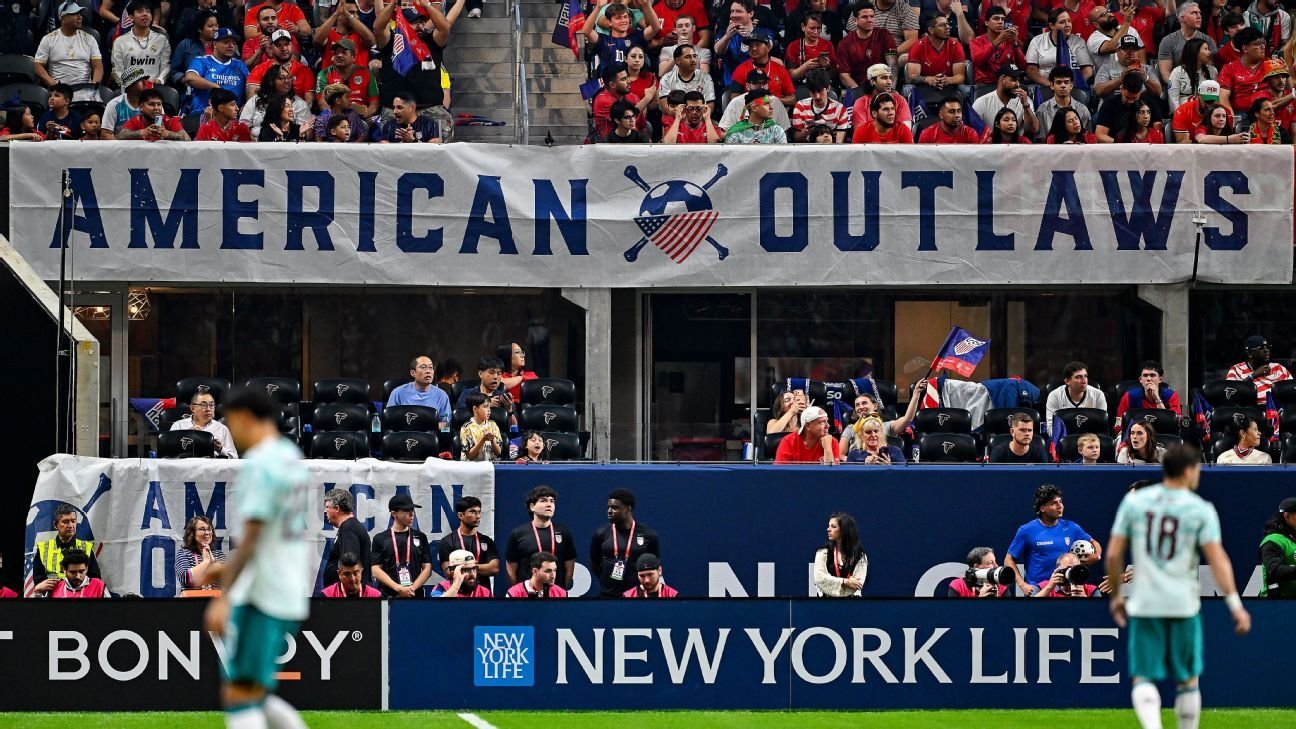
SEVEN MONTHS ahead of the 2026 World Cup, section 148 at Raymond James Stadium showcased what’s in store. On a Tuesday night in November, the American Outlaws’ Tampa Bay chapter came together for the U.S. men’s national team’s final match of 2025 against Uruguay — and they brought the excitement. As cheers erupted, a 20-by-35-foot tifo rose, its bold letters proclaiming: Sailing to Victory in 2026. The moment marked a significant achievement for Juan Ruiz, the chapter’s vice president, after extensive planning by one of the nation’s largest soccer supporters’ groups, boasting nearly 30,000 members globally and around 200 in Tampa Bay.
“It’s taken countless hours,” Ruiz states. “I hope the Tampa Bay community remembers this moment.”
Tifos have been integral to soccer fandom since the 1960s. Originating in Western Europe, these elaborate displays consist of large banners, flags, and signs created by devoted fans to showcase their support for a soccer club. The term “tifo” comes from the Italian word tifosi, meaning “fans.” However, its origins also trace back to the infectious fever of typhus, with 1930s newspapers drawing parallels between typhus symptoms and the fervent emotions of Italian soccer supporters, linking the sport with a contagious excitement.
Nowadays, tifos are grand, choreographed displays that electrify soccer supporter sections. Many utilize specialized rigging systems for a dramatic reveal. When executed well, they transform stands into artful canvases, conveying messages, themes, or tributes with striking effect.
“They’re crafted by fans, and the process involves extensive preparation, designing, and execution,” says Jeffery Kassing, co-author of “The Art of Tifo.” He views tifos as a “symbolic platform” for the communities formed through soccer, allowing fans to embody their “identity” and “group membership.”
“It’s a love letter to the club or team,” Kassing elaborates. “It’s a powerful mode of showing devotion.”
0:34
USMNT supporters create tifo for World Cup
The Creation of a Tifo
THE “SAILING TO VICTORY” tifo was revealed 206 days before the U.S. matchup against Paraguay on June 12. The project was initiated during an October conference call involving members of the American Outlaws Tampa chapter and national representatives. Andy Gustafson, the chapter’s president, proposed creating a tifo for the November match, which received full support, prompting preparations to commence. As per Whitney Zaleski from the American Outlaws, designers often team up with national representatives for tifo projects, although local chapters typically provide the designs.
“Once we got the go-ahead, we knew we had to find a designer,” shares Ruiz, who participated in the call.
Shortly after, at a Tampa Bay Rowdies game, Ruiz met James Hartzell, the artistic director for Ralph’s Mob, an enthusiastic supporters group for the Rowdies. After the match, Ruiz aided local friends in folding and storing banners before getting introduced to Hartzell, setting the stage for a collaboration on the tifo project themed around the World Cup.
Tifo designs must undergo a formal approval process to meet design standards, requiring coordination with team officials. For example, the Kansas City Cauldron — supporters for Sporting Kansas City — seeks internal approval from marketing and security teams before displaying a tifo on matchdays.
“Once we finalize a design, we share it with some team members internally for input,” explains Chris Miles, a Cauldron board member. Unauthorized sponsors are often flagged, but approval is granted “99%” of the time.
For the American Outlaws, all tifo designs necessitate approval from national representatives before submitting to the U.S. Soccer Federation, applicable only for matches hosted by U.S. Soccer.
“We generally have a lot of freedom, though we typically avoid player likenesses or trademarked logos,” Zaleski notes via email. An early design featuring an image of the World Cup trophy was flagged for violation of FIFA’s intellectual property rights, prompting the Tampa chapter to revisit their concept.
“Should we focus on our destination, the final in New York, or truly highlight Tampa?” Ruiz pondered.
Tifo Concepts – Behind the Designs
LAST JUNE, Cloud 9, the supporters’ group for Gotham FC, devised a tifo for the team’s Pride night titled, “Your True Colors Are Beautiful.” Using rainbow hues from the pride flag, Jen Muller, a Cloud 9 board member, aimed to resonate with the LGBTQ+ community. “With everything happening, we want them to know they are seen,” Muller shares. “Our fanbase has a sizable LGBTQ population; we want to communicate that this is their safe space.”
During a 2023 friendly between the U.S. women’s national team and South Africa, Kristi Bridgwater Kivi developed a tifo concept inspired by Taylor Swift. “I often consider relevant pop culture and its connection to the team,” Bridgwater Kivi shares. “Coming after the summer of 2023, with both the Eras Tour and the ‘Barbie’ movie, it truly felt like a celebration of girlhood and the rising prominence of women’s sports.”
As the Design Director for the American Outlaws in Cincinnati since 2021, Bridgwater Kivi reimagined the Eras Tour poster incorporating legendary U.S. women’s players throughout the years. This tifo exemplifies how designs can hold significance: “It’s visually striking; people immediately grasp the connection,” she explains. “But if asked, ‘Why is Megan Rapinoe featured as ‘Reputation’?’ I can share the backstory.” Alex Morgan, who appeared on the banner, reposted a photo of the tifo on her Instagram, calling it “13 out of 10,” much to Bridgwater Kivi’s delight. “That was monumental since there’s a good chance Taylor Swift noticed it if Alex did, given their friendship,” she adds with a laugh. “Having Alex recognize and appreciate it was incredibly fulfilling.”
The Journey to Completing a Tifo
RUIZ CREATED ANOTHER mock-up design and shared it with Hartzell, setting the direction for what followed. Hartzell always sketches his concepts in ink after compiling related images. He shared designs with Ruiz, who gathered feedback from American Outlaws Tampa members. “There were iterations to ensure the board’s satisfaction,” Ruiz added. The design went through twelve versions before finalization. Hartzell, who recalls doodling in class as a kid, named his initial concept “To Victory,” incorporating a colonial-era ship with Tampa Bay’s Skyway Bridge as a backdrop. “We aimed for it to symbolize a send-off from Tampa Bay towards victory, hoping to see you in the final in New York,” Hartzell shared.
The Secrecy of Tifo Creation
THE FIRST RULE of tifo creation is secrecy. The design and planning are generally kept under wraps until the unveiling, reflecting Kassing’s notion of “intense secrecy” to preserve surprise. During public painting sessions, participants understand that nothing should be shared online until game day. “You can snap photos, but don’t post them until kickoff to maintain confidentiality,” Miles explains. “Fortunately, most people respect that.”
Hartzell and Ruiz adhered to these guidelines with the USMNT tifo, permitting no social media posting before the official reveal. Only American Outlaws members received sneak peeks of the design. “General tifo rules feel like fight club rules… they protect the surprise for players and fans,” Hartzell explained.
Materials and Constant Preparation
JUST OVER TWO WEEKS before the Uruguay match, the tifo design was finally approved by both the American Outlaws and the U.S. Soccer Federation. Ruiz ordered muslin fabric directly to Hartzell’s home in Florida, sourced from Big Duck Canvas, a wholesale fabric supplier in Georgia. Given the bulk required, standard craft stores wouldn’t suffice. Fifty yards of unbleached muslin were procured, chosen for its slightly parchment color to achieve a woodblock-printed newspaper effect as envisioned. The lightweight fabric is ideal for the intricate detailed work required.
“It holds less dirt,” Hartzell states. “If it’s walked on, footprints are less visible. The fabric color can function as a base layer, making the added colors pop.”
Efforts were made to minimize costs. Hartzell contributed some of his paint brushes and leftover supplies from past projects. Approximately $80 was spent on additional interior-quality paint, favored for its non-absorbent properties. Other necessities included roller heads and kneepads for tracing and painting. The total cost for the tifo was around $300, reimbursed by the American Outlaws. “Some of our membership dues contribute to national efforts,” Ruiz explains, noting the average tifo cost ranges from $200 to $400.
The collected fabric arrived as a 5-foot-wide roll, wrapped in plastic, and laid in Hartzell’s living room. The fabric was cut into four panels, each 10 feet tall and 15 feet wide. Hartzell complied these panels to produce the full 20-by-30-foot tifo banner. He hemmed the edges to prevent fraying and has organized sewing parties in the past to expedite the sewing process. “This reduces the time from two or three days to just a couple of hours,” Hartzell says, expressing his newfound respect for sewing. This time, he completed the sewing solo over two days. Subsequently, the tifo was carefully folded and brought to a local gym for tracing and painting. Eric Turner, the principal and an American Outlaws member, facilitated access to the gym for the weekend.
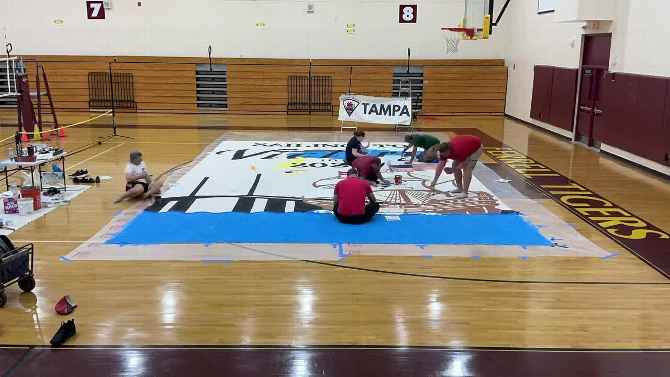
Tracing commenced that Friday with around five individuals present. The muslin was affixed to the gym wall with gaffer tape, and the design was uploaded from Hartzell’s laptop to a projector for tracing. The image was traced in 10-foot sections. “We measure 10 feet, then fold and mark each side to maintain alignment before moving the design,” Hartzell explains. The recording took about four hours.
The tifo was relocated onto a plastic tarp and taped down for stability during painting. Around this time, Hartzell noticed a scaling issue. “We projected the design starting at the top but realized it was slightly off,” he recounts. “We needed to ensure enough ocean space was depicted, so we added an extra five feet.” After adjustments, the tifo measured 20 by 35 feet.
A painting party unfolded over the subsequent two days, with more than a dozen supporters from the American Outlaws-St. Petersburg, Ralph’s Mob, Skyway Casuals, and Heatwave, the Tampa Bay Sun FC supporters, joining forces. The atmosphere was community-oriented, with pizza and lively conversations making for a memorable experience. “It became a family-friendly project,” Hartzell added. Several painters maneuvered around each other in a playful, collaborative environment, transforming painting into an enjoyable, almost game-like experience. In total, the painting took over 20 hours from Saturday through Sunday. “It was incredible,” Ruiz reflected.
After the paint dried overnight, Turner enlisted some of his students to assist Hartzell with folding the tifo. “Would anyone like to help with a large soccer banner?” he recalled asking. The tifo was then taken to Hartzell’s home for final touches, completing it eight days before the match against Uruguay. Ruiz picked it up shortly after. “It’s like sending your child off on the first day of school,” Hartzell humorously noted. “You worry and check in, ‘Is it okay? Is everything dry?’ and everyone reassures you.”
Tifo Community Dynamics
THE INDEPENDENT SUPPORTERS COUNCIL (ISC), a coalition of soccer supporters’ groups, has awarded the Tifo of the Year since 2016, celebrating the best tifo in North America each season. Founded in 2009, the ISC includes over 140 member organizations across the United States and Canada. Throughout 11 years, seven groups have earned this award, with several being repeat honorees chosen by vote at the ISC annual conference each January.
“It’s certainly a point of pride and recognition for groups,” Bailee Brown, ISC North America President, stated via email. “However, most groups celebrate and immediately focus on the upcoming season.”
Cloud 9 has won the award twice, including in 2019 for its “Don’t Give Up The Fight” tifo. “It served dual purposes,” Muller explained. “The team hadn’t won any games that year, and it coincided with discussions about the poor conditions players faced. ‘Don’t Give Up The Fight’ emphasized perseverance both on and off the field, marking our first ISC award.”
The ISC advocates for supporters’ groups’ fair treatment and culture promotion. Since 2020, the organization has included tifo breakout sessions at annual conferences to foster collaboration, idea sharing, and inquiries. “When groups lack pulley systems, they share how they obtained them,” Brown elaborated. These sessions empower groups to replicate successful ideas in their contexts.
“I’ve attended a few sessions; folks share their methodologies,” Muller noted about these workshops. “Resources can differ significantly, so learning from diverse groups can inspire.”
“There’s a high demand for these sessions,” Brown confirmed, “and they’re typically led by members for members.”
The Grand Reveal
WITH 205 DAYS left until the World Cup, matchday was finally here. Ruiz gained early access to the stadium with fellow American Outlaws as they set up drums and banners in the USMNT supporters’ section. He transported the tifo in a large blue IKEA bag, passing through security with X-ray inspection. Thankfully, transport went smoothly, an experience not always guaranteed.
In 2024, the Cauldron showcased a massive 40-by-60-foot tifo at Arrowhead Stadium, supporting Sporting Kansas City. Weighing around 200 pounds, the experience taught Miles the importance of precise folding for effective transport. “It’s like folding a fitted sheet but on a massive scale,” he remarked.
Once the tifo cleared security, Ruiz laid it down in an empty row of section 148, poised for the perfect moment to lift it. American Outlaws’ member and game coordinator Philip Labas was charged with leading chants and timing the display. A large American flag would be raised first during the National Anthem, followed by the tifo once Labas issued the signal. After final logistics were confirmed, Ruiz departed for an American Outlaws tailgate nearby. Shortly after, the march to the stadium commenced, and everyone filed into the section. Hartzell arrived a little later and messaged family to keep an eye out for the tifo before kickoff. It was his first trip to Raymond James Stadium, and the excitement was palpable as word spread about the planned tifo unveiling.
“We informed those nearby,” Hartzell recounted. “The singing of the anthem began, followed by the lifting of the tifo post the flag’s descent.”
Ruiz shared his anxious thoughts leading up to the unveiling. “I was just hoping it wouldn’t rip and that it would hold,” he admitted. Previous malfunctions, like an Atlanta United tifo that didn’t fully rise in their home opener, lingered in his mind. “There’s always jitters,” Hartzell noted.
Just before kickoff, Hartzell made it back in time. As the massive American flag billowed during the National Anthem, the moment the call “Tifo Up! Tifo Up!” rang out from Labas.
The section erupted in synchronized shouts to alert those behind them of the tifo’s impending display. “An immense wave of emotion and pride swept over us,” Hartzell declared. The entire process took about fifteen seconds, with the display elevated for over a minute before being lowered. Soon after, the match commenced, leaving Hartzell overcome with emotion. “Tears filled my eyes even as I relive it now,” he expressed. “It was a privilege to play a significant role in the design and painting of this tifo.”
Unfortunately, during the broadcast, the optimal shot of the tifo was missed; the U.S. players clustered in the foreground as the tifo descended in the backdrop. “I wish we’d let it show for a bit longer,” Ruiz joked. The tifo remained displayed in an empty row for the duration of the game. Just 17 minutes into the match, Sebastian Berhalter scored, putting the USMNT ahead 1-0, followed by two goals from Alex Freeman in the 20th and 31st minutes. The match resulted in a resounding 5-1 victory, matching the USMNT’s record for the largest win against a South American team. “Afterward, I chatted with a Uruguayan family who acknowledged, ‘The team is still figuring things out,'” Ruiz shared. The win elevated the spirits, celebrating the beginning of their World Cup campaign.
The Afterlife of a Tifo
AFTER THE FINAL WHISTLE, Ruiz’s thoughts shifted to, “How do I store this?” The fate of a tifo can vary greatly. Some are discarded, while others are kept for future use. Bridgwater Kivi, an active member of The Forge for FC Cincinnati, references the “tifo burger,” a pile of folded tifos stored beneath the Bailey, their supporters’ section. “We often discuss if there is a better way to utilize them; we don’t want to dispose of them, yet the usage often remains a question.”
Miles confirmed the Cauldron recycles damaged tifos. “We keep ours through the season, with some older ones tucked away. There are varied creative ways to repurpose them; some teams partner with producers to convert them into tote bags.”
Hartzell proposed an alternative approach: implementing community displays. “Having an exhibit or showcasing a tifo at youth soccer tournaments in parks would help kids appreciate the art form,” he suggested.
Despite transport challenges, Ruiz carefully folded the tifo with his 14-year-old son’s assistance. Given limited storage at home in Tampa, the tifo now resides at his father’s home in Atlanta.
The Enduring Nature of Tifo Culture
FROM CREATION TO REUSE, tifos symbolize community and belonging. Kassing spent countless hours co-authoring his book on tifos. Ironically, amid his research, the tifo culture was interrupted by the COVID-19 pandemic. “Tifo displays ceased for about a year or 18 months,” he remembers. “It was an anomaly in my writing experience; typically, this aspect is continuous.” As the world evolved during the pandemic, tifo culture also adapted, eventually returning with renewed vigor.
“They’re making a comeback, and it’s more vibrant than before,” Kassing noted.