



-

Bill Connelly
Multiple Authors
HOUSTON — It’s remarkable how a 0-0 draw between teams ranked 59th and 64th in the FIFA world rankings can spark celebrations not just in NRG Stadium (and at a lively drum party in a nearby strip mall) but also across Massachusetts, Rotterdam, and a tiny island nation off West Africa’s coast.
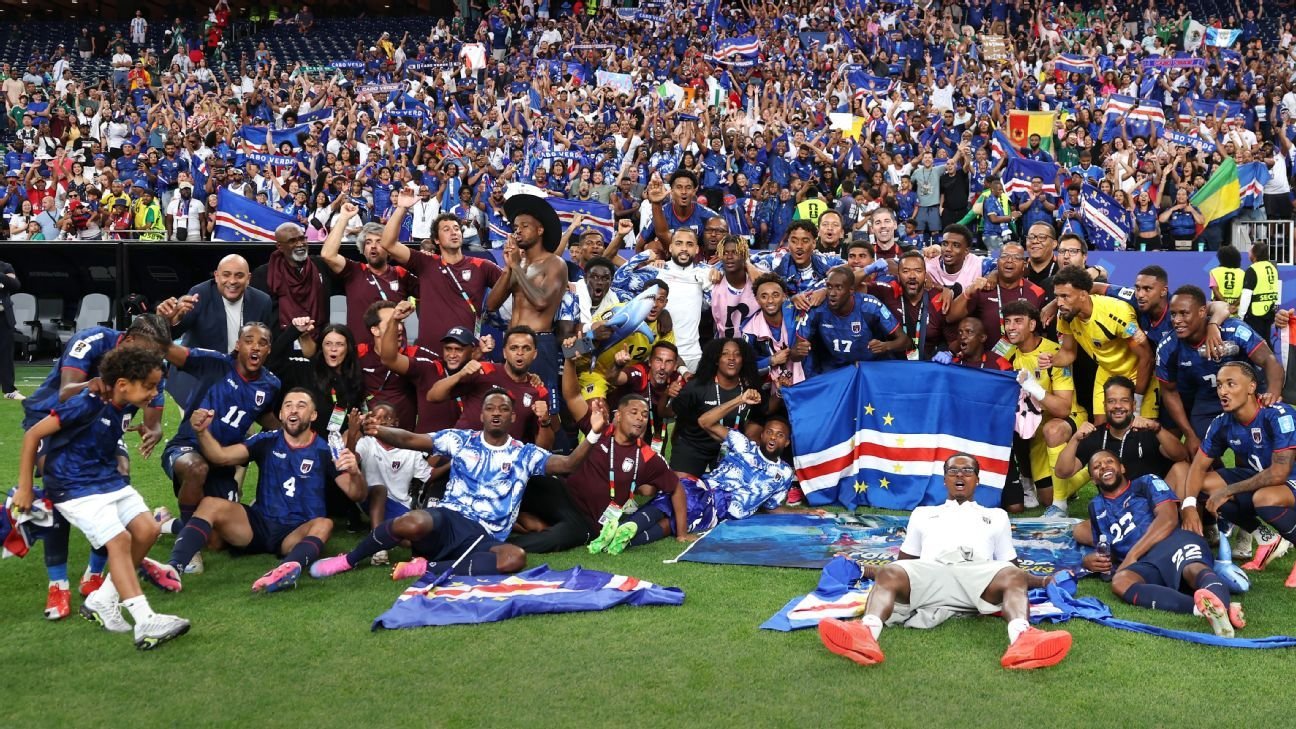
The reason for the jubilation? Cape Verde made history as the smallest nation ever to reach the knockout stages of the FIFA World Cup on Friday night. Their draw against Saudi Arabia secured them second spot in Group H, ahead of both Uruguay and Saudi Arabia. What began as a captivating tale with their earlier draw against Spain—which turned 40-year-old goalkeeper Vozinha into an overnight sensation—will now lead them into a knockout match against Lionel Messi and Argentina.
“I never imagined we’d be here,” Vozinha said after the match. “We know we have quality. Qualifying for the next round is hugely rewarding for us. Playing against Argentina and Messi is a dream for every player.”
After their match concluded, Cape Verde’s players gathered around a phone to check the result of Spain’s 1-0 victory over Uruguay. “I almost cried,” midfielder Deroy Duarte recounted. “It was incredibly emotional. We were all just waiting, hoping for a good result. It was a moment unlike any I’ve felt on the pitch, and I hope we can experience that feeling again in the next match.”
An unforgettable moment for Cape Verde and its fans 🇨🇻 pic.twitter.com/xsWixLJJUH
— FOX Sports (@FOXSports)
June 27, 2026
A True Underdog
With a population similar to Fresno, California (around 530,000), Cape Verde is a quintessential underdog. The players on their 26-man roster are spread across 26 different club teams in 14 countries. Seven of them play in Portugal, a link stemming from their colonial past until 1975, which is why the official language remains Portuguese.
Out of the 2,970 total minutes played by their squad in the World Cup, only 256 were logged by players affiliated with top 100 clubs worldwide (according to Opta): 166 by left back Sidny Cabral (Benfica) and 90 from winger Willy Semedo (Omonia Nicosia).
Vozinha is currently a free agent after his time in the Portuguese second division last season, while Duarte, named man of the match on Friday, plays for Ludogorets Razgrad in Bulgaria. Other pivotal players are based in the UAE (Diney from Al Bataeh), Ireland (Pico from Shamrock Rovers), Turkey (Ryan Mendes from Idgir), as well as the Netherlands (Jamiro Monteiro from PEC Zwolle) and Israel (Hélio Varela from Maccabi Tel Aviv).
Gaining independence from Portugal in 1975, Cape Verde joined FIFA in 1986. Over the last two decades, the quality of the national team has steadily improved, although some players were born abroad; there’s also a strong sense of pride in their diaspora.
“We love our country,” Vozinha stated passionately. “We are filled with spirit. We faced many struggles growing up. Our parents and grandparents sacrificed immensely for our education, teaching us to value our opportunities. I think we’ve demonstrated the resilience of the Cape Verdean spirit.”
Duarte affirmed, “While we have Cape Verdeans abroad, we are a small nation with a small population, yet we possess a big heart.”
The Blue Sharks advanced through three draws, each representing its own accomplishment. The draw against Spain tested their endurance—Spain took 27 shots, with Cape Verde blocking eight and Vozinha saving seven more. A post did its part to keep the scoreline intact when Ferran Torres‘ shot hit the woodwork before halftime, marking the only attempt by Spain with a significant expected goal value. Cape Verde exhibited remarkable defense without fouling, earning a historic result.
The 2-2 draw with Uruguay showcased their resilience as well. After taking an early lead, their spirits dipped following an equalizer by Maxi Araújo. A consequent goal just before intermission seemed to seal their fate, but they quickly regrouped. They scored again in the 61st minute with a goal from Helio Varela, and within that half, they took 10 shots (0.83 xG) while conceding just six (0.41). It appeared that Cape Verde was more likely to take home a win.
The pivotal 0-0 draw against Saudi Arabia tested their mental strength. When Spain scored against Uruguay late in the first half, consequently advancing Cape Verde to second place in Group H, the announcement made waves in the stadium. Almost immediately, Saudi Arabia began mounting serious threats, and had they scored, they would have seized second place. Yet Cape Verde withstood the pressure until halftime, delivering a solid performance in the second half and nearly scoring on several counterattacks. Despite Saudi Arabia’s late push led by Abdullah Al Hamddan in stoppage time, the score remained unchanged, allowing Cape Verde to progress.
“We didn’t come here merely to secure a draw,” Vozinha remarked afterward. “From the moment we re-entered the pitch for the second half, we aimed for victory. We were aware that Saudi Arabia also has considerable quality. We gave it our all to score, but it just didn’t happen.”
Nevertheless, they held their composure.

0:39
Cape Verde sends its fans into a frenzy as they secure a place in the World Cup knockout stage.
The Magic of an Expanded World Cup
While one could be skeptical about FIFA’s rationale for increasing the World Cup from 32 to 48 teams, given the financial motivations behind it, the trade-off with FIFA and the sport of soccer has always existed. It’s akin to a deal: FIFA can pursue its monetary ambitions while offering the game and its riches to more nations. As fans, we are treated to new stories and characters to enjoy. Ultimately, FIFA can’t undermine the essence of the game itself.
The World Cup’s expansion suits countries like Cape Verde, which have been on the brink of Africa’s soccer elite for some time. In previous qualifying campaigns, they finished second to Cameroon in 2010, to Tunisia in 2014, and to Nigeria in 2022.
They have also reached the quarterfinals of the African Cup of Nations three times in the last 13 years. African teams had five spots available for a 32-team World Cup, which nearly doubled to nine with the expansion. While Cape Verde’s stellar qualification campaign (23 points from 10 matches) might have secured them a spot even under the previous system, the expansion offers chances for teams like Cape Verde, Curaçao, and Jordan, leading to memorable moments that encourage aspiring players.
“What’s happened is immensely rewarding,” Vozinha emphasized. “We aim to create memories and serve as role models for future generations. Who knows? Moving forward, we could have Cape Verdean role models that children can aspire to be like, such as [defender] Stopira or [midfielder] Ryan Mendes. That’s incredibly fulfilling.”
While the stakes may seem lower for many group stage matches with more teams allowed, and only 32 of 48 teams advancing, the world is now familiar with Cape Verde. It recognizes Curaçao, for instance, celebrating even a scoreless draw against Ecuador; the delight was palpable. There’s also a newfound awareness of the Congo DR, broadening the narrative beyond conflict and disease. This tournament brings the world closer together, celebrating common dreams and aspirations, a testament to soccer’s unifying power, despite FIFA’s controversies.
“In our games against Uruguay and Spain, we received immense support from people from various nations,” Duarte shared. “This is what soccer brings: it unites us. Cape Verdeans welcome anyone and treat them like family. That spirit fills us with pride.”
The World Cup may be taken home by powerful nations, but the true essence of it is embodied by the smaller ones. While France, England, and Argentina remain favorites, the exuberance from Ecuador, Congo DR, and, notably, Cape Verde has marked this tournament. Their presence enriches the event profoundly. Cape Verde may soon face an uphill battle against Messi and Argentina, but in soccer, nothing is impossible.
“This is undoubtedly a remarkable moment,” Duarte added. “Yet, as we’ve seen, outcomes can be unpredictable. Our draws with Spain and Uruguay illustrate that. So, why not?”
“The joy I felt on the pitch is something I’ve never experienced before. I hope to feel it again while facing Argentina.”