



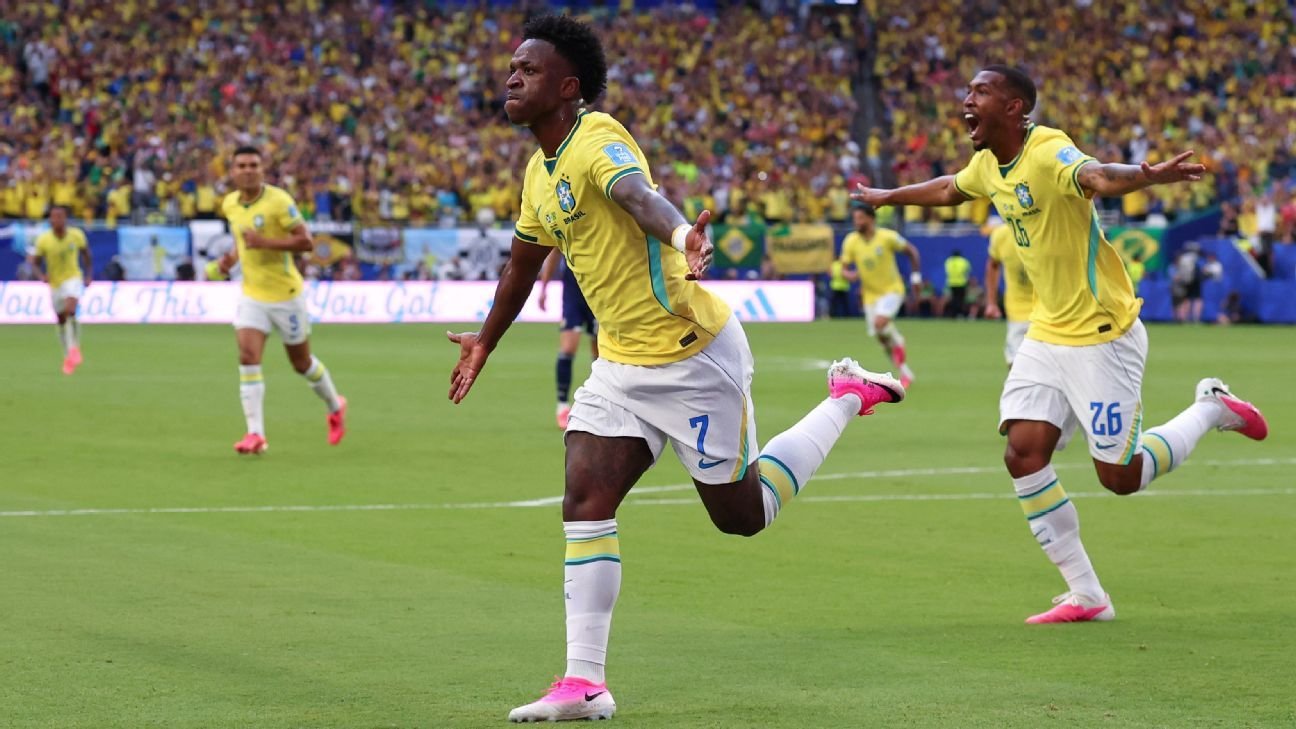
Following Brazil’s 3-0 victory over Scotland on Tuesday, manager Carlo Ancelotti appeared more optimistic than he has been throughout the World Cup.
“This is the goal,” he stated. “We are now playing as a cohesive unit.”
It wasn’t just the win that brought a sense of quiet satisfaction for Ancelotti; it was the noticeable progress. He felt that this performance not only marked Brazil’s best showing in the World Cup so far but could also be their standout match since he took charge in Rio de Janeiro over a year ago.
The key to this improvement lay in the team’s execution of the strategies Ancelotti has prioritized since his appointment.
One of the main principles he emphasized from the outset was avoiding a rigid team identity, which he believed could make players predictable. Instead, he aimed for a squad capable of adjusting their style of play based on the circumstances they faced.
This flexibility was evident in the match against Scotland. Although Brazil conceded slightly more possession to their opponents in the first half—intentional as Ancelotti sometimes prefers his team to sit back—the two first-half goals, and a third that was controversially disallowed, resulted from a well-orchestrated high press that forced Scotland into mistakes while they attempted to build from the back.
Brazil adeptly transitioned between aggressive pressing and defensive organization—an approach that had previously yielded success against Egypt in their final warm-up match. However, they struggled during their opener against Morocco, falling behind due to poor positioning in the face of a rapid counter-attack.
“I’m satisfied because the team has improved significantly,” Ancelotti remarked. “We now exhibit solidity, which is crucial in the knockout stages.”
This emphasis on balance was another cornerstone of Ancelotti’s vision from the beginning. Upon taking the job, he recognized the lack of equilibrium in the previous game, where Brazil suffered a disheartening 4-1 loss to Argentina. His conclusion? “No balance. Plenty of talent, but lacking balance.”
Ancelotti’s main task as Brazil’s coach has been to ensure the team achieves a balance that allows its talented players to shine. The specific challenge lies in integrating a roster that boasts remarkable wingers, particularly Vinícius Júnior.
The journey has not been entirely smooth. Ancelotti’s initial plan featured a front four, which proved challenging as it left only two midfielders—one being the 34-year-old Casemiro.
Indeed, during the first half of Brazil’s first warm-up match against Panama, the midfield duo of Bruno Guimarães and Casemiro struggled against a superior opposition, highlighting the need for a third midfielder.
However, Ancelotti had initially selected only five midfielders for his World Cup squad, which was insufficient for a tournament of this magnitude.
This issue was addressed after the match against Egypt when right-back Wesley was injured. He was replaced by newly-signed Manchester United midfielder Éderson.
Yet now, Ancelotti found himself without an attacking right back. Wesley had been intended to add width to that side of the pitch, forcing Ancelotti to adjust his tactics to uphold his original strategy.
Traditionally, he prefers a 4-4-2 formation (“It reflects the shape of the pitch,” he stated). The wide players are expected to track back diligently.
However, Vinícius Júnior, being a wide player, is not expected to defend extensively; it would be counterproductive. Brazil needs him positioned near the opponent’s goal.
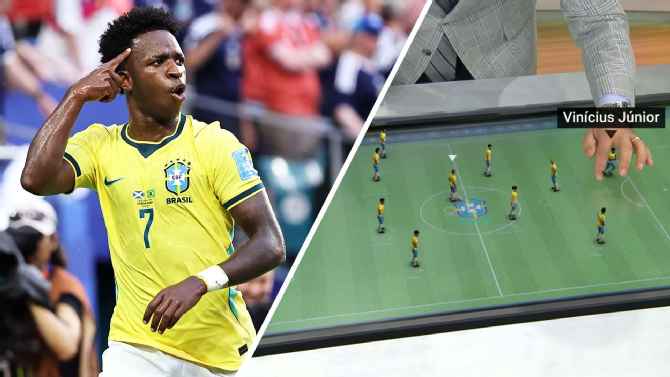
2:33
Why Vinícius Jr. needs to play centrally for Brazil
So, how does Ancelotti resolve this conundrum? By incorporating another forward who is willing to track back to cover the left flank. This player was to be Matheus Cunha, making his exclusion from the starting eleven against Morocco quite puzzling—and ultimately a mistake.
His place was taken by Igor Thiago, a player who primarily operates within the penalty area, leaving insufficient coverage behind Vinícius. This vulnerability allowed Achraf Hakimi, Morocco’s dynamic right-back, to exploit the gap, contributing significantly to Brazil’s struggles in the first half. Brazil performed better after Cunha joined the match, effectively sealing off the wide areas.
Following Raphinha’s injury, Cunha’s role has adapted. Now Lucas Paquetá, as the third midfielder, bears greater responsibility for defending the left flank. Cunha has shifted into a more central role, taking Raphinha’s place alongside Vinícius in the 4-4-2 structure, while demonstrating greater versatility.
Cunha can play as a traditional No. 9 but can also drop deeper, functioning like a No. 10 to help maintain the midfield block while remaining available for attacks through the central zones. He also has the ability to interchange positions with the left-footed right winger Rayan, who has recently been integrated into the squad post-Raphinha’s injury.
At times, Rayan has partnered with Vinícius, such as during the opening goal against Scotland, with Cunha responsible for monitoring the space on the right.
The team is finally beginning to gel just in time, as Ancelotti has always perceived the group stage as a prelude. His objective was to use these matches to establish a cohesive unit for more significant challenges ahead.
To date, aside from his backup goalkeepers and a couple of reserve defenders, most of his squad members have participated, and he appears to have clarity on his most effective lineup. He is positioned where he wanted to be. But will that be sufficient?
Brazil managed to find their rhythm in a forgiving group, but the stakes are now much higher, and the challenges tougher. Ancelotti is mindful not to underestimate Japan, their next opponent in the round of 32 on Monday. Back in October, Brazil suffered a 3-2 defeat at the hands of this challenging side.
Despite a two-goal lead and appearing in control, Brazil—aided by a makeshift defense—collapsed in the second half due to one of Japan’s extraordinary 20-minute spurts.
Ancelotti will need to be prepared for Japan’s ability to shift tactics rapidly and their precision in ball movement, which could pose a significant challenge for a Brazilian side that at times appears sluggish in midfield.
Brazil is favored to win, yet there are growing concerns among fans back home regarding Japan’s capabilities—perhaps for the very first time.
As for Ancelotti, he exudes confidence, focused on his strategic game plan and convinced that everything is proceeding as it should.