



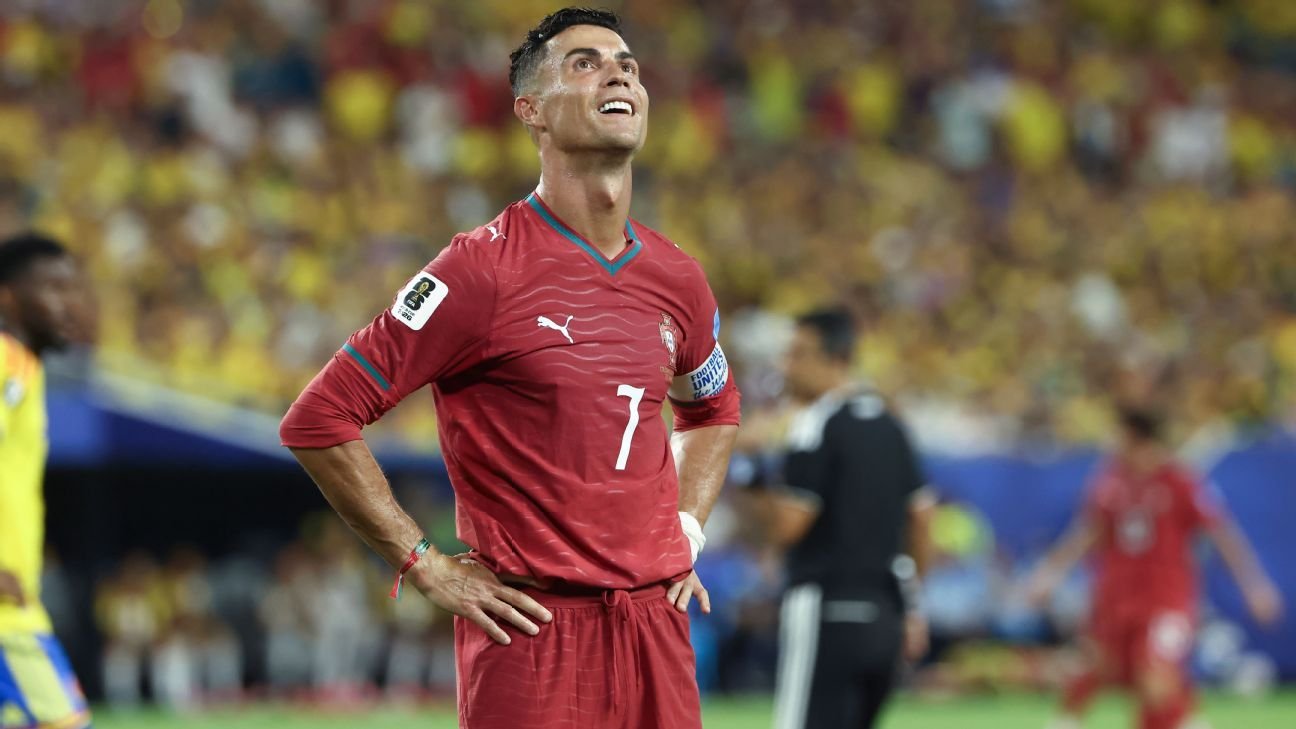
MIAMI GARDENS, Fla. — Cristiano Ronaldo struggled to move quickly during Portugal’s 0-0 draw with Colombia on Saturday. The grueling heat and high humidity of Florida, with a “feels like” temperature reaching 106 degrees Fahrenheit, certainly contributed to his sluggishness, raising the question of why a 41-year-old still playing at a World Cup was left on the field when the referee called for five minutes of stoppage time after an exhausting Group K match.
It seems that the Portugal captain is viewed as irreplaceable, even when substituting him might be more beneficial for both him and the team.
In the punishing conditions of Miami’s final half hour, Ronaldo was virtually inactive and should have been taken off. His performance, marked by an expected goals (xG) of 0.17 and expected assists (xA) of 0.03, highlighted his ineffectiveness.
Roberto Martínez’s squad now looks ahead to their round of 32 matchup against Croatia in Toronto on Thursday, with Ronaldo having played every minute of their 270 group stage minutes. Including stoppage time, he has likely logged around 300 minutes in the World Cup so far.
While it’s clear that Ronaldo is impressively fit for a player in his 40s—an embodiment of dedication and professionalism—his age means that no amount of ice baths or specialized diets can counteract the effects of aging. Managing his minutes is essential.
However, Martínez seems unable or unwilling to rest his star player, ultimately leading to a situation where neither the player nor the team benefits. Martínez maintains that Ronaldo can perform regardless of his playing time.
“Cristiano is always in the right place at the right time. He is mentally and physically disciplined and strong,” Martínez stated.
“It’s not a concern for Cristiano to play 90 minutes, but you never know how it will affect the next game. We’ve utilized 21 outfield players, so we’re sharing the minutes,” he added.
Ronaldo, who netted twice in Portugal’s 5-0 victory over Uzbekistan on Tuesday, showed promise in the first half against Colombia, defending his selection. In contrast, 25-year-old Gonçalo Ramos, a player for back-to-back UEFA Champions League winners Paris Saint-Germain, sat on the bench while Ronaldo moved slowly around the field like an exhausted marathon runner in the second half.
Top players are recognizing the importance of managing their minutes in this World Cup. For instance, Erling Haaland did not play in Norway‘s 4-1 loss to France on Friday after coach Ståle Solbakken expressed concern about fatigue before their round of 32 match against Ivory Coast on Tuesday.
Even Lionel Messi was rested by Argentina coach Lionel Scaloni, who confirmed that the 39-year-old would not start against Jordan on Saturday.
Both Haaland and Messi are opting to preserve their energy to ensure longevity in the tournament, a wise choice made by their coaches. Yet, Ronaldo persists in staying on the pitch, which could lead to negative consequences for both him and Portugal, especially against Croatia.
“We don’t compare ourselves to players from other teams,” Martínez said in response to questions about resting Ronaldo like Haaland or Messi. “That would be immature.”
The ongoing debate regarding Ronaldo’s significance to this Portugal team has led Martínez to repeatedly assert that the Al Nassr player is an elite goal scorer deserving of playing time.
While many may disagree with Martínez’s stance, as the coach, he is responsible for these decisions. However, it is entirely valid to question why Ronaldo’s playing time is not being managed better to ensure he can perform optimally when Portugal truly needs him.
Even Kylian Mbappé and Ousmane Dembélé, the superstars of France, have logged fewer minutes than Ronaldo in this World Cup. In contrast, Harry Kane, the captain of England who values every minute on the field for scoring opportunities, was substituted with just six minutes remaining in Saturday’s 2-0 victory over Panama.
Yet Ronaldo continues to play on. At this rate, it seems conceivable he could be leading the line for Portugal at 45 years old in the 2030 World Cup across Spain, Portugal, and Morocco.
Though it may seem absurd, the idea of a 41-year-old playing every minute of the group stage becomes less far-fetched, especially after securing qualification a game early.
If Martínez had replaced Ronaldo with a quicker, more agile forward like Ramos, Portugal might have secured the victory necessary to finish first in their group, thus easing their path to the quarterfinals.
Ultimately, Martínez opted not to substitute, Ronaldo remained in the game, and Portugal ended up in second place.
If they defeat Croatia, a likely matchup awaits against Spain in the round of 16, where a sluggish Ronaldo may struggle against the European champions.