



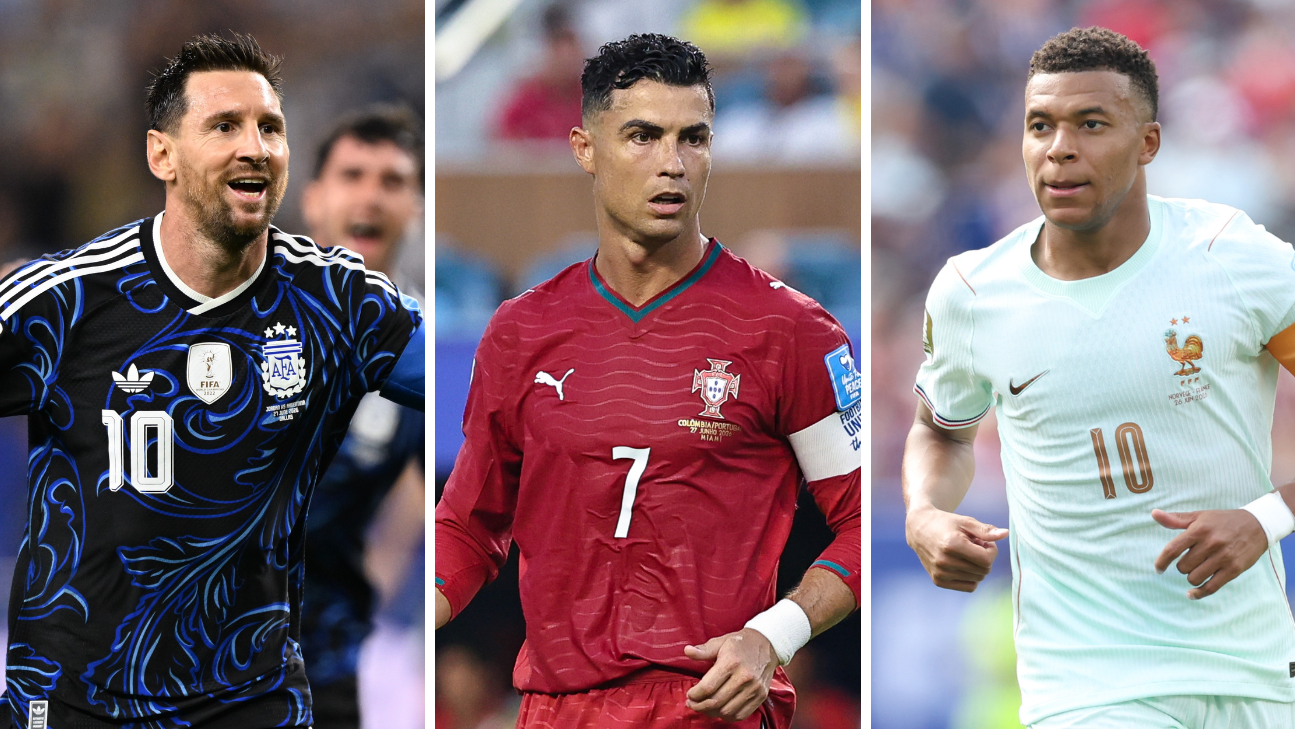
At the 2026 FIFA Men’s World Cup, major stars are shining brightly, showcasing their A-list talents on the global stage.
Take a look at the Golden Boot leaderboard: Lionel Messi currently leads with six goals from three matches. Following closely are Kylian Mbappé, Ousmane Dembélé, Erling Haaland, and Vinícius Júnior, all netting four goals each. Not to be outdone, England’s captain Harry Kane remains in contention with three goals in as many games, while even Cristiano Ronaldo, at 41, has added two goals for Portugal in the group stage.
Teams such as Argentina, Norway, England, Brazil, and Portugal heavily rely on their top forwards. While Dembélé showcased his abilities with a hat trick against Norway, Mbappé continues to be the clear standout for France.
But which team is truly dependent on its star player? ESPN has crunched the numbers since the 2022 World Cup to analyze which nation struggles the most without its main striker.
All statistics provided by ESPN Global Sports Research
– Full World Cup match schedule: Fixtures, Results, Features
– World Cup Power Rankings: Who holds the No. 1 spot after group stage?
– O’Hanlon: Ratings for each eliminated team
LIONEL MESSI (Argentina)
– Goals: 25
– Assists: 9
– Appearances/Starts: 30/24
– Goal Contribution Percentage: 27% (excluding own goals)
Argentina is often seen as a team that relies heavily on Messi, who has netted six of their eight goals in this World Cup. He has also set a record by scoring in seven consecutive World Cup matches dating back to the last tournament. In 2022, Argentina triumphed in the World Cup, marking their first victory since 1986, largely thanks to Messi’s pivotal role. However, despite Messi’s current brilliance, Argentina’s win rate remains unchanged whether he plays or not, standing at 83%.
Since the last World Cup, Argentina has maintained an 83% win rate with and without Messi. They score significantly more goals when he is on the pitch (58) compared to when he is absent (35). Messi’s contributions amount to 25 goals and 9 assists across 30 appearances since 2022, representing 27% of Argentina’s goals. Yet, they are still a competitive side even in his absence.
CRISTIANO RONALDO (Portugal)
– Goals: 27
– Assists: 4
– Appearances/Starts: 35/34
– Goal Contribution Percentage: 25% (excluding own goals)
Though there is an impression that Portugal’s success hinges entirely on Cristiano Ronaldo, the statistics paint a different picture. Since 2022, Portugal’s win percentage with Ronaldo is 67%, slightly higher than the 63% when he’s off the pitch. Notably, even as Ronaldo’s abilities wane, Portugal performs better statistically with him in the lineup, scoring more goals (68 against 40) and creating more chances (381 to 185). Nevertheless, 75% of the time, goals have been netted by players other than Ronaldo.
HARRY KANE (England)
– Goals: 29
– Assists: 2
– Appearances/Starts: 37/34
– Goal Contribution Percentage: 32% (excluding own goals)
As the captain of England, Kane is their all-time leading goal scorer with 82 goals in 117 matches, making him a pivotal figure for the team. Statistics show that England’s win rate without him drops to 29%, while their success rate soars to 76% when he’s present. Their goal tally significantly favors him as they scored 73 goals since 2022 compared to just 19 without him, creating 351 chances alongside his presence versus merely 168 when absent. His contributions make up a staggering 32% of England’s total goals since 2022.
KYLIAN MBAPPÉ (France)
– Goals: 24
– Assists: 17
– Appearances/Starts: 35/31
– Goal Contribution Percentage: 24% (excluding own goals)
France’s status as favorites for the World Cup can be attributed greatly to their attacking lineup. Among the collection of talents, Mbappé stands out as the superstar. His absence significantly impacts the team’s performance, with a win rate of just 50%, increasing to 71% with him on the field. Furthermore, they score at a rate exceeding 3-to-1 when he plays, producing 472 chances compared to 154 without him. Though he accounts for 24% of France’s goals since 2022, the team has shown they can score even without him, thanks to coach Didier Deschamps’ utilization of his support players.
VINÍCIUS JÚNIOR (Brazil)
– Goals: 11
– Assists: 7
– Appearances/Starts: 32/31
– Goal Contribution Percentage: 15% (excluding own goals)
Vinícius Júnior, a standout for Brazil and a key player for Real Madrid, has not yet matched the goal-scoring prowess of his counterparts, having netted 13 times in 52 appearances for his country. Surprisingly, Brazil’s performance doesn’t dip dramatically in his absence; they win 63% of their matches without him compared to 44% when he plays. Still, they perform better in terms of goals scored (48 vs. 25) and chances created (269 vs. 120) when he’s involved, indicating the potential for him to elevate his goal-scoring record.
LAMINE YAMAL (Spain)
– Goals: 7
– Assists: 11
– Appearances/Starts: 28/23
– Goal Contribution Percentage: 6% (excluding own goals)
Lamine Yamal, an 18-year-old sensation at Barcelona, has already made his mark in international tournaments like Euro 2024. With a goal every four games since his debut in August 2023, Spain doesn’t depend heavily on a single goal scorer. Although Yamal adds depth to the attacking options, the team wins more (75%) when he’s not on the pitch than when he is (71%). They marginally score more goals with him (59 vs. 54), but creative chances increase without him.
ERLING HAALAND (Norway)
– Goals: 38
– Assists: 4
– Appearances/Starts: 29/28
– Goal Contribution Percentage: 40% (excluding own goals)
For Norway, the importance of Erling Haaland is undeniable. His absence can be quite telling, as shown in their recent loss to France. The statistics reveal a clear disparity: Norway has won 69% of their matches with him on the pitch, yet only 25% without him. Haaland has netted 38 goals and added four assists in this time, contributing a hefty 40% of Norway’s total goals since 2022. If Haaland remains fit, Norway stands a chance at going deep in the tournament; without him, their prospects dim considerably.