



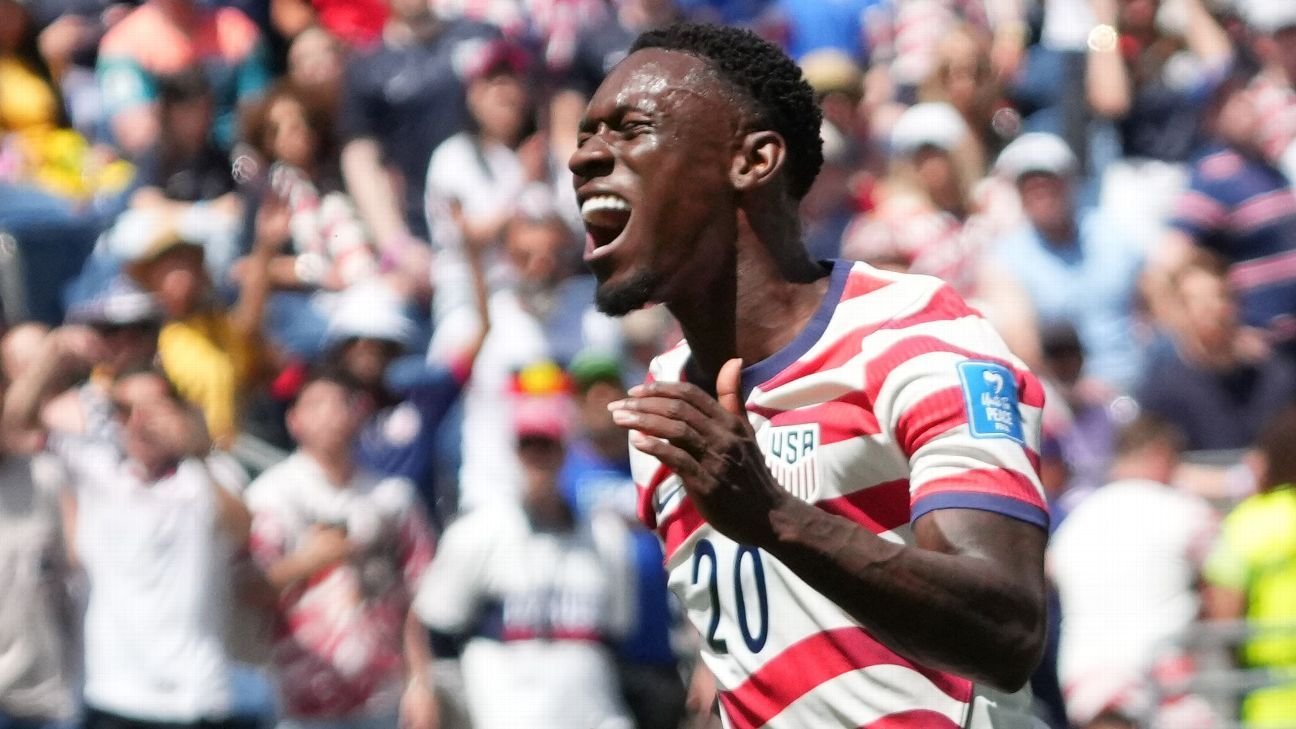
On Sunday, FIFA announced the suspension of the red card issued to U.S. striker Folarin Balogun during the match against Bosnia-Herzegovina in the round of 32. This decision allows him to be eligible for the upcoming round of 16 match against Belgium at the World Cup.
FIFA’s official statement explained: “Following Article 27 of the FIFA Disciplinary Code, the mandatory match suspension for U.S. player Folarin Balogun will be suspended for a probationary period of one year.”
ABC News confirmed that the White House reached out to FIFA following the U.S. victory over Bosnia-Herzegovina last week, urging FIFA President Gianni Infantino to reconsider Balogun’s red card.
President Donald Trump expressed his support for the reversal, stating on his social media platform, “Thank you to FIFA for doing what was right and reversing a great injustice!”
The U.S. team is set to compete against Belgium on Monday at 8 PM ET in Seattle, aiming for their first World Cup quarterfinal appearance since 2002. Historically, they faced challenges advancing past the round of 16 in previous tournaments, having lost to Ghana in 2010, Belgium in 2014, and the Netherlands in 2022. They also did not progress from the group stage in 2006 and failed to qualify for the 2018 tournament.
U.S. Soccer released a statement saying, “We accept the decision by the Disciplinary Committee and are pleased that Folarin Balogun is eligible to play tomorrow.” They further emphasized their focus on the upcoming match against Belgium and the support of their fans.
Typically, a red card results in an automatic one-game suspension, but news of Balogun’s reinstatement reached the players during a bus ride to training shortly after the announcement. Social media posts sparked initial confusion among the team members.
Defender Chris Richards shared, “Initially, many of us thought it was AI-generated. We were uncertain about its authenticity.”
Belgium’s football federation expressed shock at the decision and stated it is “examining all possible options.” In their official statement, they noted their astonishment at FIFA’s ruling, particularly emphasizing the contradiction it poses against established FIFA Disciplinary Code provisions.
U.S. coach Mauricio Pochettino addressed the situation, clarifying that he had not been involved in the lobbying efforts as he remained concentrated on preparing the team for the Belgium match.
Pochettino stated, “The process was normal, and of course, the federation was working diligently. J.T. Batson and the entire federation were advocating for our situation.” He also expressed his disapproval of political intervention concerning FIFA’s decisions.
“We cannot mix politics with this. The red card decision rests solely with FIFA, based on prior evidence,” Pochettino remarked. “It’s a good outcome for football when unfair situations can be reviewed and amended.”
Balogun had scored the opening goal for the U.S. in their 2-0 win against Bosnia-Herzegovina, but was sent off in the 64th minute for a challenge on defender Tarik Muharemovic. Balogun previously voiced his feelings of injustice regarding the red card, noting the unavoidable nature of the competitive situation that led to it.
U.S. Soccer did not make Balogun available for comments on Sunday, but the striker shared a photo on social media depicting himself with U.S. fans, accompanied by Michael Jackson’s song “Bad.”
FIFA’s ruling hinged on Article 27 of their disciplinary framework, which permits the suspension of disciplinary measures, resulting in a probationary period for Balogun.
This decision echoes past instances where FIFA deferred suspensions for other players due to significant circumstances, including deferring sanctions for Cristiano Ronaldo and Nicolás Otamendi for World Cup qualifiers.
Earlier cases of political pressure influencing FIFA decisions include the 1962 semifinal ejection of Brazil’s Garrincha, who was later allowed to compete in the final against Chile.
Additional information was obtained from the Associated Press, with contributions from ESPN writer Jeff Carlisle.