



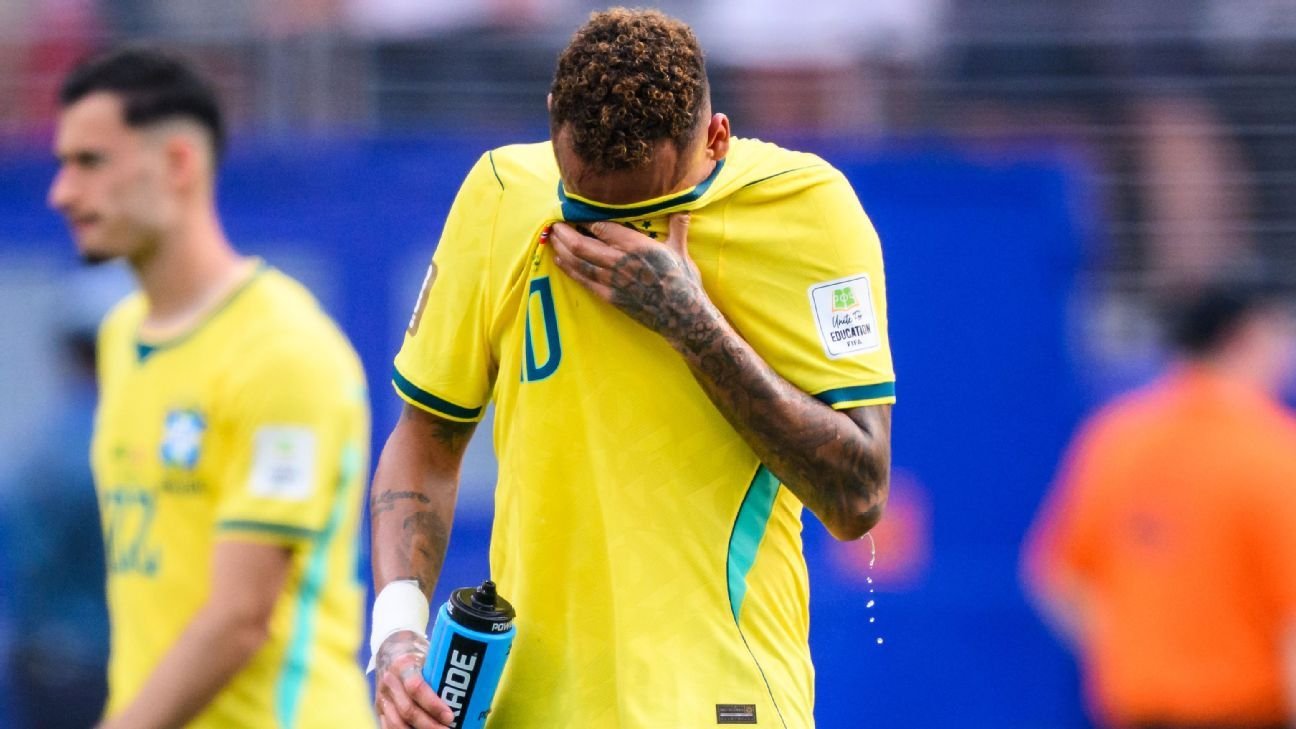
EAST RUTHERFORD, New Jersey — After a 28-year wait for their first World Cup triumph, Brazil now faces another lengthy wait following their elimination from the tournament due to a 2-1 defeat against Norway. This loss symbolizes a continuation of their dry spell, potentially extending another 28 years before they can hope to lift the trophy once more.
This setback is a significant psychological blow for the five-time champions, who have long been seen as the benchmark in international football. They are not alone in this struggle; fellow past champions are also experiencing difficulties. Four-time winners Germany exited early in the round of 32, while Italy, equally with four World Cups, failed to qualify entirely.
Brazil has struggled against European teams since their victory in the 2002 final, with their most notable knockout win being against Colombia at home in 2014.
This is why they turned to experienced foreign coach Carlo Ancelotti, known for his exceptional record in high-stakes knockout competitions with Real Madrid and AC Milan. His composed demeanor and extensive experience are well-established. To further demonstrate their trust, the Brazilian Football Federation awarded him a new four-year contract, extending his tenure through 2030, after less than a year in charge.
Immediately following the match on Sunday, Ancelotti emphasized his commitment to the Seleção, stating, “Today we have to deal with the disappointment, and starting tomorrow, we can think about what the future might hold for this national team. We’re at the beginning of a cycle, not the end.” However, the pressing question remains whether Brazil will maintain that faith in him, especially after a game where they held only 36% of possession against Norway, a team not traditionally associated with dominant possession play.
Additionally, the expected goals stat, showing Brazil at 2.61 to 1.05, is skewed due to penalties—one missed by Bruno Guimarães and another scored by Neymar in the dying moments. Though Brazil created promising chances—such as Endrick‘s one-on-one opportunity—and Norway’s keeper Ørjan Nyland made several impressive saves, it’s undeniable that each match represents a nation’s legacy.
Seeing Brazil struggle with possession was indeed shocking.
Ancelotti attributed this to Norway’s effective ball management, explaining that he preferred not to press aggressively due to the threat of their star striker, Erling Haaland, countering on the break. While this may be a justifiable strategy for smaller nations, it seems inadequate for a Brazil side.
Brazil’s prestigious history demands a higher standard; it feels incongruous for them to express concern over their opponents. Sure, worrying about Haaland when you have Gabriel and Marquinhos at the back is one thing, but how should Norway feel when forced to counter against a star like Vinícius Júnior with defenders like Kristoffer Ajer and Torbjørn Heggem?
Furthermore, Ancelotti’s strategy did not transform Brazil into a rigorous defensive side. Haaland capitalized on defensive lapses—his first goal came after he was allowed to slip past Gabriel unnoticed, and his second found him with ample space to score without opposition. Such scenarios are unacceptable for a Brazilian defense.
After the match, Ancelotti refrained from criticizing his players, nor did he take the blame for altering the formation, suggesting the introduction of midfielder Éderson in a 4-3-3 could have improved their midfield’s performance. His substitutions, particularly involving Neymar and Endrick, appeared more sentimental than strategic.
In the following days, it will be interesting to see how Brazilian fans and critics respond to his decisions.
Instead of dwelling on the game’s shortcomings, Ancelotti highlighted the valuable lessons learned, expressing pride in his players and optimism regarding the youthful talent emerging alongside the veterans.
Such qualities are why he is considered the ultimate “players’ coach.”
2:03
Burley: Ancelotti will get ‘hammered’ by Brazil fans
However, a harsh truth remains: despite the “what ifs” surrounding Nyland’s incredible saves or Haaland’s precise finishing, Brazil’s overall performance was lacking. For too long, they embodied talent and depth fueled by their football-loving population of 213 million, but that seems to no longer be the case.
Injuries highlight vulnerabilities; losing Wesley meant relying on a soon-to-be 35-year-old Danilo at right back. Losing Raphinha resulted in a 19-year-old Rayan stepping up, while Lucas Paquetá’s absence required a full restructuring that included integrating Gabriel Martinelli into the starting lineup. Ancelotti’s initial substitutions included a teenager (Endrick), who has netted just six league goals in two seasons, and a 34-year-old Neymar suffering from frequent injuries and having played just 27 games since February 2023.
The talent gap that once existed between Brazil and other nations seems to have diminished. Norway, returning to the World Cup after a long absence since 1998, sees eight of its players competing in the Champions League over the past season—one more than Brazil.
While Ancelotti is optimistic about the future, it’s clear that Brazil is now navigating a more competitive landscape, and their wait for a sixth World Cup title is set to continue.