



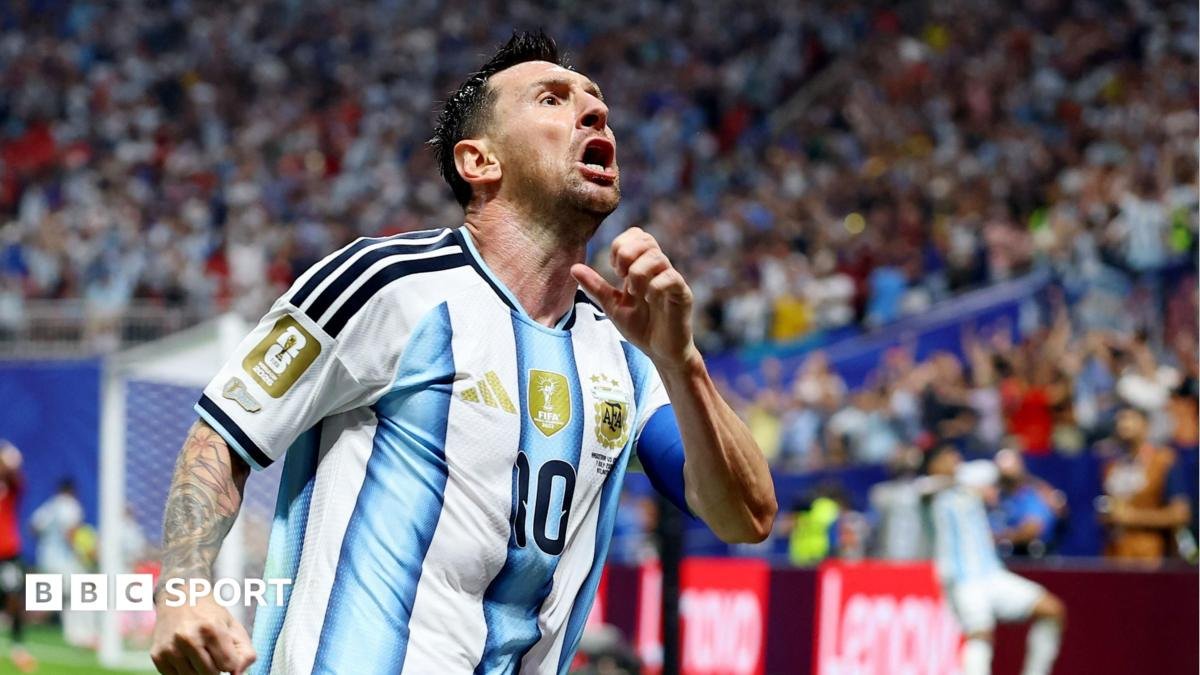
Had Argentina fallen here, it might have been Messi’s World Cup farewell.
He would be 43 by the next tournament—the oldest outfield player ever to feature—though the chance to play matches on home soil might still have enticed him.
Instead, he can now look ahead to a quarter-final against Switzerland or Colombia.
Former England goalkeeper Paul Robinson, covering the match in Atlanta for BBC Radio 5 Live, described the turnaround as remarkable: at one point Argentina looked out.
Egypt were incensed by several officiating calls—one saw a second goal chalked off for a foul committed near their own touchline—before momentum swung.
Then Messi took charge, supplying a brilliant assist, finishing clinically himself, and benefiting from substitutions that changed the game for Argentina.
Argentina’s revival—far from a one-man show—also altered England’s perspective; while Egypt led, there was a sense it might be a rare opening to reach a first men’s World Cup final since 1966.
England’s potential route had appeared to be Norway in the quarter-finals, then Egypt, Switzerland or Colombia in the semis if they advanced.
Now, Messi and Argentina could still stand in the way—provided England first negotiate a dangerous Norway.
Even late in his career, Messi’s presence looms over every opponent, as Egypt learned.
He is the first player to score in six straight World Cup knockout matches and already has eight goals at this tournament—the best tally through five games since West Germany’s Gerd Müller hit 10 in 1970.
Across his past nine World Cup appearances, he has contributed to 16 goals (13 scored, three assisted).
England’s concern is that he looks capable of adding more—and very much in the mood to do it.