



-

Ed Dove
Multiple Authors
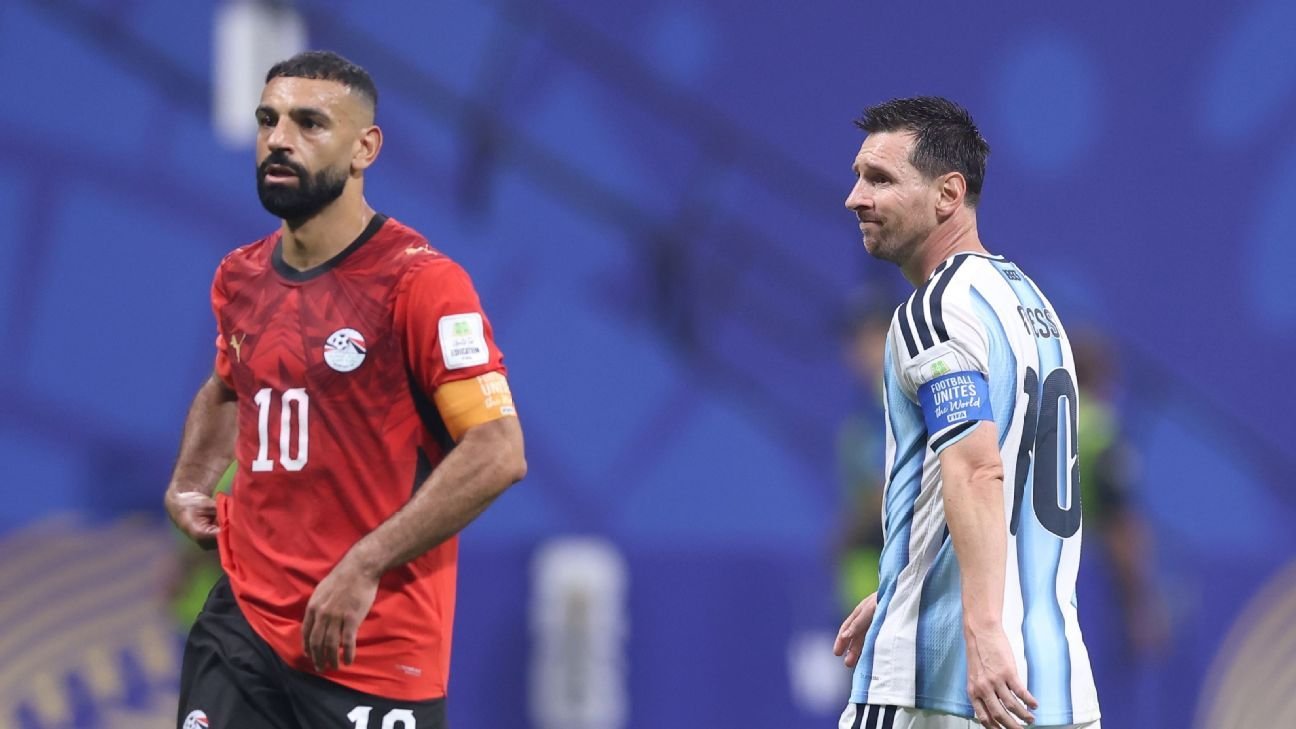
With just eleven minutes remaining and trailing 2-0 to Egypt, Argentina began to grapple with the haunting prospect of witnessing Lionel Messi’s remarkable World Cup journey drawing to an end.
However, the 39-year-old superstar proved once again that it’s premature to count him out.
For Mohamed Salah, the Tuesday match became another chapter of disappointment in a career filled with impressive performances yet devoid of a crowning international achievement.
It was a poignant irony that Salah’s potential last chance for a defining World Cup victory came against the player whose title he once bore.
As a teenager rising through the ranks at El Mokawloon in Cairo, Salah was often dubbed the “Egyptian Messi”—a flattering description for any agile, left-footed attacker gifted with speed and an eye for goal.
Countries yearned for their own version of Lionel Messi.
Two decades later, what stands out in Salah’s journey is not his resemblance to Messi, but rather how he has carved a unique path free from the shadow of that comparison.
The Round of 16 encounter between Egypt and Argentina underscored this reality—a battle between two superstars whose international careers have unfolded in drastically different ways.
Messi exited the tournament still in pursuit of greatness, while Salah left it with his standing solidified, even as a truly defining international moment eluded him once more.
During Messi’s prime, a myriad of “next Messis” surfaced; it felt ubiquitous during that era.
Japan had Ryo Miyaichi, Scotland had Ryan Gauld, Germany showcased Marko Marin, Israel had Gai Assulin, Mexico had Giovani dos Santos, South Korea had Lee Seung-woo, Algeria produced Yassine Benzia, Croatia had Alen Halilovic, Spain had Bojan Krkic, among others.
Nearly all of them fell short in fulfilling expectations, some spectacularly so.
Others failed to recover from the burden of the comparison.
In contrast, Salah has come closer than most to matching Messi’s influence, despite a markedly different ascent to the pinnacle of football.
Messi joined Barcelona as a young prodigy, clinching every significant title as part of one of the greatest club teams alongside Xavi, Iniesta, and Busquets, while enjoying nearly two decades within an ecosystem tailored to showcase his talents.
Salah’s journey took him from Egypt to Basel, then to Chelsea, where he faced a stagnation—a false start that required him to backtrack through Fiorentina and Roma before exploding onto the world stage at Liverpool.
Despite their similar ages, Messi had already amassed five Ballon d’Ors, eight league titles, and four Champions League trophies by the time Salah achieved his breakthrough season at Anfield in 2017-18.
Unlike Messi, Salah is not often celebrated as football’s artistic maestro. Rather, despite his immense skill, he is frequently viewed as akin to Cristiano Ronaldo, known for relentless self-improvement and professionalism—guarding his physicality, maintaining peak condition, and maximizing his talent.
In their prime, both were lethal left-footers, charging down the right flanks and cutting in to unleash their power. However, age has transformed their styles.
As demonstrated in Atlanta, Messi has evolved into football’s chief orchestrator, combining extraordinary dribbling with unmatched match control through strategic passing and vision.
On Tuesday, when Argentina appeared on the verge of defeat, Messi’s influence intensified, first delivering an assist to Cristian Romero for a late header, followed by a powerful equalizer just minutes after.
Salah, while not possessing Messi’s passing range or playmaking instinct, thrived as one of the most impactful attacking players during transitions—direct, explosive, and highly efficient.
As his speed has waned over the past 18 months, he has adapted into a player who sparkles in isolated moments rather than throughout games.
This was enough to clinch victories against Belgium and New Zealand. However, against Argentina, even a tireless effort could not conjure a late penalty as Egyptian hopes were dashed before Messi and company secured a winner.
0:45
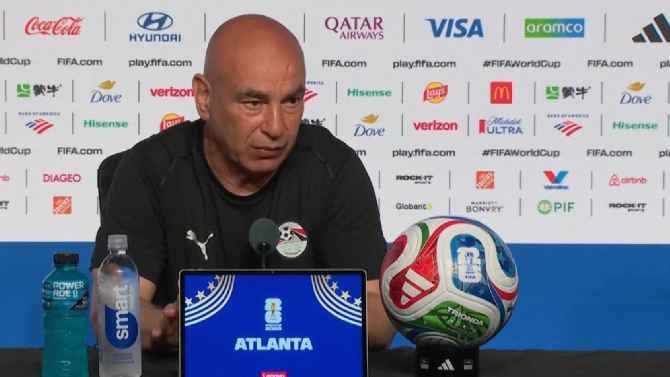
Egypt coach Hassan brands Argentina’s win ‘entirely undeserved’
At the club level, both players have enjoyed stellar careers, yet international football has maintained a divide between them.
Messi faced years of scrutiny with the national team before scripting an incredible redemption arc between 2021 and 2022. Again in the USA, he has turned the tide to keep La Albiceleste in contention for the title.
Once again, as the stakes heightened, he delivered, proving that international football remains firmly within his grasp.
Salah’s international narrative, however, continues to be one of frustration, despite his contributions to Egypt. He played an instrumental role in qualifying for the 2018 World Cup, only to see injury rob him of a significant impact in Russia, and he has suffered losses in two Africa Cup of Nations finals against Cameroon in 2017 and Senegal in 2022.
Nevertheless, this World Cup has shifted some elements of that storyline; he played a pivotal role in helping Egypt reach the knockout stage for the first time in their history, eventually leading them to their first World Cup knockout victory over Australia.
These accomplishments remain significant, even if they fell just short of the quarterfinals, and within the defeat to Argentina, flashes of brilliance highlighted why he is the Arab world’s most influential player in modern football.
Despite his achievements, Salah has not been prominently included in global football discussions in the same manner as Messi has.
This is true despite his consistency, record-breaking performances, and status as one of the most recognizable Muslim athletes, making him an inspiration throughout the Middle East. He has not occupied the same discourse as Messi, Cristiano Ronaldo, or even Kylian Mbappé.
Perhaps he is a victim of his own reliability, or perhaps his excellence is seen as more of a collection of performances rather than concentrated into iconic highlights. Lingering doubts about his biggest match performances may also contribute to this perception.
Interestingly, Tuesday’s defeat may not significantly shift that narrative but should not detract from his achievements.
He was instrumental in Egypt’s most remarkable World Cup run, breaking new ground, and even if he is not the electrifying player he was in 2018, he still left his imprint on the tournament.
With the next World Cup set to kick off when he will be 37, his participation is uncertain, and the loss to Argentina likely marks the end of his journey on the world’s biggest stage.
His story has come full circle.
Originally likened to Messi, he ultimately was unable to outshine the GOAT in the grandest tournament of them all. Yet, he departs Atlanta with dignity, having accomplished what many of the “next Messis” could not—establishing himself as a legend in his own right.