



MIAMI, Fl. — Noel Gallagher, the songwriter behind Oasis, has often left the meaning of “Wonderwall” open to interpretation. At first, he referred to it as a heartfelt letter to his then-wife. Later, he described it as an “imaginary friend who’s going to save you from yourself.”
In the context of England’s World Cup journey, perhaps the 2026 interpretation of “Wonderwall” should symbolize their unwavering spirit that has kept England fighting in this tournament.
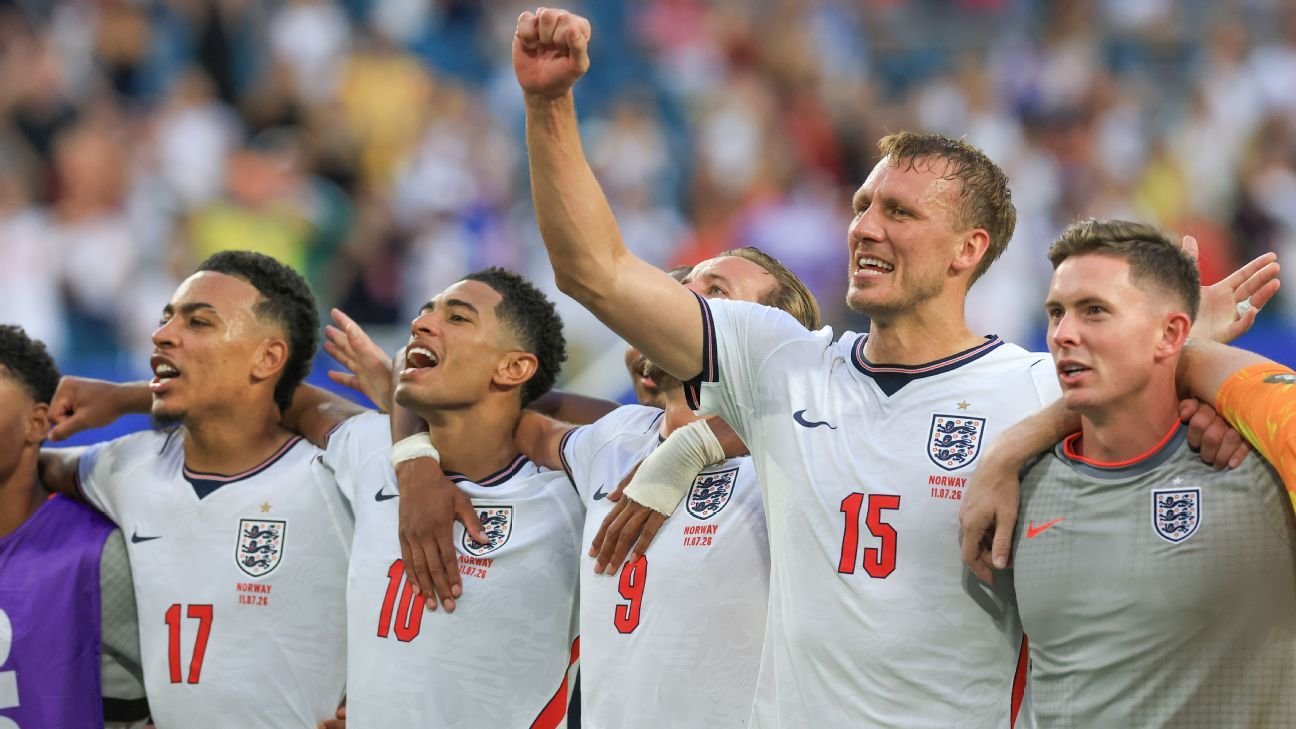
During their Round of 16 victory against Mexico and the quarterfinal against Norway, they demonstrated resilience by introducing 6-foot-7 Dan Burn to their defense. His presence helped them counteract high balls into the box as both teams pushed for late equalizers.
In the dying moments of extra time against Norway, Burn leapt to head the ball out of danger, colliding with Leo Østigard in the process, and celebrated triumphantly for having held strong once more.
England’s manager, Thomas Tuchel, has made it a priority to articulate the identity of the England team. He openly critiqued Gareth Southgate’s squad during Euro 2024 for lacking a clear identity and for being more anxious about elimination than seizing opportunities to advance.
However, Burn’s defiance showcases a recurring theme of heroic efforts. England was just 15 minutes from elimination against Congo DR in the Round of 32 when striker Harry Kane conjured up his own magic, scoring twice. In the sweltering Miami heat against Norway, central midfielder Jude Bellingham completed a brace, salvaging a performance that even Tuchel questioned.
England now has two comeback victories in this tournament alone, compared to their entire historical tally of two prior comebacks (excluding third-place matches): the renowned 1990 World Cup quarterfinal against Cameroon and their iconic win over West Germany in the 1966 final.
This resilience reaffirms Tuchel’s assertion pre-World Cup that he was assembling a “brotherhood”—a group of players not necessarily the most skilled, but capable of uniting and excelling in a tournament spanning three countries over seven weeks.
Tuchel’s hiring is a testament to his knack for influencing matches dynamically. He has capitalized on the culture that Southgate fostered in the England setup, carefully maintaining figures like 36-year-old midfielder Jordan Henderson, selected more for his leadership qualities than current form.
In contrast, Southgate struggled to make impactful substitutions; his meticulous Plan A often fell short when needed, as seen in the matches against Croatia in 2018 and the Euro 2020 final against Italy, where England led but ultimately lost grip on victory.
Tuchel openly seeks to maintain flexibility in response to the evolving dynamics of each match. This is why he opted for a squad of “specialists” at the World Cup, capable of adapting to varying scenarios. He views each player as a distinct asset, knowing that only in the heat of competition can he determine the best choice to deploy.
The players also receive clear directives. Burn noted, “I understood my role at the World Cup. I may not have been a starter, but I knew I’d make an impact in moments where we needed to defend or push forward for a goal.”
Yet even Tuchel may not have anticipated a situation where a 10-man England was leading 3-2 against Mexico at the Azteca with 20 minutes remaining, trying to preserve a knockout victory amidst immense pressure.
1:15
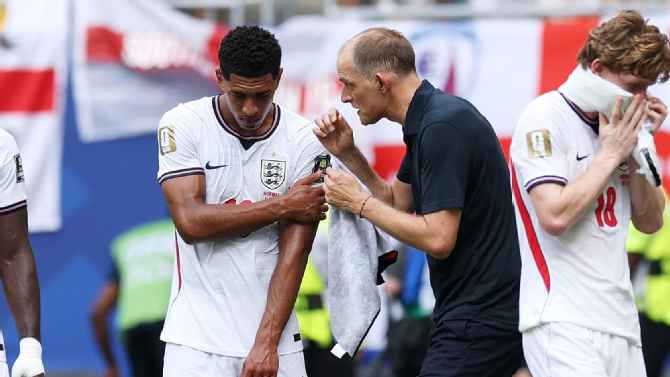
Are there signs of tension between Tuchel and Bellingham?
“This was a failure in planning… I did not see this coming,” Tuchel remarked with a smile after the match. “Ezri Konsa ended up playing as a wing-back, Anthony Gordon became a box-to-box midfielder, and Jude [Bellingham] ended up as a central striker.”
“I genuinely believe we’ve formed a cohesive unit that means a lot. If you ask any player to perform an extraordinary task during a game, it’s evident they instinctively know what to do. They are so committed, and they understand how to contribute—it’s a beautiful and rare quality to possess. We didn’t anticipate this level of spirit, but it’s clearly evident now.”
Against Norway, the situation demanded further improvisation. Declan Rice, Nico O’Reilly, and Konsa were feeling the impact of the humidity. During 120 minutes and six substitutions, Tuchel implemented continuous adjustments. He later commended his players for their ability to adapt to new roles.
Despite this, Tuchel’s post-match remarks emphasized his dissatisfaction with the overall performance, even in the face of reaching just the fourth World Cup semifinal in England’s history. Expectations are typically more stable in elite teams.
The critical question remains: can England sustain this freestyle approach? Tuchel recognizes the unlikelihood of this and has suggested that his team requires greater control, smarter passing, bravery, and conviction to triumph over Argentina and Lionel Messi in what stands to be their greatest challenge yet in this tournament.
For the time being, England has bolstered confidence through their comeback triumphs. In past tournaments, adversity would often overwhelm them; the burden of history would weigh them down. Yet, if they can conquer Messi and Argentina, potentially in another comeback, perhaps the final rendition of “Wonderwall” on July 19 against either France or Spain could be the one that ultimately saves them.